The Inconsistency of the Left and Required Virginia Ultrasounds
Okay, to be fair, I think this goes both way in American politics. I’ve always said that everyone is a fiscal conservative until it is “their cause” that gets defunded, and everyone is a fiscal liberal until it is “their tax rate” that gets increased.
Nevertheless, some things ooze such inconsistency that it is almost laughable. As many are aware, the Virginia state legislature recent passed a bill that requires a woman to have an ultrasound before they may have an abortion. As you can imagine, the pro-abortion constituency is out in full force over such a perceived “injustice.” Now, call me crazy, but it seems that such a requirement should at least implicitly be considered under “informed consent.” And besides, if those on the pro-abortion side are so sure that the fetus growing inside the womb is really just a mass of tissue, then there should be nothing to worry about, right? Let us not be fooled here – the objection to the ultrasound has nothing to do with the requirement itself – it has much more to do with the fear that this just may actually convince more women that the baby growing inside them actually is a life.
At any rate, an article appeared on Slate.com by Dahlia Lithwick last Thursday that would have had me falling off the couch in hysterics had it not been meant to be actually taken seriously. It was a great example of how the line between laughter and tears is often fine indeed when reading liberal commentaries.
The first laughable/cry-able moment came when the author implied … no wait, she flat out said it … that such a requirement constitutes an act of rape:
[This] means most women will be forced to have a transvaginal procedure … the law provides that women seeking an abortion in Virginia will be forcibly penetrated for no medical reason. I am not the first person to note that under any other set of facts, that would constitute rape under state law.
Okay, now let’s first note that no-one is forcing any woman to have such an ultra sound; the law merely provides such an action as a pre-requisite for the abortion procedure. Any woman could alway opt not to have the abortion, and consequently be spare the “violation” of the ultrasound. The logic here is intellectually dishonest at best, and manipulative at worst. Under the same logic, we could object to any medical pre-requisite. Besides, and I am happy to be correct on this, in the event that the individual decides to proceed with the abortion, is not penetration inevitable? In fact, one could argue that the ultrasound is not a separate procedure but rather the first step in the abortion.
The argument continued,
Evidently the right of conscience for doctors who oppose abortion are a matter of grave national concern. The ethical and professional obligations of physicians who would merely like to perform their jobs without physically violating their own patients are, however, immaterial.
So here we have it … the left refuses to admit that the recent HHS mandate is a violation of conscience for individual business owners and religious organizations, they often even want to eliminate a Catholic hospital’s right to refuse abortion services based on conscientious objections, but now all of a sudden conscience should be a part of the conversation.
Lithwick goes on,
Next month the U.S. Supreme Court will hear argument about the obscene government overreach that is the individual mandate in President Obama’s health care law. Yet physical intrusion by government into the [body] of a pregnant woman is so urgently needed that the woman herself should be forced to pay for the privilege.
Another inconsistency: the Virginia law is a clear overreach of government by requiring an individual to pay to a procedure to which they conscientiously object, yet the ability of the Catholic Church to opt out of paying for practices that they find morally incompatible with its faith is just plain silly. Am I understanding this right?
Finally,
You can shame and violate women, while couching it in the language of Justice Anthony Kennedy’s gift that keeps on giving—his opinion in Gonzales v. Carhart. That opinion upheld Congress’ partial-birth abortion ban on the grounds that (although there was no real evidence to support this assumption) some women who have abortions will suffer “severe depression” and “regrets” if they aren’t made to understand the implications of what they have done.
And at the end of the article,
Abortion is still legal in America. Physically invading a woman’s body against her will still isn’t. Let’s not casually pass laws that upend both principles in the name of helping women make better choices.
So, as is commonly stated, nationally legalized abortion is the “law of the land,” so while it is okay for you to personally object to the practice, please don’t try to push that belief on others. However, even thought the same Court has made the ability of the States to prevent partial-birth abortion the “law of the land” … well, in that case they were just plain wrong.
So which is it, my dear leftist friends? Is conscientious objection important or isn’t it? Should individuals be required to pay for procedures they find objectionable or shouldn’t they? Does the “law of the land” matter or doesn’t it? It seems to me that the answer depends greatly on the ideology at hand, which in this case is the perceived “right” to abortion on demand. In other words, we must accept a priori the right to abortion, and then we use any and all arguments available to defend that decision, even if it means speaking out of both side of the mouth at times.
Now, in fairness, it could be asked whether the political right is being just as inconsistent in all three arguments. Whether this is true or not I leave up to political commentators. For my own part, I submit that the Catholic position has no such inconsistencies, and here is why. First, we don’t ground our positions in the law of the land or conscience seen as an unfettered freedom to relieve one’s self from any and all acts. Rather, we ground our positions in natural law and conscience seen as the freedom to pursue truth and goodness. Forcing a doctor to perform an abortion is a clear violation of his or her right to act in a way consistent with a belief system. The act itself is the violation – the Catholic finds the act objectively immoral. It is not that a Catholic doctor wants to perform abortions in some cases and not in others, it is that he or she never wants to perform them. In requiring an ultrasound for a woman seeking abortions, what act is being found objectively immoral? Correct me if I am wrong, but an ultrasound, whether external or internal, is a perfectly acceptable medical procedure by both the left and the right.
Second, from a Catholic position, the natural law it the governing principle, not the “law of the land.” Natural law, inscribed on everyone’s heart, deeply suggests that the taking of a life is intrinsically immoral. Science has shown over and over again that the “mass of tissue” in the womb of a mother is a life. Even rudimentary philosophy says that it is a human life. But returning to the matter of conscience, if we understand that freedom of conscience does not give an individual the right to abstain from any and all acts (for instance, it does not give and individual the ability to refrain from stopping a violent crime taking place before him), then we can see that freedom of conscience does have limits. The question for the left is: in what do you ground the limits of freedom of conscience? For Catholics, the answer is clear: natural law. Therefore, it is a violation of conscience to require the taking of this life. Yet in supporting the required ultrasound, rather than seeing it as violating conscience, we understand in the greater context of the right to life.
Third, if freedom of conscience is at the service of pursuing truth, then how does giving the doctor and patient more information violate this process? In other words, if a doctor has the “right” to eliminate the ultrasound from this procedure, the same logic could be used to dismiss all informed consent laws form the books.
Finally, it is always amusing to hear the left decry government regulation in cases such as this. Somehow the government not only has the right, but the duty, to regulate Wall Street and the Health Care industry in a way that destroys any rational notion of subsidiarity and was never envisioned by the founding fathers, yet when it comes to a required ultrasound before an abortion … well, clearly that is a government overreach.
Religious Liberty: A Council Ahead of Its Time?
So much of the discussion in the public square of late concerns religious liberty. Not to obscure the other issues involved in the recent HHS rule and its subsequent “accommodation”, for assuredly there is also the issues of natural law, the right to life, and others. However, it is curious that the issue on the front line for Catholics and non-Catholics alike has been religious liberty. I say “curious” not to express disapproval; quite the opposite, for I myself think this is the crux of the issue. I say “curious” because it has caused me to reflect on the Church’s teaching on religious liberty, particularly those of the Second Vatican Council.
In discussions with various groups that are not in full communion with the Church (okay, let’s not beat around the bush – we mean SSPX here), no issue has caused more angst than that of religious liberty and Vatican II (except perhaps the validity of the Novus Ordo). Now, there is a certain amount of irony to this, because the “conservative” apologists are now clinging (rightfully) to religious liberty in order to combat the rhetoric and actions of the Obama administration, but the “really conservative conservative Catholics” (e.g., SSPX) find themselves in a bit of a pickle. For it is this teaching of Vatican II that they have rejected publicly. (See my footnote below for an apology and explanation of my meaningless labels.*) Yet we have seen in the last month just what happens when religious liberty is not protected.
With that, let’s have a look at what Vatican II said. The document in question is Dignitatis humanae (“The Dignity of the Human Person”), and paragraph 1 begins,
A sense of the dignity of the human person has been impressing itself more and more deeply on the consciousness of contemporary man, and the demand is increasingly made that men should act on their own judgment, enjoying and making use of a responsible freedom, not driven by coercion but motivated by a sense of duty. The demand is likewise made that constitutional limits should be set to the powers of government, in order that there may be no encroachment on the rightful freedom of the person and of associations. This demand for freedom in human society chiefly regards the quest for the values proper to the human spirit. It regards, in the first place, the free exercise of religion in society … On their part, all men are bound to seek the truth, especially in what concerns God and His Church, and to embrace the truth they come to know, and to hold fast to it … Religious freedom, in turn, which men demand as necessary to fulfill their duty to worship God, has to do with immunity from coercion in civil society.
It seems to me that the USSCB could use this paragraph as it mantra for the battle against the HHS mandate. But let’s continue … from the next paragraph:
This Vatican Council declares that the human person has a right to religious freedom. This freedom means that all men are to be immune from coercion on the part of individuals or of social groups and of any human power, in such wise that no one is to be forced to act in a manner contrary to his own beliefs, whether privately or publicly, whether alone or in association with others, within due limits.
The council further declares that the right to religious freedom has its foundation in the very dignity of the human person as this dignity is known through the revealed word of God and by reason itself. This right of the human person to religious freedom is to be recognized in the constitutional law whereby society is governed and thus it is to become a civil right.
It is in accordance with their dignity as persons-that is, beings endowed with reason and free will and therefore privileged to bear personal responsibility-that all men should be at once impelled by nature and also bound by a moral obligation to seek the truth, especially religious truth. They are also bound to adhere to the truth, once it is known, and to order their whole lives in accord with the demands of truth However, men cannot discharge these obligations in a manner in keeping with their own nature unless they enjoy immunity from external coercion as well as psychological freedom. Therefore the right to religious freedom has its foundation not in the subjective disposition of the person, but in his very nature. In consequence, the right to this immunity continues to exist even in those who do not live up to their obligation of seeking the truth and adhering to it and the exercise of this right is not to be impeded, provided that just public order be observed.
Now this is where SSPX starts to get nervous. They would claim that no-one has the “right” to adhere to falsehood, and the Second Vatican Council implies otherwise. As for the first part of the claim, I agree. I made the point in a previous post that nobody has the “right” to contraception, not just from a constitutional standpoint but also from the perspective of natural law. However, with regards to “what Vatican II really said,” I read over this section at least three times, as well as the rest of Dignitatis humanae, and I simply cannot see how it implies that people have the right to adhere to falsehood, theological or otherwise. It does say that religious freedom is essential for man’s search for truth, and that political coercion flies in the face of this necessary freedom, and that “the right to this immunity [from coercion] continues to exist even in those who do not live up to their obligation of seeking the truth and adhering to it and the exercise of this right is not to be impeded.” Yet nowhere do I see that people have the “right” to adhere to falsehood.
At any rate, I meant not for this post to become an occasion for dialog about the SSPX-Vatican disagreements. I meant only to point out that the Vatican II “Declaration on Religious Freedom” may turn out to be a very useful document for those of the conservative political persuasion in the current climate, and that there is a certain amount of irony, because it was one of the documents of the Council that was most hailed by the “progressives” in the Church.
Certainly the declaration was written within the context of 1965, the year in which Paul VI promulgated it: a time when the world was still very concerned about the oppressive regimes of Communism and Nazism. Yet I can’t help but think that (surprise, surprise) the Holy Spirit knew what he was doing, for we may well find in our own era the need for Dignitatis humanae. The battle currently is in the medical field: the fundamental right to religious liberty being trumped by a fabricated “right” to obtain contraception and abortion services free of charge. However, the battle lying just around the corner will inevitably involve the issue of homosexuality – here we will see a parallel conflict, but it will be the fundamental right to freedom of speech, either in religious or secular circles, being trumped by a fabricated “right” to live one’s life without criticism. Consider all that is in front of us together with that which is to come, it warrants asking: was Vatican II a council ahead of its time?
* I am at loss for labels here (as if this weren’t obvious in my use of “really conservative conservative Catholics.” I inherently reject using the word “traditionalist” because all Catholic should be traditionalist – our faith is a faith of tradition, built on an original deposit that unfolds slowly overtime. Yet “conservative” is a political term more than a religious term. At the same time, politics and religious, while distinguished in concept, are not entirely separate. (There is a reason why politically conservative people also tend to prefer more “traditional” liturgies.) I hope that the point is not lost here … it seems obvious to me that the SSPC is a sort of “ultra conservative” group, clinging to a tradition that does not allow for any sort of unfolding, organic or otherwise, but rather is frozen in time (arbitrarily chosen as the middle of the 1900’s). Then again, I write with a certain amount of trust that I am among friends who will understand the irony which I attempt to disclose, that, despite a lack of appropriate labels, the most “conservative” Catholics (so “conservative” that they have left the Church), are now in need of the one of the very doctrines they reject from Vatican II (the teaching on religious liberty) in order to be “conservative” in our current political battle.
Food, Guns, and Contraception: A Random Followup to Some Random Thoughts on the HHS Rule
Instead of responding to comment on my previous post in the proper place, I decided to do a followup of sorts to clarify two issues and to expand on a few of the initial thoughts and their reactions. As a starting point, I want to consider the following comment left by “Mary”:
What about an employer forcing their religious beliefs onto their employees? My daughter is a nurse and works at a catholic [sic] hospital. She is not Catholic and feels birth control should be a woman’s decision. The woman has the right to decide when she wants to start a family. She was surprised when she found out that birth control was not part of the insurance program. She has been buying it on her own, and it is not cheap. What about those who can not afford to purchase birth control? Viagra is covered under the insurance program, and that is health care? Don’t think so. I’m not surprised that the article and comments here are all by men. It is not your body and you should not make the decision for women who want to use birth control.
It seems to me that this misses the point I was initially trying to make, and I take responsibility for any lack of clarity in my presentation. To make up for this, I want to consider Mary’s argument from two perspectives. Both perspectives will consider Mary’s assertion that women have the right to use birth control. First, I will temporarily grant Mary this assertion and re-present the argument that it still does not make it right to force Catholic hospitals, Catholic-owned businesses, or Catholic-run insurance companies to cover contraception. Second, I will challenge Mary’s assertion by arguing that women don’t in fact have the “right” to oral contraceptives.
1. What if Mary is Right?
What if we temporality lend credence to Mary’s statement that women have the right to use birth control? At the risk of sounding like a broken record, I will direct you back to my initial analogy of gun ownership. I firmly believe in the right to bear arms, but this in no way means that I believe the government should purchase a gun for me, still less does it mean that the government to force my employer to purchase a gun for me. There is a difference between the right to posses and use something and the “right” to have it at no cost to ourselves. This distinction has been lost in the national conversation. Even if Mary is correct that women have the right to use oral contraceptives, it still leaves me wondering why the cost for this should come out of the employer’s pocket or the pocket’s of the insurance companies.
Allow me to illustrate this point with another analogy. I think all of us can agree that the human person has the fundamental right to eat food. Should our employers then be required to provide us with our weekly groceries? Should they be required to give us vouchers with which we can obtain meals? Correct me if I am wrong here, but I thought the point of employment was to provide labors with a fair and honest wage, and the wage earners then get to decide how to spend those wages. Think here for a minute how you would feel if instead of providing you with a paycheck, your employer gave you vouchers for very specific kinds of food. Is this not a restriction of freedom rather than its expansion?
Actually, when you see the contraceptive coverage in this light, I think you will come to see that having the employer/insurance company forced to cover it is actually the more inequitable scenario. Allow me to explain. First, understand that contraception itself is not “free.” It is a product, and as such it has a cost associated with its production. If an employer is forced into providing this coverage for all employees, the cost of the plan will be effected somehow. I will leave it up to the actuaries to weigh in on how this cost works out, but the fact remains that the cost needs covered in some form or another. Contrary to popular belief at the moment, money cannot be arbitrarily created out of thin air. (This is a more complicated way of putting the age-old adage, “Nothing in life is free.”) Now, once the employer has this cost added to the plan, his budget must take that into account somehow, which will translate eventually into wages in some form or another.
Why is this inequitable? Because it effectively means that all employees will suffer the economic effects of some people choosing to use contraceptives. Of course, I am not naive enough to think this is a dollar-for-dollar transaction. Rather, the costs will be spread out through actuarial means. Nevertheless, would not a more “fair” system be to not cover contraceptives, to pass on the savings in the form of wages and salaries, and to allow those women that choose to use oral contraceptives under Mary’s claimed “right” to do so?
This is precisely what happens with both food and guns. The employer pays the employee, and the employee then decides what to spend his or her wages on: food, guns, or oral contraceptives. I would think that the advocates of “choice” would prefer this system anyway, for in taking money in the form of wages and then making an active choice how to spend the money, is that not a more powerful statement than having an employer (by means of government coercion) tell you how you have to spend your wages? Said differently, the problem with Mary’s “right to contraception” plan is that is actually takes away the right not to purchase contraception – it results in less choice, not more. If the insurance plans are forced to cover it, all employees are forced to purchase it, although some will choose to leave their supply at the pharmacy counter. In effect, Mary’s argument actually reduces choice and freedom.
Two other points are worth considering here. First, Mary claims that contraception is expensive, and that is why insurance companies should provide it “for free.” The problem with this is the illusion of “free.” It is basic economics here, something that seems to be absent from the Obama administration’s manner of administrating. As I pointed out above, the production of contraceptives costs money, and to think that this cost will not be passed on eventually to the employees is naive at best. The insurance companies are not going to take this “bottom line” hit – their very bright actuaries will work to makes sure that the cost is covered in the premiums charged. The employer won’t take the “bottom line” hit either. They employee likes to think of wages and benefits in two separate categories, but to the employer they are both part of a compensation package, and they both cost money. Whatever is added to the cost of medical insurance will necessarily be made up for in salaries. Of course, it won’t be right away, but it will be reflected in future salary negotiations. Anyone who has been a part of contract negotiations knows that it is never simply about salaries and wages. The “bottom line” will eventually be covered by all employees. Thus, Mary’s daughter will end up paying for the contraception anyway through lower-than-would-be salaries. When insurance plans cover something like contraception, it does not “save” the employee money, it simply forces them to spend some of their money in a particular way.
An analogy here is a local collect some years back that “gave” all entering Freshman an iPod. On the surface, it seems like a “free and generous” gift. However, the university is mindful of its finances, which means that the cost of this iPod is somehow or other figured into the cost of tuition. Seen in this light, it is not a “free gift,” but rather forcing all entering Freshman to purchase an iPod.
Returning to the forced purchase of contraception, even from a women’s dignity perspective, I would think that most would find this reprehensible. It is as if the government is saying, “We don’t trust that you will spend some of your money on contraception, so we are going to force you to spend it just to be sure.” Once more, apply this to something like food. It would be like your employer, under government coercion, withholding part of your wages and instead giving you food vouchers for specific items that the government deems “essential” to “healthy eating.” (Actually, the more I think about it, the more fitting this analogy is.) Wouldn’t it be better to have the money passed on in the form of wages to allow the individual the right to choose how to spend it? Once you understand that you will be paying for the contraception in some form or another, does not the whole thing sound rather insulting? In fact, I do something similar with my kids allowance: I give them a certain sum of money, and then I mandate that they put a portion of it in the Church basket on Sunday. Why? Because without the mandate, they won’t do it. Why? Because they are children. When it comes to the forced purchase of contraception, the government is treating women as if they are children: they don’t trust that you will purchase contraception on your own, so they are going to make you purchase it. (This is what they are doing with the health care mandate itself, by the way.)
The other more obvious problem is that this also forces women who chose not to use contraception to carry plans that cover it, thereby essentially purchasing it themselves (one the cost of the plan is passed to the employee in the form of not-as-high-as-they-would-be wages). In this way, then, the whole issue is not about the right to obtain contraception, it is about the right not to purchase contraception.
Further, Mary brings up the idea of Viagra coverage. There is an obvious difference, pointed out by one commenter, in that Viagra is correcting a bodily system that isn’t functioning as it should (and is thus much closer to actual “health care”), whereas birth control is doing nothing of the sort. However, I will say that in this case I agree with Mary. I also think that the government should not force insurance companies to cover Viagra, but that the employer should simply pay salaries and wages to its employees and allow them to choose how to spend their money. The difference here is that, to my knowledge, the government is not doing this in the case of Viagra. In fact, it may help to clarify the outcry over the contraceptive mandate to imagine the vitriol reactions that would surface if the HHS mandate required the coverage of Viagra.
2. But in the End, Mary is not Right.
All of the previous argument is null and void however, if Mary is not correct in her assertion that women have the natural “right” to use oral contraceptives. In order to address this, we must first re-think the whole notion of “freedom” and “rights.” The problem with our pluralistic society is that everything is couched in terms of “rights,” and further that this terms is never fully defined. Even so, a discussion bases solely on rights, defined or undefined, could never actually be consistent, because “rights,” understood in simple unqualified terms, will necessarily lead to situations of “competing rights.” In this case, we end up arguing over which has precedence: the “right” to religious liberty or the “right” to use oral contraceptives. When we find ourselves at the inevitable impasse of unqualified and competing rights, the only thing left to decide a “winner” is pure power. Whichever “party” finds itself in control will force its priority on the populus, and this is exactly what we see happening with the Obama administration.
The difficulty here is that freedom is not the random ability to choose between contraries. Rather, it is the ability to choose the good. Servais Pinkaers gives a great illustration of this in his book Sources of Christian Ethics by giving the example of a well-trained piano player. An individual who has no respect for the “rules” of music and the instrument is “free” to bang randomly on the keys (a “freedom of indifference”), but a trained pianist who has been taught the “laws” and “nature” of the piano is able to create music, a freedom that is much more authentic (a “freedom for excellence”).
The moral life is not much different than the musical arts. We are created with a purpose, a sort of definition of what it means to be “fully human”, what the Greeks called a telos. We are “free” insofar as we act in a manner consistent with what it means to be human. In a dilapidated view of freedom, we are of course able to act arbitrarily. But such a view is not authentic freedom. Authentic freedom is found when we act according to our design, according to the natural law inscribed on our hearts.
Understanding the natural law is the only way to avoid the inevitable conflict of arbitrary and competing rights. The only “right” we have is the right to act according to our design, to act in a way that is authentically human. Religious liberty falls generally under this one “right” because we know that we need to freely pursue and accept God. One can never be coerced into faith (even if the “faith” into which they are coerced is objectively “true”).
The question then is, does an individual have the “right” to use artificial contraception? Does the use of contraception allow an individual to be more “fully human.” From a Catholic perspective, the answer is clearly, “No.” Now, it is not my intent here to defend the Church’s teaching on contraception – numerous arguments far better than what I could produce have been written about this already. My point here is much simpler: we cannot approach this argument purely from some abstract and ill-defined notion of “freedom” and “rights”, but rather must conceive (pun fully intended) of “rights” and “freedom” under their proper telos of natural law.
I will give only one attempt at an argument against the “right” to oral contraceptives. I mean this not as the only, and maybe not even as the best, but I do think is it the most important one to publicize: oral contraceptives are abortifacient. It is in the very design of the pill that on the off chance (the measure of which is hotly debated) that fertilization occurs, the lining of the uterus is renders unstable so as to prevent implantation. In this case, a newly created human person is destroyed – a life is ended. Now, the fundamental “right”, if we are to speak in these terms, is the right to life. Understanding the notion of “freedom for excellence,” the path towards fulfillment as a human person, or the ability to choose the good … none of this is possible without the possibility of living in the first place. (Another “silver lining” to this tragic situation in which we find ourselves is the mere mentioning of this fact on national television by those members of the Episcopacy (un)fortunate enough to land an interview. It is about time the terrible truth about abortifacients in oral contraceptives gets more press.)
This is not the best argument against the “right” to use oral contraceptives, because it is conceivable (there is nothing worse than the same pun twice in one article) that someday the pharmaceutical companies will develop an effective oral contraceptive that is not abortifacient. Even then, seen in the light of Catholic teaching, there will still not be a “right” to use such medication to prevent pregnancy, the prevention of which drives a wedge in the very definition of marriage which by its nature is both unitive and procreative. In doing so, contraception thereby does not allow a couple to strive towards their fulfillment as human persons in their marital vocation. (For marriage, after all, is a vocation, and hence a “path to fulfillment.”) Nevertheless, it the abortifacient argument is an effective argument here and now, because oral contraceptives here and now are abortifacient.
Random Thoughts on the HHS Rule
So much has been written about the HHS rule and its “compromise” that I hardly think I have much to add to the conversation. Nevertheless, there are a few points that I think have been missing form the debate, even in Catholic circles. Allow me to take a brief moment to give a relatively disconnected trio of issues that just may help to spark some more conversation.
1. Religious Liberty is an Individual Freedom.
It seems to me that the focus of the national Catholic conversation has been on the Obama administration’s violation of the freedom of religion by forcing Catholic institutions such as hospitals and universities to provide employees with contraceptives and sterilizations, a practice that is in clear contradiction to the teachings of our faith. While this is certainly deplorable and the most overt violation of the First Amendment, what has been relatively missing from the dialog is that religious liberty is not merely a liberty granted to religious organizations. First and foremost, religious liberty is an individual liberty. Each and every citizen of our nation is guaranteed under the Constitution the freedom to practice one’s religion both publicly and privately and to not be coerced into violating our consciences by acting in a way contradictory to the tenants of one’s faith.
Thus, the HHS rule is not simply a violation against specifically religious organizations. It is also a violation of the religious liberty of the individual business owner, Catholic or otherwise. As a Catholic, the owner of a private business cannot, under the Constitution, be compelled by the government to pay for “medical” services that violate his or her faith, including contraceptives and sterilizations. This applies not only to those companies that have a religious mission, such as EWTN or the Knights of Columbus, but also to the owner of a chain of restaurants, a manufacturing form, or an publishing company. Further, it also applies to the faithful Catholic owner of a medical insurance company. Forcing the insurance company to provide coverage for these services despite religious beliefs, is a clear violation of the protection guaranteed under the First Amendment.
My fear is simple. If the conversation focusses exclusively on those organizations for which Bishops have direct involvement, we may very well see further “compromise” between the Obama administration and the USCCB, but tens of thousands of other Catholic business owners will be lost in the shuffle. In fact, I will go so far as to say that even if the HHS does a complete 180 on the current issue, i.e. incorporating Catholic hospitals and universities in the exemption clause without the bogus compromise that forces the insurance companies to cover the costs and services … even then, the fight is not over. Because even then there will be thousands of businesses who are not included in the exemption clause because business activities have no specifically religious purpose. Yet these owners too have the right to practice their religion, and hence should not and cannot be compelled to act in a way contrary to their faith.
That being said, there is admittedly a certain advantage in focussing on overtly Catholic organizations like hospitals and universities. First, they are the most obvious cases of government intrusion in the religious sphere. Second, they have high profile leaders, i.e. the episcopacy, that will be forced to take a stand. Yet still, we should not for a minute think that the battle ends with these organizations. Each and every one of us is entitled to religious liberty as an American citizen, and forcing a Catholic (or other religious) business owners to pay for plans that include contraception and sterilization is very much a violation of this liberty. The problem is compounded, of course, if the business is a medical insurance company.
2. There is a Silver Lining.
The felix culpa effect never ceases to amaze me. God can bring good out of the most heinous evils, the case and point being the crucifixion. The silver lining to the current HHS tragedy is the unified effort of the Catholic Episcopacy. While the thought that the Obama administration feels that it can abuse its power in this manner terrifies me, the response by the Bishops has given me great cause for joy. When the Bishop’s letter was read from the pulpit two weeks ago, the congregation applauded. It is a powerful moment for the Church.
Our Church, after all, thrives on persecution. It is precisely in the midst of being “kept down” that we can rise up against tyranny. Such is the lesson of the Cross. There is a quote from 2010 that has been circulating recently, in which Cardinal George of Chicago says, “I expect to die in bed, my successor will die in prison, and his successor will die a martyr in the public square.” Whether or not the Cardinal is prophetic remains to be seen, but such an “exaggeration” may not be so exaggerated after all.
In light of this, I would encourage those whose Bishop was one of the hundreds that wrote a letter and had it read to send a note of gratitude. Yes, it was a coordinated effort, but it was the coordination that made it so powerful and effective. While Friday’s “compromise” is manipulative and nothing really close to a compromise, it seems clear that even this minimal response would not have happened had it not been for the organized outcry.
3. ”Health Care” is Being Redefined.
My final point has been mentioned by several others, but it warrants reiteration. There is a not-so-subtle redefinition of “health care” in this whole debate. There is a certain amount of irony that under the president’s health care bill and the accompanying HHS ruling, I will not be able to receive Tylenol or toothpaste for free, but women will be able to receive birth control and abortifacients for free. Tylenol is a drug that actually tries to cure something that is “wrong” with the body, and toothpaste is authentically “preventative” in terms of dental health problems. Yet birth control and abortifacients have little to do with the health of the body. In fact, they are often used for reproductive systems that are otherwise heathy. They are designed to take a perfectly healthy and well-functioning bodily system and stop it from functioning how it should. Since when did fertility and pregnancy become a disease? Since when is birth control more “preventative” than toothpaste and abortifacients more of a “cure” than Tylenol.
Whether we agree or disagree on the morality of birth control is not the relevant question here, nor is whether or not we agree or disagree on the “right” of a woman to take these drugs. The Catholic Church has always been clear on this, but it seems to me that there is something else at issue here. Even for those who condone the consumption of these drug, it is a rather large leap to insist that someone else pays for it.
Let me give an analogy. I believe firmly in the right to bear arms. However, I do not believe the the government should provide a gun to every citizen who wants one. Moreover, I don’t believe that my business owner should be forced to provide each of its employees with a gun. Yet this is precisely what is happening with the HHS rule. Even if an individual thinks they should have the right to use oral contraceptives, how does that translate to insisting that the government forcing employers and insurance companies to pay for it? The only answer is to misclassify the contraceptives as “health care.”
I have two clarifications before I sign off, mostly to ensure that I am not misunderstood. First, I understand quite clearly that oral contraceptives are occasionally prescribed for reasons not having to do with birth control. This is emphatically not what I am talking about, and such an issue requires a separate conversation. For my own part, I am of the firm belief that non-contraceptive methods such as NaPro technology have had far more positive results at a cost that is a fraction of many of the contraceptive techniques in dealing with serious medical issues. Yet again, this is another topic for another time, and is not my intent here. However, the media has successfully and unfortunately recast the debate in this light, causing a decent amount of public confusion over the issue. (In a way it reminds me of a person who believes in abortion on demand up until the cutting of the umbilical cord who insists of focussing the debate on the “hard” cases of rape and incest. In the HHS debate we have people who believe that the government can force employers to cover contraceptive for every purpose but insist of focussing just on those cases where they are not being prescribed for contraceptive purposes. It is both misleading and disingenuous.)
Second, I am in no way claiming that an individual does have the right to use contraceptives (for reasons of birth control), less so abortifacients. For my own part, given the objective immorality of such acts, such a “right” would be in direct contradiction of the natural law in which we were created. My point was only that even if one believes in the right to birth control, it still doesn’t mean that employers or insurance companies should be forced to provide it anymore than they should be forced to provide their employees with firearms.
The main point is simple: birth control is not health care because fertility is not a disease.
The Triple Meaning of Epiphany
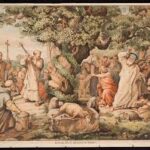
| The Visit of the Magi |
The Feast of Epiphany is preceded in importance by only three other feasts during the liturgical year. (As a good exercise, see if you can name the three feasts in order of their liturgical importance.) The connection between Epiphany and Christmas is not only in the fact that it is twelve days after the celebration of Christ’s Nativity, but also in its modern emphasis on the visitation of the Magi to the Christ Child. Historically, however, the connection is stronger still. Laurence Paul Hemming, when describing the history and theological significance of Epiphany in his book Worship as Revelation, reminds us that the feast of Christ’s birth was originally celebrated on January 6th rather than the current date of December 25th. “[F]ollowing the arguments of Sextus Julius Africanus … the actual birth of Christ was redated to December 25th …. So important was the date of the feast of the 6th January, however, that the established feast of that date remained, in both the East and the West.”
| The Wedding at Cana |
Once the feast was redated, what was the purpose of reserving January 6th as a day of particular reverence? It might seem at first that the date of January 6th was kept for purely historical or nostalgic reasons. On the contrary, Hemming indicates that the Feast of Epiphany originally had a triple significance: The Nativity (together with the visitation of the Magi), the Baptism of the Lord, and the commemoration of the Wedding at Cana. Thus, even with the transference of the Nativity to December 25th, there were two remaining significations of the feast of Epiphany: the Baptism of Jesus and the commemoration of the Wedding at Cana. Interestingly enough, “[t]he least of the significations of the feast (so much so, that it gets no mention in the liturgies of the East) is the appearance of the wise men of Magi from the East, the so-called ‘three kings.’”
![]() |
| The Baptism of the Lord |
The connection the Nativity shares with the Baptism of the Lord is more profound when we recall that the sacrament of Baptism is a celebration of heavenly birth. While Christmas Day is the celebration of the Incarnation, the earthly birth of Jesus, the Baptism of the Lord (as seen by Origin) is a celebration of the heavenly birth of the Savior, not in a temporal sense of course (because the Second Person of the Trinity is an eternal procession from the Father), but in an eschatological sense. There is, then, a connection between the Christmas-Epiphany cycle and the hypostatic union. The Christmas-Epiphany pair celebrates the union of the divine and human natures in the one person of Jesus Christ. Liturgically, we hear this celebration of the hypostatic union and its importance in our own lives in the Opening Prayers from Christmas, Epiphany, and the Baptism of the Lord.*
O God, who wonderfully created the dignity of human nature and still more wonderfully restored it, grant, we pray, that we may share in the divinity of Christ, who humbled himself to share in our humanity.
O God, who on this dayrevealed your Only Begotten Son to the nationsby the guidance of a star,grant in your mercy, that we, who know you already by faith, may be brought to behold the beauty of your sublime glory.
Almighty ever-living God,who, when Christ had been baptized in the River Jordanand as the Holy Spirit descended upon him,solemnly declared him your beloved Son,grant that your children by adoption,reborn of water and the Holy Spirit,may always be well pleasing to you.
My Official Protest – A Two Part Announcement
Part I. In gratitude for the authorial opportunity granted to me by The American Catholic, I would like to use this forum to host my official “Announcement of Protest.” Let it be forth known that from this point forward, I am protesting. The status quo has become too much of a status, and as for the quo … well, who knew what that ever really meant. Yes, I am protesting, and as such, I am a protester.
Part II. I would now like you to all join me in a round of congratulations. Growing up in small-town Ohio, I never in my wildest dreams thought I would be named Time Magazine’s “Person of the Year.” It is humbling, of course, to be in the company of George W. Bush, Pope John Paul II, and Henry Kissinger. When I receive my plaque from Time, I will be hosting a party, and all of you are invited.
Part II(B). As an added bonus to using an online forum for my official announcement, it turns out I have post facto been named “Person of the Year” for 2006. This secondary plaque will be occasion for a separate, but equally elaborate, celebration, to which all of you are also invited.
Part II(B)(iv). It is unclear at this point whether or not I won the same award post facto for the 1969 prize. While certainly a “Middle American,” I was not yet born. I have sent a request for clarification to the good folks at Time. I will await the official word before scheduling the third celebration.
Part II(B)(iv)(e). My MacBook Pro is under the impression that it should receive the 1982 prize. I tried to tell it that this was just plain silly, but now it is officially protesting me, thereby potentially qualifying it for not one, but two prizes. It has sent a clarification Tweet to Time. In the event that it is correct, the computer can plan its own darn party.
Catholic Identity and the New Translation
Lord,fill our hearts with your love,and as you revealed to us by an angelthe coming of your Son as man,so lead us through his suffering and deathto the glory of his resurrection,for he lives and reigns with you and the Holy Spirit,one God, for ever and ever. Amen.
Gratiam tuam, quaesumus Domine,mentibus nostris infunde,ut qui, Angelo nuntiante,Christi Filii tui incarnationem cognovimus,per passionem eius et crucemad resurrectionis gloriam perducamur.
Pour forth, we beseech you, O Lord,your grace into our hearts,that we, to whom the Incarnation of Christ your Sonwas made known by the message of an Angel,may by his Passion and Crossbe brought to the glory of his Resurrection.Who lives and reigns with you in the unity of the Holy Spirit,one God, for ever and ever.
| The Angelus (1857–59) by Jean-François Millet |
A Funeral of Sorts: The Last of the Old Translation
Almighty and merciful God,you break the power of evil and make all things newin your Son Jesus Christ, the King of the universe.May all in heaven and earthacclaim your glory and never cease to praise you.
Almighty ever-living God,whose will is to restore all thingsin your beloved Son, the King of the universe,grant, we pray,may render your majesty service
that the whole creation, set free from slavery,and ceaselessly proclaim your praise.
May we, too, be set free from the slavery of a translation that was in desperate need of being cleansed of its iniquities, and may we ceaselessly praise our Lord and Savior, the King of the universe, through this great gift that has been given to us: The New Translation of the Roman Missal.
As a complementary bookend to this last Sunday of the last year of the old translation, I give you the article written, nearly a year ago, on the first Sunday of the last year of the old translation:
I feel like each Sunday this year presents a funeral of sorts … a passing of Mass texts that will never be heard again. Rather than mourning this passing, my heart finds solace in the assurance that these texts will rise again in a more perfect form with the “advent” of the new translation. While we have a full year to pay our respects to the passing Ordinary, there is a rejoicing of sorts that the current Propers have reached the end of the proverbial line: their days are numbered, their time has passed, and blessed be God for that.
Da, quaesumus, omnipotens Deus,hanc tuis fidelibus voluntatem,ut, Christo tuo venienti iustis operibus occurrentes,eius dextrae sociati, regnum mereantur possidere caeleste.
All-powerful God,increase our strength of will for doing goodthat Christ may find an eager welcome at his comingand call us to his side in the kingdom of heaven.
Grant your faithful, we pray, almighty God,the resolve to run forth to meet your Christwith righteous deeds at his coming,so that, gathered at his right hand,they may be worthy to possess the heavenly kingdom.
The Paradoxes of Economic Measures
I am not an economist, and I don’t claim to have anything close to useful knowledge in the area. However, like many areas in which I have little knowledge, I find that I have lots of question. Economics is a particularly interesting field in that two “experts” can examine the same problem and come up with solutions that seem diametrically opposed. I put “experts” in quotes because I sense that the discrepancy of opinions lies more in politics than it does in the discipline itself. By its very nature, the science of economics intersects the arena of politics, hence the phrase “economic policy.” The down side of this is that even the “orthodox” positions, those on which nearly all economists agree, can be colored for political purposes. In general, it seems that any social science has something of this. For whatever reason, the “hard” sciences produce less public controversy. Perhaps this has to to with the relative ease of experimentation in the hard sciences when compared with the social sciences. Perhaps it has to do with the fact that the social science have as their subject the human person, which by nature cannot be reduced to overly rationalistic or mechanistic behavior. Not being an expert in either hard sciences or social sciences, I can only speculate.
Yet despite my near total lack of experience and absolute total lack of expertise, it strangely enough doesn’t seem to hinder me from thinking about paradoxes in the field, or at the very least “perceived” paradoxes. One such paradox that has kept me up at night, (well, let’s not go that far), is the obsession that political economics has with using GDP/GNP for measuring the health of the nation’s economy. Now, let’s not go off the deep end here; I am not saying to toss the measure out the window altogether. But consider the following relatively useless mental exercise.*
We all have household tasks to perform: mowing the lawn, washing the dishes, cooking meals, even watching our children. We do perform these tasks willingly, and no one pays us to perform them. The services themselves don’t contribute to the GDP. Now, one day, my neighbor and I become concerned about the GDP and decide to do something to help it out. We agree to take some of these services, say mowing the lawn and washing the dishes, and hire each other to do them. I pay him $20 to mow my lawn and an additional $30 to wash my dishes every week. Thus, I am hiring him for $50 a week, or $2600 per year. Now, let’s be honest, with five kids, I can hardly afford to pay someone to do these menial tasks for me, so I get my neighbor to agree to pay me $50 per week to mow his lawn and do his dishes, coincidentally just enough to cover my new annual $2600 expense. In total, we have collectively contributed $5200 per year to the GDP. Yet our lives have not changed in the least, neither in income or standard of living. Further, our workload has not really changed at all. Yet we have now contributed to the GDP.
To make the mental exercise even more absurd, after a month of doing this, we decide that it is a real inconvenience. My neighbor simply doesn’t want to walk across the street to mow my lawn and do my dishes. However, he doesn’t want to give up his new-found $2600 profit. He decides to subcontract this work out to a poor soul who will be willing to do the work for half the price, $1300. That poor soul ends up being me. In other words, I am paying my neighbor $2600 a year to mow my lawn and do my dishes, and he in turn is paying me $1300 to do this work for him. I, in turn, play the same game with him. He pays my $2600 a year to mow his lawn and do his dishes, and I hire him for $1300 a year to do his own work. The net result of this is as follows. We have added $5200+$2600 = $7800 a year to the GDP, yet the net change to my fiscal situation is $0 (likewise for my neighbor), and the net change in my workload is 0. (I am mowing my own lawn and doing my own dishes, just like I was before we had our brilliant idea.)
To exaggerate this even further, because we have now become obsessed with our own brilliance, my neighbor and I decide to up the ante by multiplying all of our payments by 1,000,000. (Of course, we will have to take out loans for this, but once the banks recognize our raw intelligence and entrepreneurial spirit, they will be fighting to give us loans.) We have now contributed to the GDP $7,800,000,000, or 7.8 billion dollars, all for mowing our own lawn and doing or own dishes.
While I am admittedly unclear on the exact accounting of such an experiment (for instance should the subcontracting fees be deducted from the profits), something of this already exists when trying to compare the GDP in the United State over long periods of time. In the last two-hundred years, the GDP in our county has grown enormously, yet the figure overstates the growth in production over the that time period. Two-hundred years ago, far more people (most people?) produced their own food and many of their own possessions (clothing, etc.). As self-produced, these activities and products were “off the ledger” of the GDP, so to speak. Perhaps the biggest change came when many women moved from the home into the workforce. Activities once done for no monetary exchange were now part of the GDP calculation: housekeeping, child care, cooking, etc. The affect of this was essentially one of accounting: much of this activity moved from “off the ledger” to “on the ledger.” The activity itself didn’t necessarily change, nor did the production of goods and services (yes, this oversimplifies the situation), yet the GDP was grossly affected by the accounting move.
The same sort of game can be played with unemployment rates. The unemployment rate is calculated by dividing the number of unemployed individuals by the size of the labor force. An “unemployed individual” is defined as someone who is not currently working by is willing to work for pay. In the midst of our recession/double-dip-recession/ whatever-the-experts-are-calling-the-current-situation, no number has been tossed around the news media more than the unemployment rate. However, this number is just as easily manipulated. For instance, let’s take every household in which one of the two parents stays home decides simultaneously, “I want a job.” All of a sudden, even though the financial situation of the country has not changed, the unemployment rate goes through the roof.
On the other hand, suppose every one of these parents decides to engage in a deal such as between me and my neighbor. Maybe they decide to pay each other to watch their own children for the day. Now we have the opposite effect: the unemployment rate goes down.
In the interest of attempting some sort of pseudo-rational analysis, I suppose that these numbers are not entirely absurd if only because people don’t act in ways proposed by my two mental exercises. Nevertheless, it does make one question how much stake we put into a system that relies almost solely on quantifying economic behavior, which is essentially human behavior. I want to be careful here to once again separate the discipline of economics from the politics of economics. I cannot in good conscience speak for a discipline of which I have so little experience, but I can speak to the way in which numbers such as GDP and unemployment rate are used (and abused?) by the news media which makes its way into my living room.
In the interest of giving the discipline itself the benefit of the doubt, I will assume that it has as its goal to both measure and increase the well-being of citizens. (Actually, does not every discipline have this as a sort of telos, each with its own methodology?) If so, should not the measure of economic well-being somehow take into account how well the beings actually are? And surely this is a larger question than one of just exchange of dollars and cents.
Further, even if the discipline limits itself to the question of economic well-being (however that is defined), surely the two mental experiments show that the current methods are not at all adequate, despite their preferential treatment in popular conversation. I have a sneaky suspicion that respectable economists realize this in their theoretical work, yet because it is theoretical and altruistic (I use that word as a compliment), the message is drowned out in the overly-pragmatic popular press which likes to grab on to easily digestible but often misunderstood or misused measurements such as GDP and unemployment rate.
In the current climate in which we find ourselves, there seems to be an inherent contradiction in terms. More than any other time in my short history, folks are talking about not spending money, about being responsible with their finances. In short, people are quite concerned about being economical with their resources, financial or otherwise. Yet according the measure such as GDP and unemployment rate, acting in a way we deem “economical” is one of the most un-economic things we can do. I speak here not form the level of an individual consumer, for the act of “not spending” often involves investing, even if it be in something as simply as a savings account, which by any measures grows the economy. As a good friend wrote to me, “Rather than focusing on wisdom, responsibility, and prudent management of resources, the popular discussion focusses single-mindedly on improving questionable measures of national well-being; As a result, gimmicks rule the conversation and common-sense gets lost in the commotion.”**
I beg you not to misconstrue my point – I am not suggesting that there is no place for numerical measures in the life of the economy. I am not even saying that there is no place for the specific measures of GDP and the unemployment rate. Rather, I am suggesting that such measures not “rule the conversation.” The conversation should instead be ruled by solid philosophy. And as a good Aristotelian, I suggest we begin with the highest ideas, such as the “happy life”, or “fulfillment.” Rather than measuring raw dollars and percent growth in spending/income, perhaps we should be thinking about how fulfilled people are, how much closer (or farther?) are they from being “fully human”, and how economic policy can work to bring about the “happy life”. Did not the philosophers of old define a good society as one in which the greatest number of individuals are able to achieve their telos as human person? Surely economic measures and policies should keep the proverbial end in sight if they are to be anything that remotely resembles a success?
Soap box abandoned.
* This exercise was not of my own creation. It is a modified version of a situation describe by Joseph Pearce in Small Is Still Beautiful: Economics as if the Family Matters.
** I am highly indebted to Bill M. for reviewing this post for me. Unlike myself, Bill actually does have some background in economics, and my ideas, while more than likely still flawed, are at least clearer because of his input, much of which made its way into the final version. In some cases, I have used his wording. Nevertheless, any errors in perception or thinking are still mine and mine alone.
Calculating Divorce
Several days ago, Creative Minority Report posted a video interview with comedian Steven Crowder on the state of marriage in our country. Before I get on with my own comments, I should say that Crowder makes several good points, and overall his spiel is very pro-marriage. Give it a watch if you haven’t already seen it.
The “myth” that caught my attention is the one about a 50% divorce rate. If it is indeed a myth, then I have certainly been taken in by it. For, not only have I believed it for several decades, but I have found myself irresponsibly quoting it without having an actual source. (Such is the case with myths, yes?) I suppose the purpose of this post is not much better, because still don’t have a source. However, the mathematician in me go to thinking about how one might go about “measuring” the rate of success in marriage at a given point in time. Rarely do numbers lie, but people (and people’s lack of basic statistical understanding) often lie with numbers. I made a similar point a while back with the the myth of the “99% effectiveness” of Natural Family Planning.
In other words, studies are often perfectly clear on their methodology, but most people have no idea what the studies actually measure, and they misapply the end results.
Let’s think about two different methods one might use to measure the current “divorce” rate.
The first method is the obvious one. It is entirely accurate, but altogether impractical. If we want to know the divorce rate for marriage that occurred in the year 2011, we take all those who were married and wait until one of two things happen: the couple divorces or one of the spouses passes away. The marriage in which a couple passes away are deemed “successful”, whereas the ones that divorce are not. With a simple division, we have our divorce rate. Unfortunately, this means we have to wait until at least a half a decade in order to report on the success of marriage in any one given year. For, although it is unlikely that a couple who is married past fifty years will end up divorcing, we cannot be sure – so we must wait it out. (Of course, at any given moment, we could count the number of divorces and say, “The divorce rate for 2011 is at least x%.”) This method seems to assume that divorce is a product of cultural attitude at the time of marriage. In other words, we blame the failure of marriage on the year in which the marriage occurred.
The second method is the flip side of the first method. It is quite easy to do, but perhaps not all that accurate. We count the number of marriages that occurred in 2011, and we count the number of divorces that occurred in 2011, and we divide. The upside is that all the information is available at the close of the year. The down side is that we are comparing apples to oranges. (Additionally, in theory very strange results could occurs, such as divorce rates above 100% .. unlikely, of course, but in this scheme, theoretically possible). This method assumes that marriages fall apart based on current cultural attitudes, not on the attitudes in the year in which the couple was married. Perhaps that is better, yet there still seems something wrong with counting divorces and marriages with an entirely different set of couples and then attributing the result to that particular year.
To illustrate how these calculations might differ, let’s come up with some hypothetical data. I admit that I am over-simplifying the situation, but the goal is to point out the difference that results between the two calculations, not to give an accurate description of divorce in our country. Because it is easier to begin with method one, we will assume that we have a 40% divorce rate that never changes. Further, we will assume that 10% of the marriages end within the first year, 10% in the second year, 10% in the third year, and then 5% per year in years 4 and 5. After year 7, no more divorces occur for that cohort. (We attempt here to model the phenomenon that marriages that last tend to last!) We will also assume for the sake of simplicity, that the number of marriages climbs by 10% every year. Finally, we have a hypothetical starting data for the year 2000. In order to compare results, we will need to wait through at least one cohort length, but we will extend it to two cohorts, or ten years. Thus, our data looks like this
(My apologies for the small image. Open it in a new window to see the full calculations and results.)
I have only totaled the years after 2004 because this is the first year we have all the divorce information (due to our assumption that no divorce takes place after five years of successful marriage).
Let’s look at the year 2005. We know from our assumption that Method One yields a 40% divorce rate. What does Method Two yield? Method two suggests that we divide the number of divorces by the number of marriage in that year. This gives us 505,510/1,610,510 = 31.4%. There is quite a difference, yes? (An 8.6% difference to be precise.)
Let’s see what happens as we progress through 2010. Remember, we decided to keep a constant “Method One” divorce rate of 40%. It turns out, and I’ll leave the reader to check this, that the 31.39% rate continues into the subsequent years. (As a challenge, can you prove that a constant “Method One” rate yields a constant “Method Two” rate?) Why is Method Two lower? Because it is counting divorces with a higher cohort than might be appropriate – a number that ends up in the demoninator. Of course, this is because the number of marriages is increasing throughout the years. (Again, as a challenge, can you prove that if the number of marriages stays constant, there is no difference between the Method One rate and the Method Two rate?) If the number of marriages decreases, then the Method One rate is less than the Method Two rate. As an example, suppose that the number of marriages decreases by 10% rather than increases. The Method One rate is still 40%, but the Method Two rate comes out to be 53.2%.
If you are savvy with a spreadsheet or a programming language, you can play around with the Method One rate and the way in which it is broken down (I broke 40% into 10%, 10%, 10%, 5%, and 5%) to see just how far apart the two method can get. For instance, when I broke down the 40% into 10%, 10%, 5%, 5%, 5%, 1%, 1%, 1%, 1%, and 1%, the Method One 40% rate came out to a Method 2 rate of 30.1%. The farther into a marriage that divorce is allowed to go in our model, the farther apart the two calculations get. (Incidentally, that was with a 10% growth in marriages every year. With a 10% decline, the 40% rate led to a 57.4% Method Two calculation.)
There are, of course, all sorts of auxiliary points. For instance, the comedian seemed to suggest that people were afraid to get into marriage at all, in which case the rate we are really interested in is the divorce rate for first time marriages. This will clearly be different than when we take into account all marriages. Further, while it might be true that divorce numbers (in any calculation) might be dropping, let us not conclude that this means that marriage itself is becoming more successful. It could mean that the number of marriages itself it dropping (or at least not growing as much as it once was). With an increase in cohabitation, I would have to imagine that we are experiencing less marriage than perhaps would have been predicted given the rate of growth of population. More to the point, those who chose not to get married are also those that would have been more susceptible to divorce. (This is my intuition, not the result of actual data.)
Completely tangental, perhaps a more interesting number, especially as an educator, would be to look at the percent of the population who are the children of either a divorce or an out of wedlock relationship. Conversely, this would mean looking at the percent of the population whose parents are either still together or have suffered the loss of a spouse. If we are talking about the impact of divorce on future society, this seems like a valuable number to know, and the calculation is much more straightforward the the divorce rate.
I can’t say that I have read the research in front of me that proposes a near 50% divorce rate. Likewise, I haven’t seen the research that backs up the numbers quoted by Steven Crowder. What I can say is that it is not altogether unthinkable that both numbers were arrived at in scientific papers, each calculating the rate of divorce differently. What this means for our casual conversation is this: try to understand what a statistic means before quoting it, and I include myself in this docile chastisement.
The Holy War: Mac versus DOS
With the resignation of Steve Jobs as CEO of Apple Corporation, it seems timely to revisit a classic piece of prose from Umberto Eco. Many have seen this, some have not.
For my own part, I have always been an Apple guy at heart. My family’s first computer was an Apple IIGS, purchased in 1986, retailing at just under $1000. My first personal computer was a Power Macintosh 5260 during my Freshman year at college. (By the way, had I taken my $2000 and invested it into Apple stock rather than buying the computer, it appears that the stock today would be valued over $100,000.) Shamefully, I admit that I went through a three year stint on a Sony Vaio that I obtained as a gift. To this day I still question the decision that a free PC was better than a paid-for Apple. Nevertheless, I returned to Apple when the Vaio crashed and burned, and needless to say, Steve took me back with open arms and a big smile of forgiveness. Yes, folks, I am a revert.
Umberto Eco wrote “The Holy War: Mac versus DOS” on September 30th, 1994, for the Italian weekly publication Espresso. I altered his title in my post as we are seemingly past the point where the three letters D-O-S mean anything to the average consumer. His piece, however, is brilliant, and confirms what I have always suspected. Moreover, with the stepping down of Apple’s “pope” and the “election” of his successor, Tim Cook, the nostalgia of this article that I read years ago was fueled by its recent mention by Whispers. (Yes, I am well aware that I am taking the analogy entirely too far.) Enough of all that, though. Without further delay … Umberto Eco:
The Holy War: Mac versus DOS
by Umberto Eco
Friends, Italians, countrymen, I ask that a Committee for Public Health be set up, whose task would be to censor (by violent means, if necessary) discussion of the following topics in the Italian press. Each censored topic is followed by an alternative in brackets which is just as futile, but rich with the potential for polemic. Whether Joyce is boring (whether reading Thomas Mann gives one erections). Whether Heidegger is responsible for the crisis of the Left (whether Ariosto provoked the revocation of the Edict of Nantes). Whether semiotics has blurred the difference between Walt Disney and Dante (whether De Agostini does the right thing in putting Vimercate and the Sahara in the same atlas). Whether Italy boycotted quantum physics (whether France plots against the subjunctive). Whether new technologies kill books and cinemas (whether zeppelins made bicycles redundant). Whether computers kill inspiration (whether fountain pens are Protestant).
One can continue with: whether Moses was anti-semitic; whether Leon Bloy liked Calasso; whether Rousseau was responsible for the atomic bomb; whether Homer approved of investments in Treasury stocks; whether the Sacred Heart is monarchist or republican.
I asked above whether fountain pens were Protestant. Insufficient consideration has been given to the new underground religious war which is modifying the modern world. It’s an old idea of mine, but I find that whenever I tell people about it they immediately agree with me.
The fact is that the world is divided between users of the Macintosh computer and users of MS-DOS compatible computers. I am firmly of the opinion that the Macintosh is Catholic and that DOS is Protestant. Indeed, the Macintosh is counter-reformist and has been influenced by the ratio studiorum of the Jesuits. It is cheerful, friendly, conciliatory; it tells the faithful how they must proceed step by step to reach — if not the kingdom of Heaven — the moment in which their document is printed. It is catechistic: The essence of revelation is dealt with via simple formulae and sumptuous icons. Everyone has a right to salvation.
DOS is Protestant, or even Calvinistic. It allows free interpretation of scripture, demands difficult personal decisions, imposes a subtle hermeneutics upon the user, and takes for granted the idea that not all can achieve salvation. To make the system work you need to interpret the program yourself: Far away from the baroque community of revelers, the user is closed within the loneliness of his own inner torment.
You may object that, with the passage to Windows, the DOS universe has come to resemble more closely the counter-reformist tolerance of the Macintosh. It’s true: Windows represents an Anglican-style schism, big ceremonies in the cathedral, but there is always the possibility of a return to DOS to change things in accordance with bizarre decisions: When it comes down to it, you can decide to ordain women and gays if you want to.
Naturally, the Catholicism and Protestantism of the two systems have nothing to do with the cultural and religious positions of their users. One may wonder whether, as time goes by, the use of one system rather than another leads to profound inner changes. Can you use DOS and be a Vande supporter? And more: Would Celine have written using Word, WordPerfect, or Wordstar? Would Descartes have programmed in Pascal?
And machine code, which lies beneath and decides the destiny of both systems (or environments, if you prefer)? Ah, that belongs to the Old Testament, and is talmudic and cabalistic. The Jewish lobby, as always….
Why the Youth are Rioting
I beg your patience over my absence, and I ask for your prayers. In June I accepted an administrative position with a new school district. While this is a very good opportunity in so many ways, I have never in my life found myself so overwhelmed. I can only say this: teaching was so easy!
At any rate, while this post is not original by any means, I couldn’t help but share the content of an article I ran across today. The liberal left often likes to pin social unrest on the ills created by the conservative right. You know how the goes … the economy is in the pits because of right wing policies put in place by George W. Bush … because people don’t have jobs they become socially discontent … because they are socially discontent they rise up “against the man”, so to speak. Rarely are people actually held accountable for their actions. Instead, we live in a culture that seeks to pin people’s actions on something external to the human will, something other than sin (dare I even use the word). Actually, this is nothing new. It is merely a modern version of ancient Christian heresies that seek to separate the body and soul, in this case to separate the external actions from the internal person. How often as a teacher did I hear a student explain their dishonesty with, “I know I cheated, Mr. Tawney, but I am not a cheater. I am a good person.” The danger in separating our actions from our persons will be catastrophic for the world. The Christian principle of sacramentality, understood here in its most general sense, says quite the opposite: the external is a reflection of the internal, and at the same time the external forms the internal. This is true whether we are talking about the words of consecration (which are externally symbolic of the underlying reality and are simultaneously efficacious in bringing about the internal reality) or whether we are talking about the moral act. Friends, we are how we act, and we act how we are. When we stand before God, we will not be able to pin our sin on the social policies of one party or another.
I have rambled enough … more than I intended. With that, I give you the motivation behind these thoughts: an article on the London riots.
The depressing truth is that at the bottom of our society is a layer of young people with no skills, education, values or aspirations. They do not have what most of us would call ‘lives’: they simply exist.
Nobody has ever dared suggest to them that they need feel any allegiance to anything, least of all Britain or their community. They do not watch royal weddings or notice Test matches or take pride in being Londoners or Scousers or Brummies.
Not only do they know nothing of Britain’s past, they care nothing for its present.
They have their being only in video games and street-fights, casual drug use and crime, sometimes petty, sometimes serious.
The notions of doing a nine-to-five job, marrying and sticking with a wife and kids, taking up DIY or learning to read properly, are beyond their imaginations.
Read the rest here.
Catholic Christianity and the Millennium: Frontiers of the Mind in the 21st Century
The past couple weeks I posted a summary and brief commentary on an address given by Francis Cardinal George at the Library of Congress in June of 1999. While it didn’t spark that much debate, several people have written to me asking if I could upload the document, which appears to be absent from the internet as it stands. (Yes, it is hard to believe, but there are some things that are not yet on the internet.) I was, and still am, apprehensive about violating any copyright laws, either in letter or spirit. While I am fairly confident that it is okay for me to post this, I wish also to make it publicly known that if Cardinal George, or any other who claim rights to this fine essay, wish it to be removed, I will do so immediately and with sincere apologies.
That is the “fine print,” if you will.
What follows is the speech in its entirety: Catholic Christianity and the Millennium: Frontiers of the Mind in the 21st Century, an Address at the Library of Congress on June 16, 1999, by His Eminence, Francis Cardinal George.
Catholic Christianity and the Millennium: Frontiers of the Mind in the 21st Century
Fiat voluntas tua sicut in caelo et in terra, Secunda pars
The following is the second part to this post. It is recommended that you read the first part before reading the second part. There has been some request for the original address given by Cardinal George. I have been unable to locate it on the web and have not gotten around to scanning it in. As soon as I get a chance, I will try to get to up and available, barring any unforeseen copyright issues. For now, my humble comments and summary will have to suffice.
*******
While the time from Augustine to Aquinas embodied a realization of Cardinal George’s incarnation metaphysics, things began to take a turn for the worse with Duns Scotus, a contemporary of Thomas. Scotus radically separated God from the world, and in so doing separated grace from nature. Instead of a metaphysics of participation, Scotus promulgated that, “God is no longer that generous power in which all things exist but rather that supreme being next to whom or apart from whom all other beings exist” (George, 15). Scotus begins what Descartes (through philosophy) and Luther (through theology) would complete. “In both its Lutheran and Cartesian manifestations, modernity assumes a fundamental split between the divine and the non-divine and hence implicitly denies the participation/communio metaphysics that had shaped the Christian world thought the ancient and medieval periods” (George, 16).
Fiat voluntas tua sicut in caelo et in terra, Prima pars
The following is the first part of a gloss on an article I recently received from a friend. The second part will appear in a few days. I apologize for not having the full reference for it, but it appears to be an address by Francis Cardinal George given to the Library of Congress on June 16, 1999, titled “Catholic Christianity and the Millennium: Frontiers of the Mind in the 21st Century.” In light of the missing reference, the citations below are paragraph numbers rather than page numbers. I apologize ahead of time for those who have read or plan to read the article. While I have tried to give the Cardinal credit where due, a reading of his paper will reveal my blatant plagiarism.
The Thomistic scholar Etienne Gilson describes in The Unity of the Philosophical Experience the inevitable demise of a philosophy that ignores the highest question of being, i.e. metaphysics. In “Catholic Christianity and the Millennium: Frontiers of the Mind in the 21st Century,” Cardinal George argues for a specifically Christian metaphysics, or an “incarnation metaphysics.” This metaphysics begins with the “provocative claim” that is at the heart of Christianity. “In Jesus Christ, God has become a creature, without ceasing to be God and without compromising the integrity of the creature he becomes” (George, 3). The radicality of this Christian claim is evidenced by the history of heresies, most of which denied either the divinity or humanity of Christ, or in some cases, both, by arguing for a quasi-divine and quasi-human nature in the incarnated Lord. At least two Ecumenical Councils (Chalcedon in 451 and Nicea in 325) upheld the hypostatic union, the fact that, “in Jesus, the divine and the human unite without competition or compromise” (George, 3).
The Beatitudes from the Gospel According to Luke, Tertia Pars
This is the third and final part of a three-part piece. The first part is found here, and the second part is found here.
4. Commentary on the Kingdom and Poverty
There are two goals for this final section. The first is to investigate what is meant by Christ’s phrase, “the Kingdom of heaven,” and the second is a reflection on why the here-and-now-ness of the kingdom has particular relevance for the blessing of poverty in Luke’s Beatitudes.
As stated in the previous part, Christ’s promise, “yours is the kingdom of heaven” immediately harkens back to His own proclamation, “The Kingdom of God is at hand; repent, and believe in the Gospel” (Mark 1:14-15). We have already seen the interpretation given by Origen/Pope Benedict, but let me diverge for a moment and examine one other interpretation. During the later half of the 20th century, a particularly secular view (held mostly in Catholic theological circles) of the Kingdom of God gained considerable ground (Benedict, 53). This position is motivated by the desire to apply Christ’s supposed message to the widest possible audience. It is a slow process of moving from any kind of specificity with regards to God’s people to a meaningless generality. Beginning with the rejection of Judaism in general (for in Judaism the focus is on a specific people), Christ, it is claimed, came not for a chosen subset of people, but for the individual; he came to establish a Church that is inclusive of all people. This desire for an all-inclusiveness is seen as violated by the Church in her so-called “pre-Vatican II nature,” a nature that was guilty of “ecclesiocentrism.” Thus, to continue this search for all-inclusivity there was a move towards “Christocentrism” (and away from the Church herself) which strived for a less “divisive” message. However, the next two steps were quick to follow. Since Christ belongs exclusively to Christians, perhaps we should be concerned only with the general idea of God, hence a “theocentrism.” The final step was a surrender of the very idea of God, since even God can be a cause of division among people and the various religions of the world. In the end, we are left only with man, and in this stripped down theology, the “Kingdom” is simply a name given for a world governed by “peace, justice, and the conservation of creation” (Benedict, 53). The task of religion, it is held, is to work in harmony to bring forth this kingdom on earth.
On one hand, this seems laudable; it finally allows all people to enjoy Christ’s message in harmony, to appropriate it in their own belief systems and world views. On the other hand, there is not much left of the message itself; it has been stripped down to what amounts essentially to secular humanism.
To rescue Christ’s message from such deprivation, we must first recognize that the Lord never preaches simply a “Kingdom” but instead preaches the “Kingdom of God” or the “Kingdom of Heaven.” “When Jesus speaks of the Kingdom of God, he is quite simply proclaiming God, and proclaiming him to be the living God, who is able to act concretely in the world and in history, and is even now so acting…. The new and totally specific thing about his message is that he is telling us: God is acting now – this is the hour in which God is showing himself in history as its Lord, as the living God, in a way that goes beyond anything seen before. ‘Kingdom of God’ is therefore an inadequate translation. It would be better to speak of God’s being-Lord, of his lordship” (Benedict, 55-56). This is consonant with the prior observation that the Hebrew word malkut and the Greek word baseleia are action words. It is also consonant with the use of the present tense in Luke 6:20.
To further our understanding of Christ as the Kingdom of God incarnate, let us examine Saint Thomas Aquinas’ observation that man’s final cause is identical with his efficient cause, i.e. from God we have come and to God we must return. Our fulfillment, our telos, is in nothing other than God himself. In order to be fully man, we must give our entire existence back to the very source of our existence. Man is unique in the world in that he alone can actively strive away from his proper telos. That is, man can, by the gift of free will, choose not to give himself back to God. To do so is to be in-human, to remain unfulfilled. Given that man’s proper end is God himself, we can understand why Vatican II says, “Christ, the final Adam, by the revelation of the mystery of the Father and His love, fully reveals man to himself and makes his supreme calling clear” (Gaudium et Spes 22). Finally, if what it means to be human is to give of ourselves to God and to possess God deep within our souls, and if the Kingdom that Christ promises is none other than His very self, we can conclude that the promise, “Blessed are ye poor, for yours is the kingdom of heaven” can be understood as, “Blessed are ye poor, for yours is Christ,” or rather, “Blessed are ye poor, for you have already within you what it means to be fully human.” When understood this way, if it is true that the poor already possess within their being their own fulfillment, then is is abundantly clear why they are “blessed.” *
It remains now to try to come to grips with why poverty brings with it such blessing. What is it about poverty that is so authentically human? We must first make a critical distinction between poverty and destitution. All human beings are entitled to have their basic needs met. The fact that millions are living in our world in the state of destitution, where hunger and disease ravage entire cultures, is a great sin against humanity, and it cannot be ignored that Christ was relentless in his call for a preferential option for the destitute. Every time we withhold our cloak from the naked or our food from the hungry, we perform sin not only against the human person, but also against Jesus himself. Poverty, on the other hand, is not identical with destitution. The Latin word used in the Nova Vulgate is pauperes. It is true that this is best translated as “poverty,” but what is perhaps more noticeable is that the Gospel does not use the word egenus or the word inops, both of which could be translated as destitute (though inops is more often rendered as “helpless”). Nor did the author use a form of the verb destituo (forsaken). Poverty (pauperes), as opposed to destitution, is the state of having only what one needs. It is this state of simplicity that Christ calls “blessed” and to which he attaches the promise of the kingdom of heaven.
As the Fathers of the Church unanimously observed, to advance in the life of virtue, poverty must come first. This is due to the ontological difference between God and the world. It is the unique Christian distinction that God is absolutely other to the world. God is not part of the world, nor is the world as a whole equivalent to God. Because of this distinction and because of our call to return to God, this world becomes God’s gift to us to be used as a means for this return. Simply put: God is the end; things are means to this end. On one hand, when one is deprived of the basic needs of life, this physical state of destitution necessarily brings with the challenge of spiritual destitution (for the human person is a body-soul unity). This is precisely why we must work to eliminate destitution in the world, not primarily because of the physical sufferings, but first and foremost to allow God’s people the freedom to worship Him in health of body, mind, and soul **. On the other hand, the possession of goods beyond that of basic necessity brings with it the risk of using goods as ends in themselves. It is interesting that, while Christ cured the sick, made the blind see, made the deaf hear, to my recollection, he never once made a poor man rich.
Christ, in this first beatitude, does not say, “To those who are impoverished, I say to you, do not think that this most unfortunate state is permanent, for the day will come when I will relieve you of this poverty and make you rich.” Instead, he says, “Blessed are you poor.” Poverty itself bring with it blessing, or rather sanctity. If the possession of goods beyond that of basic needs bring with it the risk of treating this excess as an end in itself, then it follows that the more we possess, the further we find ourselves from pursuing our proper end: God. The further we are from our proper end, the less human we find ourselves. We are now in the position to reason our main thesis.
In proclaiming, “Blessed are ye poor, for yours is the kingdom of heaven,” Christ is making an ontological observation. Poverty brings with it the simplicity to give oneself to God, which is the final cause of all of humanity. In other words, poverty provides a more authentic human experience. In this, there is blessing.
Of course, all of this is more pressing given the large percentage of humanity that are living in the state of destitution, a state that potentially hinders their ability to know, love, and serve God. It becomes all the more crucial for us to divest ourselves of our excesses to satisfy the basic needs of others. However, we must be careful to avoid misrepresenting the Gospel as a kind of call for a distributive justice. Virtue is always performed in the heart of the individual. We cannot expect political agendas and government policies to force virtue upon the hearts of its citizens. To do so ignores the authentic freedom that is at the core of the dignity of the human person. The ends of such policies can only be atheistic ends, as history has demonstrated. This does not mean that charity and generosity cannot be cultivated among groups of people, but the Church has consistently and wisely taught the principle of subsidiarity, that things are best handled by the smallest competent authority.
In summary, I would be remiss if I did not clarify one last thing. The state of poverty is not purely material; material poverty alone does not bring salvation. Recall Basil’s comment from the second part, “For many are poor in their possessions, yet most covetous in their disposition; these poverty does not save, but their affections condemn.” On the other hand, neither is poverty is purely spiritual. There are those who want to reduce Christ’s call to poverty to the mere detachment from goods. This too is a distortion of the Gospel message. Recall also from the first part the two critical Greek manuscripts (Papyrus 75 and Codex Vaticanus) deliberately avoid the phrase “poor in spirit” and instead opt for simply “poor.”
Finally, there are many other aspects of the Beatitudes and the Sermon on the Mount that could enrich this discussion, such as the connection the Beatitudes share with the presentation of the Ten Commandments. Many writers far more learned than myself (Pope Benedict, Servais Pinkares, and Thomas Dubay to name only but a few) have already done so; thus, I humbly leave the reader to take up the various texts on this topic for further spiritual reading.
* As a side note, the present possession of our eschatological fulfillment is at the heart of the Christian virtue of hope. See Pope Benedict’s second encyclical letter Spe Salvi for a more lengthy discussion of this.
** In Pope Benedict’s first encyclical letter, Deus Caritas Est, he warns against separating the preaching of the Gospel from humanitarian efforts to alleviate people from their sufferings. Primarily, we are called to preach Christ crucified.
The Beatitudes from the Gospel According to Luke, Secunda Pars
3. Patristic Background from the Catena Aurea
Latin for “The Golden Chain,” St. Thomas Aquinas’ Catena Aurea is the Angelic Doctor’s compilation of commentaries by the early Church Fathers on each of the four Gospels. What follows is a gloss of the provided commentaries for Luke 6:20-23.
We begin with Ambrose. While I have not said much about the first part of verse 20 (“And he, lifting up his eyes on his disciples”), Ambrose asks, “What is lifting up the eyes, but to disclose a more hidden light?” Christ is calling his hearers to a deeper understanding of God and His plan for mankind. If I could, allow me to briefly return to the Greek for the word “Behold” (idou). An alternate translation of the imperative is “Look!” or even “See!” While Luke is using a common Greek word, this command to “See!” is reminiscent of Christ’s observation, “they have eyes but cannot see.” The Lord is not simply calling us to pay attention, but rather he is calling us to see with the eyes of faith. He is speaking directly to the heart of man. In a way, he is telling his listeners, “My friends, you have heard the Prophets, you have read the Scriptures, but you know not their fullness. I will, if you let me, show you the fullness of the heavenly mysteries. Everything you think you know is only the beginning. You have heard the ethic in the Ten Commandments, but I call you to the ethos of these Beatitudes.”
Ambrose next observes that Luke mentions only four blessings, while Matthew eight. Nonetheless, “those eight are contained in these four, and in these four those eight.” He ties each of the blessings in a specific way to a particular virtue. Poverty yields temperance because it “seeks not vain delights.” Hunger leads to righteousness in that he who is hungry suffers with the hungry, and this brings righteousness. In weeping, man learns to weep for those things eternal rather than those things of time, which requires the virtue of prudence to distinguish between the two realms. In “Blessed are you when men hate you,” one has fortitude, a fortitude which allows one to suffer persecution for faith. These virtues are then paired with Matthew’s Beatitudes in order to demonstrate continuity between the two Gospels: “temperance therefore brings with it a pure heart; righteousness, mercy; prudence, peace; fortitude, meekness. The virtues are so joined and linked to one another, that he who has one seems to have many.”
In both cases, each evangelist has placed the blessings of poverty first. For Ambrose, this is indicative that “it is the first in order, and the purest, as it were, of the virtues.” In other words, the subsequent blessings depend on the condition of being impoverished. If one is overcome by the desires of the world, he “has no power of escape from them.”
In a similar fashion, Eusebius observes, “But when the celestial kingdom is considered in the many gradations of its blessings, the first step in the scale belongs to those who by divine instinct embrace poverty. Such did He make those who first became His disciples; therefore He says in their person, ‘For yours is the kingdom of heaven.’”
Cyril agrees: “After having commanded them to embrace poverty, He then crowns with honor those things which follow from poverty.”
While Basil is consistent in placing the primacy of the blessings with that of poverty, he also warns that the blessing is not automatic but requires the correct disposition. “[N]ot everyone oppressed with poverty is blessed, but he who has preferred the commandment of Christ to worldly riches. For many are poor in their possessions, yet most covetous in their disposition; these poverty does not save, but their affections condemn. For nothing involuntary deserves a blessing, because all virtue is characterized by the freedom of the will. Blessed then is the poor man as being the disciple of Christ, Who endured poverty for us.” Perhaps this is why Cyril notes that in Matthew’s Gospel, the Lord says, “Blessed are the poor in spirit.” I have noted above the textual variants in this regard, but it should be recognized that the Fathers in no way see “poverty of spirit” as mere detachment that can exist even in the absence of actual material poverty. Instead, they see material poverty as a pre-requisite for poverty of spirit, a disposition that must be had to convert the pre-existing material poverty into a blessing.
Each of the Fathers then shows how poverty leads to the other blessings in Christ’s sermon. Cyril says, “It is the lot of those who embrace poverty to be in want of the necessities of life, and scarcely to be able to get food.” Continuing, “[P]overty is followed not only by a want of those things which bring delight, but also by a dejected look, because of sorrow. Hence it follows, ‘Blessed are you that weep.’” Finally, Theophilus indicates, “He then who on account of the riches of the inheritance of Christ, for the bread of eternal life, for the hope of heavenly joys, desires to suffer weeping, hunger, and poverty, is blessed. But much more blessed is he who does not shrink to maintain these virtues in adversity. Hence it follows, ‘Blessed are you when men shall hate you.’ For although men hate, with their wicked hearts they cannot injure the heart that is beloved by Christ.”
This gloss of the Catena Aurea is sufficient for examining the portion of the Beatitudes dealing with poverty. It is evident that each of the represented Fathers sees poverty as having a place of primacy among the beatitudes. This is indicated by both Gospel writers in their placement of the virtue first in their respective lists, lists that are renderings of the very words of Christ. However, we must not ignore the second part of the beatitude: “for theirs is the kingdom of God.” For patristic background on this, we depart from the Catena Aurea and take up Origen.
Origen referred to Jesus as the autobasileia, that is, the Kingdom in person. In other words, for Origen, the kingdom is not a geographical location; Jesus himself is the Kingdom, or rather the Kingdom is Jesus. Pope Benedict XVI in Jesus of Nazareth insists (in light of his reading of Origen) that the phrase “Kingdom of God” is a “veiled Christology.” The Holy Father states, “By the way in which he speaks of the Kingdom of God, Jesus leads men to realize the overwhelming fact that in him God himself is present among them, that he is God’s presence” (Benedict, 49). Delving deeper into the linguistic nuances of the word “kingdom,” Pope Benedict (quoting Stuhlmacher) says, “The underlying Hebrew word malkut is a nomen actionis [an action word] and means – as does the Greek word basileia [kingdom] – the regal function, the active lordship of the king. What is meant is not an imminent or yet to be established ‘kingdom,’ but God’s actual sovereignty over the world, which is becoming an event in history in a new way” (Benedict, 55).
It should be noted that the Holy Father is not actually speaking of the Sermon on the Mount when he makes these linguistic observations. Instead, he is engaged in exegesis of Matthew 1:14-15, when Jesus says, “The time is fulfilled, and the Kingdom of God is at hand; repent, and believe in the Gospel.” Nonetheless, the Greek word basileia that is used in Matthew 1 is the same Greek word found in Luke’s first beatitude. Therefore, not only are the linguistic observations still relevant for the current project, but establishing the connection (both spiritually and linguistically) between Christ’s Proclamation of the Kingdom and the Sermon on the Mount will be of prime importance in the final part. I will have more to say about Pope Benedict’s thoughts in this matter, but this mention of Origen and his interpretation of the phrase “kingdom of God” as the person of Jesus is sufficient for this section on patristic background.
The Beatitudes from the Gospel According to Luke, Prima Pars
My life has been insanely crazy lately as I am in the middle of a major career change. This in part explains my absence from these pages. My apologies, but hopefully the following three-part piece will be of interest to the readers of American Catholic while my work schedule settles down into something more manageable, or at least something that allows for more time dedicated to writing.
1. The text and an introduction.
Douay-Rheims
Luke 6:20-26
20. And he, lifting up his eyes on his disciples, said: Blessed are ye poor, for yours is the kingdom of God.
21. Blessed are ye that hunger now; for you shall be filled. Blessed are ye that weep now, for you shall laugh.
22. Blessed shall you be when men shall hate you, and when they shall separate you, and shall reproach you, and cast out your name as evil, for the Son of manʼs sake.
23. Be glad in that day and rejoice; for behold your reward is great in heaven. For according to these things did their fathers to the prophets.
24. But woe to you that are rich; for you have consolation.
25. Woe to you that are filled; for you shall hunger. Woe to you that now laugh; for you shall mourn and weep.
26. Woe to you when men shall bless you; for according to these things did their fathers to the false prophets.
Thus begins the greatest sermon ever composed. These blessings are commonly referred to as the Beatitudes, which stems from the Latin word beati, meaning “Blessed.” Servais Pinkares writes, “[T]he sermon on the Mount has been one of the chief sources of spiritual renewal known to the Church through the ages. Its fruitfulness is amply attested by its constant reappearance. There are few passages in Scripture that touch the Christian heart more surely and deeply, or that have a greater appeal for nonbelievers. Then Sermon on the Mount was one of Ghandiʼs favorite texts; he reproached Christians for their neglect of it” (The Sources of Christian Ethics, 135). As familiar as the words are to Christians and non-Christians alike, there is one word in particular that can very easily go unnoticed: is. In verses 21-23, every blessing promises a future reward for a present circumstance. Consider the first half of verse 21: “Blessed are ye that hunger now; for you shall be filled.” This indicates that those who experience hunger during their earthly time will be filled in the eschaton. The first beatitude (verse 20), however, seems to deliberately use the word is: “Blessed are ye poor, for yours is the kingdom of God.”
Narcissism in Music (or, “How Gregorian Chant can Save the World”)
Last week National Public Radio ran a story called “Narcissism on Rise in Pop Music Lyrics.” It opened up with,
On this very day in 1985, the number one song on the Billboard Top 100 was…”We Are the World” (“We are the world. We are the children.”) Fast-forward to 2007 when Timbaland’s “Give It to Me” featuring Nelly Furtado topped the charts: “…love my a$$ and my abs in the video for ‘Promiscuous.’ My style is ridiculous.”
So more than two decades ago, we were holding hands and swaying to a song of unity, and these days, we’re bouncing to pop stars singing about how fabulous they are. Psychologist Nathan DeWall has had the pleasure of listening to it all for research, and he found that lyrics in pop music from 1980 to 2007 reflect increasing narcissism in society. And DeWall is an associate psychology professor at the University of Kentucky.
Dr. DeWall proceeded to explain:
I was listening to a song that, really, one of my favorite bands, Weezer, had on one of their albums recently, and it’s called “The Greatest Man That Ever Lived,” and I kept wondering, who would actually say that out loud? ”I am the greatest man that ever lived. I was born to give and give and give.”
The ironic thing is it’s a song about how I’m the greatest person in the world, but it’s to the tune of “‘Tis A Gift To Be Simple,” which is a song about humility. And so what I wanted to do, instead of relying on self-report measures of personality like narcissism, I wanted to actually go into our culture, our cultural products, which are tangible artifacts of our cultural environment. And so, for that, I thought maybe song lyrics would be a very good jumping-off spot.
What we found over time is that there’s an increasing focus on me and my instead of we and our and us. So, for example, instead of talking about love being between we and us and us finding new things together, it’s mostly about how, you know, for example, Justin Timberlake in 2006 said, “I’m bringing sexy back. Yeah. Them other boys don’t know how to act. Yeah.”
There is no doubt that DeWall is correct. Pop music is becoming more narcissistic. The broader, age old question is: Does art imitate life, or does life imitate art? The answer is probably some of both. Our culture is increasingly narcissistic. In the spirit of the NPR article, which was about music, I wish to propose a possible antidote for narcissism: the liturgy, specifically liturgical music.
Unfortunately, we must first distinguish between music that might be heard in any given liturgy and liturgical music, properly speaking. While the Catholic Church has been plagued with bad versions of the four-hymn sandwich for decades, the fact remains that Holy Mother Church has given us a liturgical hymnbook: The Graduale Romanum, In this book, one will find the ancient Gregorian chants. But what many will be surprised to find is that the Church has given us specific chants for every Sunday of the year in the places that we currently sing “hymns.” For any given Mass, there are prescribed chants for the Introit (think here of the “Opening Hymn” you are used to hearing), the Gradual (“Responsorial Psalm”), the Offertorio (“Offertory”), and the Communio (“Communion Song”). Most of these date back more than a thousand years. Of course, in the Graduale Romanum, one will find the chant written in Latin. However, vernacular versions of these exist. What is key is that the liturgical rubrics, while they permit hymns, call for a preference given to these chants. Vatican II itself held that the Gregorian chant tradition should enjoy a “pride of place” in our liturgies.
Why do I see this as an antidote for narcissism? The surest way to deal with this problem is to give people the sense that they are not the center of reality, nor are they the source. The Cartesian turn to the subject has flipped classical metaphysics on its head so that people come to view reality as what is in their own minds rather than what their minds encounter on the outside. The liturgy is a reality that is given to us, not one that is created by us. In fact, it is in the liturgy itself that we find our own fulfillment. When we go to Mass, we participate in reality itself, something that is much bigger than us. If we see the Liturgy as something that we fit into rather than something that fits into our lives, we can come to understand that we are not the center of reality: God is.
The problem is, as has been observed on several observations over the past decade, there is an increasing narcissism even within the liturgy itself: both priests and people come to think that the liturgy is something that can be created and recreated with the fickle winds of changing culture. In fact, the lack of narcissistic language in the new translation of the Roman Missal has been pointed out in comparison with the current, defective translation. Currently, there are several places in the texts that seem to order God to do certain things and to give a primacy to the people over the divine. The new translation, being more faithful to the Latin, has sought to correct many of these errors. What remains to be fixed is the same problem in the hymns that are often chosen for Sunday worship. Many of the modern hymns focus on man rather than God (think here of “Gather Us In,” or the ever-elusive “Sing a New Church Into Being”). Quite simply, these hymns are self-centered rather than God-centered.
Contrast this with the use of the Graduale Romanum. These chants have been given to us by the Church, each carefully constructed around sacred texts in order to serve as a sort of lectio divina for the readings of the day. Indeed, when Gregorian chant is properly performed, it seems as if it is not of this world. Part of that is due to the inherent structure of the music, for chant lacks a strict meter (though it has an internal rhythm of its own). Unlike a hymn, which marches forward towards a climactic conclusion, chant allows the listener to rest in contemplation, a mirror of the eternity which we, God willing, will experience someday. But another part is due to the words, which become primary (unlike modern pop music, where the words are often a later add-on to an already existing rhythm/chord structure).
Perhaps the most important point, however, is the fact that the music of the Mass inevitably (forgive the pun) sets the tone of the entire celebration. It stands to reason, then, if we employ a music that is provided for us by the Church (not to mention encouraged by the rubrics), then the people will better understand that the liturgy itself is given and not created. If they come to understand the liturgy, which is the objective center of reality, in this manner, then they will come to see that they are not the center of reality. Thus, my rapid fire, probably incomplete, but hopefully coherent, argument that an antidote for the rise in narcissism is Gregorian Chant. Save the liturgy, save the world.
Royalty and Ritual
Early tomorrow morning, the world will be watching the royal wedding of Prince William to Miss Catherine Middleton. While there are bound to be a wide range of critiques that describe a misplaced prioritization of fanfare over marriage, I for one think there is something about the pomp and circumstance that surrounds royal customs from which modern man can take a lesson. Some time ago, I wrote about how our culture has lost a sense of formality, and along with it an appreciation for ritual and solemnity:
At the heart of liturgy is the concept of ritual. Instead of fitting the Liturgy into our lives, it is in the liturgy that we are taken up into something much bigger, the cosmic worship of God. The liturgy is a great drama that is being played out on a cosmic scale, and simply by being there, we are taken up into this drama. This is exactly why having specific rituals in the liturgy is so important. When there are “lines” that need recited, “actions” or “stage directions” that need followed, the structure of the liturgy itself teaches that the liturgy is bigger than us; we are taught that it is not something that we can create, but something that must be received. This is all a very complicated way of saying that the liturgy is an objective reality.
In contrast, when the liturgy becomes the result of the creative efforts of a “liturgy committee,” the congregation is given the impression that the main focus of the action is not on God but on the people, that we are the creators, not God. How the liturgy is presented and the way in which it includes us affects how we come to think of the essence of the liturgy and of ourselves as human agents. This is the basic principle of sacramentality in its most general form. The principle states that “we are how we act.” In other words, the way in which we act forms the views we hold and even the type of person we become. If the Mass is presented as a ritual, people are given the correct impression that it is something bigger than themselves, a sacred action into which they are taken up. They then come to realize that they are not the center of reality. If it is presented as self-created, then people come to see themselves as self-creators.
I was struck by the objections people raised to the fact that Miss Middleton will be arriving to the wedding by car instead of by carriage. Whether it was done on purpose, I cannot say, but it strikes me that Miss Middleton, before the wedding, is not in fact royalty, but rather a commoner. Particularly noteworthy is the fact that the newly married couple will depart from the church by carriage (the same one used by Princess Diana at her wedding), for at that time Miss Middleton will be Princess Kate. I would hate to concentrate solely on the carriage example, for it is but one of what will undoubtedly be a series of rituals that make the wedding not just any wedding, but a royal wedding. And I certainly don’t wish to get into the debate over the suitableness of this particular action, but rather to point out the implicit ritual and significance it carries. It is a nice reminder that actions, in particular rituals, do in fact matter. And it is ritual that gives an event solemnity. And solemnity is not necessarily somber, but in fact can be joyful. In the words of C.S. Lewis:
This quality will be understood by anyone who really understands the Middle English word solempne. This means something different, but not quite different, from modern English solemn. Like solemn it implies the opposite of what is familiar, free and easy, or ordinary. But unlike solemn it does not suggest gloom, oppression or austerity. The ball in the first act of Romeo and Juliet was a ‘solemnity.’ The feast at the beginning of Gawain and the Green Knight is very much a solemnity. A great mass by Mozart or Beethoven is as much a solemnity in its hilarious gloria as in its poignant crucifixes est. Feasts are, in this sense, more solemn than fasts. Easter is solempne, Good Friday is not. The Solempne is the festal which is also the stately and the ceremonial, the proper occasion for pomp — and the very fact that pompous is now used only in a bad sense measures the degree to which we have lost the old idea of ‘solemnity.’ To recover it you must think of a court ball, or a coronation, or a victory march, as these things appear to people who enjoy them; in an age when every one puts on his oldest clothes to be happy in, you must re-awake the simpler state of mind in which people put on gold and scarlet to be happy in. Above all, you must be rid of the hideous idea, fruit of a widespread inferiority complex, that pomp, on the proper occasions, has any connexion with vanity or self-conceit. A celebrant approaching the altar, a princess led out by a king to dance a minuet, a major-domo preceding the boar’s head at a Christmas feast — all these wear unusual clothes and move with calculated dignity. This does not mean they are vain, but that they are obedient; they are obeying the hoc age which presides over every solemnity. The modern habit of doing ceremonial things unceremoniously is no proof of humility; rather it proves the offender’s inability to forget himself in the rite, and his readiness to spoil for everyone else the proper pleasure of ritual (A Preface to Paradise Lost, emphasis added).
Mysterium Paschale – Holy Saturday
NB: After the disagreement (though not quite unanimous) that my last post generated, I hesitated briefly on this next one. Every time I bring up von Balthasar’s Holy Saturday thesis, it generates quite a bit of conversation. Nevertheless, I find it very useful on this third, and perhaps most mysterious day of the Sacred Triduum. Please know that I am not unaware of the theological controversy surrounding this thesis.
In my mind, this is an example of a deep theological question that warrants some discussion. The publication First Things did a very nice job of presenting both sides of this argument: Alyssa Pitstick representing the traditional position, and Fr. Edward Oakes defending Balthasar (or rather defending the position that Balthasar was not heretical in his claims). For my own part, I think Balthasar’s thoughts are worth pondering, and I think Fr. Oakes is correct at least in his assessment that Balthasar is not wading in heresy in his claims.
While I do not have time, space, or expertise to present this entire debate, I would reference the readers to the series of article by Pitstick and Oakes in First Things. Without further adieu …
The twentieth-century theologian Hans Urs von Balthasar wrote a work entitled Mysterium Paschale in which he attempts to come to grips with the experience of Christ on Good Friday, Holy Saturday, and Easter Sunday. The thesis of the book is that Christ, in order to redeem man from the punishment of sin, must take on sin and all of its consequences and must rise from those consequences on Easter in his return to the Father.
The most striking chapter of the book, and certainly the one that has received the most attention, is his description of Holy Saturday. For Balthasar the experience of Holy Saturday is preeminently about the credal phrase descendit ad inferna (Christ’s descent into Hell). While belief in the statement is a matter of dogmatic obedience, the Church has not been clear on exactly what Christ’s going to Hell entailed. Balthasar’s thesis hinges on two given facts. First, in order to redeem man Christ must take on the penalty of death merited by man’s sin. Second, the penalty for sin is not just death of the body, but also death of the soul.
The experience of Hell is that of abandonment by God. More precisely, the soul has chosen to separate itself from God in the very act of sin. God is both our efficient and final cause, so eternity spent in the absence of this God is greater than any suffering of which we can conceive, and certainly greater than any physical suffering.
Because Christ in his saving act must go through the entire experience of death, with the eventual result of its conquering, he must not only suffer and die a bodily death, but also must suffer a spiritual death, a death that is the complete abandonment by God. The whole idea becomes more profound when we consider that Jesus is God. As such, his “closeness” to the Father is perfect, and certainly much more intense than our own relationship with the Father. While two separate Trinitarian Persons, they are in fact one God. In this sense, Christ has a much greater loss when he is abandoned by the Father in Hell than any non-divine man could experience. (Note that only in a Trinitarian theology can we even begin to grapple with the idea of God being abandoned by God.)
Another way of looking at this is that Jesus, as true man, must experience the full depth and breadth of the human condition, and as perfect man will experience this depth and breadth in a manner more perfect than the rest of us. The human condition in its positive aspect is an original union with God, of which Jesus experiences in a far more perfect manner than we. In its negative aspect, the human condition is the abandonment of God in death caused by both original and personal sin, a death that only begins with the destruction of the body, but continues in the destruction of the soul in every way except its annihilation. Jesus, as perfect man, experiences the depths of Hell in a manner more perfectly terrible than even the souls of the damned.
As Christians, we have become accustomed to thinking about the sufferings of Christ on Good Friday. On Holy Saturday, we at times become a bit more human-centered, perhaps reflecting on the emptiness and confusion the disciples would have felt as people who did not yet fully understand the significance of the prior day’s events. Perhaps, however, we should keep our gaze on Christ, knowing that the sufferings he is experiencing today are infinitely greater than those of Good Friday. The height of his Good Friday sufferings occurs in his shout from the Cross, “My God, my God, why have you abandoned me!” This is the beginning of His Hell, and today is a long and arduous experience of this abandonment – and all of this He did for us.
Note: The traditional view on the matter comes from 1 Peter 3:19 and describes Christ preaching to the souls in prison. Balthasar notes that the tense in this and other passages is mysteriously passive, as if the preaching occurred simply by the event of the descent. Of course, the second person of the Trinity is the Word, so any action is simultaneously a “speaking” of sorts. A similar “preaching” occurred to the souls of the living in his very act on the Cross. The point is that Balthasar’s thesis in no way contradicts the traditional view.
New Urbanism and Virtue
There is an outstanding article on the blog Public Discourse about how “walkable communities” are more conducive to building virtue. (Hat tip to A Dei in the Life for this reference.) Many have argued for some time now about the merits of living in a community that does not require driving on a day-to-day basis, but Raymond Hain (the author) finds the popular arguments inadequate: controversial environmental issues, tacky architecture, and vague descriptions about the value of “community.” Instead, utilizing the work of Philip Bess, Mr. Hain seeks to establish an argument for walkable communities that is grounded in solid Thomistic virtue. His arguments are three:
1. We need others to help us to identify what is good for us.
2. True virtuous action demands that we treat others justly, charitably and with kindness, but such action is always with regards to a particular situation, not abstract generalities.
3. When our lives are fragmented in the way suburbia makes possible, it is much easier for us to act badly, and it is much harder to learn from the bad actions we do perform (and so to become someone who eventually acts well).
Regarding the first point, Thomas insists that training in virtue must be done in community (he says “in conference among several”). The demands of the moral life are not always simple, and prudence is required to sort through all the various aspects of a dilemma, but these various aspects are often disclosed to us in consultation with those in our lives.
Regarding the second point, virtue is a habit, and as such it needs practiced in order to develop. Practice means encountering real, concrete situations, not merely working our solutions in abstract. We need frequent interaction with others in order to prudently judge the merits of various moral solutions.
Finally, with respect to the third point, personal encounters provide the impetus for virtuous behavior. In the words of the author, “It becomes much easier for us to treat someone poorly, to violate the demands of true virtue, when that person shares only a small fragment of our lives.”
Mr. Hain is onto something here. Our lives are rapidly becoming both private and segmented. Both of these tendencies tend away from seeing man as made in the image and likeness of a Trinitarian God. First, God consists of three Persons, which means that God is inherently relationship. When John claims that God is love, he does not say God loves or God has love, but rather discloses that God, in his essence, is the act of love. As such, God is immanent (which is not to discount his transcendence), and as beings mades in his image and likeness, we are called to be in relationship with one another. The increasingly mobile society, together with the Cartesian turn towards the subject, promotes quite the opposite. However, God is not merely plurality, but is also unity: there is but one God. In other words, even in his multiplicity God is perfectly integrated. As an image of God, while we have different aspects to our beings and our lives, we are called to integrate them into our person. This goes first and foremost for our body and soul – our body needs trained in the ways of the soul, for a strict dualism is impossible. But it also goes for the various arenas in which we live out our vocation. Our jobs, our family, our friends, our faith … all must be oriented ad Dominum, and in doing so we come to understand a life whose singular purpose is holiness.
I would add two marginal observations to Mr. Hain’s argument. The first involves the use of communication technology. As communication became possible without physical proximity, man began to rethink the meaning of knowledge, discourse, and relationship. In the 1980’s, Neil Postman observed that this began with the invention of the telegraph: for the first time in human history, communication was not limited by geography. (Letter writing was always a possibility, but inherent to letter writing is the lack of instantaneousness, something absent from telegraphic communication.) Once the telegraph became utilized by the news agencies, it introduced three problems into rational discourse: irrelevance, impotence, and incoherence. It accomplished this by decontextualizing information and presented it as a series of disconnected (and disappearing) facts.
But the telegraph was only the beginning, for later came the telephone and the television, and the whole thing has seen a great culmination with the advent of the internet. (Postman sees the culmination, but his work was published before the internet became widespread. In this sense, he was an man ahead of his time.) Personal communication is being replaced with rapid transmission of zeros and ones, and relationships are being replaced with Facebook “friendship.” Whether this is a cause or result of the suburban sprawl is a bit of a chicken-egg phenomenon, but the correlation is obvious.
My second marginal observation is the strange juxtaposition of proximity and isolation found in the act of driving on the highway. When a driver is on the road, he is surrounded by hundreds of other individuals who are in relative close proximity, yet he is isolated in his own world. This all seems contrary to the way in which human relationships were intended to work. By this I mean that man is an embodied soul, and as such he can best relate to his fellow man when the person is physically present. (Such is the very principle of sacramentality.) True, some methods of communication can provide a substitute for the lack of proximity (such as the telephone), but they will always be substitutes. (This, indeed, is the very heart of the problem – people are coming the see the substitute as the real thing, as can be seen when today’s youth would rather send a text message than actually dial the phone or meet the person face to face.) Human relationships are intended to involve the body and physical proximity. This is why Confession must be done in the presence of a priest, and more importantly explains the reason and power of the Incarnation.
The problem with extended time in a car is that is separates relationship from proximity. It is actually the flip side of the telegraph-telephone-internet problem. Communication technology attempts to preserve the personal encounter without a corresponding physical encounter. Driving in a car presents us with a situation where we have a physical encounter but one the is completely void of anything personal. In falsely separating these two things, it is no surprise that people are less prone to virtue in their communications. On the internet, when the face-to-face encounter has been eliminated, people are more likely to behave in vicious ways because they perceive those actions as lacking consequence. Likewise, in a vehicle there is an absence of personal relationship (due to the physical isolation and confinement) and therefore people are more likely to exhibit rage and other vicious emotions. Again, a perceived lack of consequences plays a role here. The whole thing seems to separate what God has joined: relationship and physical proximity.
While marginal, these two observations are intimately bound up with the problem of suburban sprawl. Of course the second example of the car is a direct consequence of suburbia.
I would add as a final observation that both communication and transportation technology provide the one necessary ingredient for destroying virtue and human relationship: anonymity. When one is able to dissociate his personal identity from his actions, virtue becomes virtually impossible. It is telling the Scripture presents a life of virtue as tied to personal identity, or rather it presents the lack of identity as a key characteristic of evil, which is why the demons Christ encounters often refer to themselves in the plural (“We” or “legion”).
Mr. Hain ends his article with the following:
[S]uburbia represents a turning away from public life towards private life. Front porches have become back decks, and public squares have disappeared. Suppose we were to rebuild those public squares, and all of us spent our evenings on our front porches. We might discover, to our dismay, that we had almost nothing to talk about.
The last bit reminds me of a quotation from Henry David Thorough, written on the eve of the development of a transcontinental telegraph line:
We are in great haste to construct a magnetic telegraph from Main to Texas; but Maine and Texas, it may be, have nothing important to communicate. … We are eager to tunnel under the Atlantic and bring the old world some weeks nearer to the new; but perchance the first news that will leak through into the broad flapping American ear will be that Princess Adelaide has the whooping cough.
But as usual, Postman synthesizes all of this best:
A man in Main and a man in Texas could converse, but not about anything either of them knew or cared very much about. The telegraph may have made the country into ‘one neighborhood,’ but it was a peculiar one, populated by strangers who knew nothing but the most superficial facts about each other.
The Two Trees of Eden
As those who have read John Paul II’s Theology of the Body will attest, the Creation story of Genesis is the foundation of everything that follows in the Pope’s catechesis. Following that model, Anderson and Granados devote a considerable amount of time to the first pages of Scripture in their book Called to Love. In their discussion of the original sin, we find what is either a little-known detail of the account of the fall or, at the very least, an aspect of the story that often goes overlooked.
Everyone knows of the tree from which the original couple was forbidden to eat. What is often forgotten is the care that the Book of Genesis takes to highlight not one, but two trees in the garden.
“And the Lord God planted a garden in Eden, in the east; and there he put the man whom he had formed. And out of the ground the Lord God made to grow every tree that is pleasant to the sight and good for food, the tree of life also in the midst of the garden, and the tree of the knowledge of good and evil” (Gen. 2:8-9)
With two trees on the scene, let us see which of the two that the Lord places off limits to the original couple.
“And the Lord God commanded the man saying, ‘You may freely eat of every tree in the garden; but of the tree of the knowledge of good and evil you shall not eat, for in the day that you eat of it you shall die” (Genesis, 2:16-17)
The tree of the knowledge of good and evil stands for the proper order of things: God as the author of reality and man as the recipient of his love. It a the sign of distinction between Creator and creation (sign here understood as more than a symbol, but as containing something of the reality of which it signifies). Grasping the fruit from the tree is an attempt to invert reality; it is an attempt to make the creature the author of reality. “It stands for a false independence based on the attempt to determine the meaning of existence without God, to be a self-sufficient spring with no need to draw the water of life from the original Source” (Called to Love, 105).
The death that eating from this tree brings is not merely a punishment, but is also a metaphysical necessity. If the tree is a sign of the proper order of Creator and creation, then it is also a sign of the meaning of existence for man. Man can only exist in and through God’s Love and Law. In violating the command of God, man actually cuts himself off from the Source of his existence. Instead, he attempts to find (or define) the source of his life somewhere other than God, namely man attempts to find this source in himself. In doing so, he brings about his own destruction. The only thing that will eventually save man from himself is the redemption won by the Incarnation, Death, and Resurrection of the same God that gave man his existence “in the beginning.”
The whole story of the fall obtains more clarity when we examine the serpent’s temptation of man.
“[The serpent] said to the woman, ‘Did God say, “You shall not eat of any tree of the garden”?’ And the woman said to the serpent, ‘We may eat of the fruit of the trees of the garden; but God said, “You shall not eat of the fruit of the tree which is in the midst of the garden, neither shall you touch it, lest you die” ’ ” (Genesis, 3:1-4).
It is interesting that the serpent accuses God of forbidding Adam and Even to eat of any tree in the garden. This is a deliberate attempt to set up God as a tyrant that seeks to cut the couple off from all of creation (including the tree of life), the same creation that God had given as a gift. At first, the woman repudiates this lie, clarifying that God’s command “not to eat” was restricted to but one tree in the garden. The serpent’s next move is the most cunning.
“But the serpent said to the woman, ‘You will not die. For God knows that when you eat of it your eyes will be opened, and you will be like God, knowing good and evil” (Genesis, 3:4-5).
In his deception, the serpent tells the woman, “You will not die,” and implies that in eating of this tree the woman will find life and fulfillment. After all, what is it to “be like God” if not complete fulfillment/beatitude? “The serpent’s temptation, however, consists precisely in blurring the distinction in Adam’s and Eve’s minds between the tree of the knowledge of good and evil and the tree of life” (Called to Love, 105). The serpent’s lie is twofold: (1) he claims that true life is found not from the tree of life, but instead from the tree of the knowledge of good and evil, and (2) he claims that God, by withholding them from this tree is preventing them from attaining life.
“The purpose of this maneuver, of course, is to make the first couple doubt God’s goodness. After all, if the two trees really were identical, then the Creator’s commandment to avoid the tree of the knowledge of good and evil would be a blatant tactic designed to hold man back from attaining the fulness of life” (Called to Love, 105).
This is the exact opposite of God’s reality and purpose for man. Instead of withholding life, he explicitly gave them life (and continues to hold them in existence), of which the tree of life is a sign. The specific mention of the tree of life in the Book of Genesis indicates that God’s intention is for man to eat and drink of the gift of life. God is not a tyrant, but a gift-giver, a giver of life. He is prepared to give to man everything that man needs in order to be fully human, even his very own Son. What he is not prepared to give to man is what he cannot in fact give, not because of a lack of desire or a lack of power, but out of metaphysical necessity. God cannot give to man the ability to be something he is not. Just as he cannot give man the ability to be a horse, God also cannot give man divinity properly speaking (though in the Paschal Mystery, man is divinized in a certain sense), simply because the creature can never be the Creator. This does not contradict God’s omnipotence or omnibenevolence; on the contrary the Paschal Mystery only serves to exhibit the perfect power and goodness of God.
In the end, “the truth, of course, is that the two trees are not at all identical, and that the Creator has planned all along to let man eat from the tree of life. God is not envious but generous, and he wishes man to live forever in the joy that comes from the acceptance of the divine gift” (Called to Love, 105).
God’s gift for us is the same as his gift to all of creation, to ability to perfect itself. His gift to us is the ability to be fully human, and this gift begins with the act of creation. One way of defining sin is the rejection of this gift, or the attempt to be something other than what we are. In some cases, the sin of man is the attempt to be less than what he is, to be merely an animal (for instance, sins of sexual excess), whereas in other cases, man’s sin is the attempt to be more than what he is (for instance, the sin of cloning wherein man attempts to be the author of life). Holiness, seen here as the opposite of sin, is the humble acceptance of God’s grace so man can be fully human and enjoy the vision of God face to face. Comprehending this is parallel to comprehending the difference between the tree of life and the tree of the knowledge of good and evil.
The Prayer After Communion – Third Sunday of Lent
Listen to the new translation for the Prayer After Communion composed for the Third Sunday of Lent:
As we receive the pledge
of things yet hidden in heaven
and are nourished while still on earth
with the Bread that comes from on high,
we humbly entreat you, O Lord,
that what is being brought about in us in mystery
may come to true completion.
This is simply exquisite. It emphasizes that the Mass is both a foretaste of and, in some mysterious way, a participation in the heavenly banquet. That pledge which “we receive” is the Eucharist, and it is the Eucharist which unites heaven and earth. It nourishes us “while still on earth” and gives us a taste of “things yet hidden in heaven.” Cardinal Ratzinger, in The Spirit of the Liturgy describes the present time (that which is after the Resurrection but before the end of the world) as the proper time for liturgy, for it is the great “already, but not yet.” Only in such an era can something like a sacrament make sense. Only in such an era can “Bread that comes from on high” be an efficacious sign of heavenly realities.
In the same book, Ratzinger speaks of how the liturgy is anthropological. It took me several readings to fully understand the Cardinal’s words. The explanation goes something like this. We know that our completion (our “final cause” or telos) is to be found in God’s presence, that is, in heaven. In other words, we will be most fully human when we are standing before God’s loving gave in glory with the angels and the saints. Conversely, the souls of the damned are virtually inhuman, which is why even individual demons in the Gospel (though properly speaking these are fallen angels not fallen men) describe themselves in the plural: “We are Legion.” In hell, all individuality is lost, for the self is given over to sin. Said differently, sin consumes the person. Think here of the character of Gollum in Tolkien’s The Lord of the Rings. The ring, symbolic of evil, has all but claimed the identity of the wretched creature, so much so that Gollum refers to himself in the plural, experiencing the utmost of personality crises. Rather than giving the self over to evil, we are to empty ourselves out for the summum bonum: God himself. The Gospel paradox is: in giving ourselves away to God, we subsequently find our true selves. This is because all fulfillment (all telos) is found in God. From God we have come, and to God we must return. The soul who gives himself to evil merely empties the self; absent is the promise and possibility of finding the self.
Moreover, the Mass is our participation on earth in the reality that constitutes heaven, for heaven is nothing more than the eternal worship of the Almighty God. Putting these two things together, (1) if our fulfillment is found in heaven, and (2) if the Mass is a participation in the reality which is heaven, it follows that our fulfillment as human beings begins in the Mass. It is in the Mass that we find our true selves. It is in the Mass that we become that for which we are destined; it is here we become holy. This is simply an extended explanation of a sacrament as “an efficacious sign of God’s grace,” and this is what Cardinal Ratzinger means when he says that the liturgy is “anthropological.”
We return now ready to understand the Pray After Communion on the Third Sunday of Lent: “We humbly entreat you, O Lord, that what is being brought about in us in mystery may come to true completion.” I repeat that with which I started: this is simply exquisite.
It is so exquisite, in fact, that I hesitate to ruin it with the current, deficient translation. I even thought of letting it go and simply recommending that people listen carefully this coming Sunday. Alas, I am weak, and I cannot resist the opportunity to demonstrate just how deficient it is. I won’t go through the Latin; rest assured that the new translation is much more faithful. Without further adieu, here is what we will hear this weekend:
Lord, in sharing this sacrament
may we receive your forgiveness
and be brought together in unity and peace.
And with that, I leave you with that which has become my mantra as of late:
I feel like each Sunday this year presents a funeral of sorts … a passing of Mass texts that will never be heard again. Rather than mourning this passing, my heart finds solace in the assurance that these texts will rise again in a more perfect form with the ‘advent’ of the new translation. While we have a full year to pay our respects to the passing Ordinary, there is a rejoicing of sorts that the current Propers have reached the end of the proverbial line: their days are numbered, their time has passed, and blessed be God for that.
At least in terms of the Holy Mass, the 1973 ‘Prayer After Communion’ for the Third Sunday of Lent has met its maker, kicked the bucket, bit the dust, bought the farm, breathed its last, and indeed … croaked. This is not a cause for mourning, but rather a looking forward to the day of resurrection; for the Latin soul of this prayer is indeed filled with grace, so when it rises again as the 2010 Prayer, it will be gloriously triumphant.”


Recent Comments
(3 hours ago)
(3 hours ago)
(3 hours ago)
(3 hours ago)
(4 hours ago)
(4 hours ago)
(5 hours ago)
(5 hours ago)
(6 hours ago)
(6 hours ago)
(6 hours ago)
(6 hours ago)
(7 hours ago)
(7 hours ago)
(8 hours ago)
(9 hours ago)
(9 hours ago)
(9 hours ago)
(9 hours ago)
(9 hours ago)