
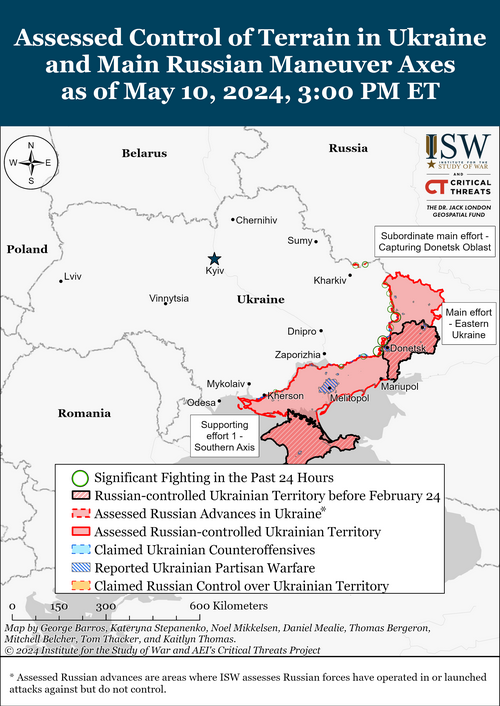
From The Institute for the Study of War:
Russian Offensive Campaign Assessment, May 11, 2024
Riley Bailey, Angelica Evans, Nicole Wolkov, Christina Harward, and Frederick W. Kagan
May 11, 2024, 8:20pm ET
Click here to see ISW’s interactive map of the Russian invasion of Ukraine. This map is updated daily alongside the static maps present in this report.
Click here to see ISW’s 3D control of terrain topographic map of Ukraine. Use of a computer (not a mobile device) is strongly recommended for using this data-heavy tool.
Click here to access ISW’s archive of interactive time-lapse maps of the Russian invasion of Ukraine. These maps complement the static control-of-terrain map that ISW produces daily by showing a dynamic frontline. ISW will update this time-lapse map archive monthly.
Note: The data cut-off for this product was 1:15pm ET on May 11 (excluding certain evidence of Russian gains in northern Kharkiv Oblast). ISW will cover subsequent reports in the May 12 Russian Offensive Campaign Assessment.
Russian forces are conducting relatively limited offensive operations along the Russian-Ukrainian border in northern Kharkiv Oblast and continued to make tactically significant gains in likely less defended areas. The reported sizes of the Russian elements committed to these limited operations and of the Russian force grouping deployed along the border in northeastern Ukraine indicate that Russian forces are not pursuing a large-scale operation to envelop, encircle, or seize Kharkiv City at this time. Ukrainska Pravda reported that Russian forces resumed offensive operations north of Lyptsi (north of Kharkiv City) on the morning of May 11 and focused on Hlyboke (immediately north of Lyptsi), where Russian milbloggers claimed that Russian forces advanced to the outskirts of the settlement and later seized and cleared the settlement.[1] NASA Fire Information for Resource Management (FIRMS) data captured on May 10 indicates that there has likely been heavy fighting near Hlyboke, and ISW assesses that Russian forces have advanced up to the outskirts of the settlement.[2] Geolocated footage published on May 11 indicates that Russian forces have seized Morokhovets and Oliinykove (both northeast of Lypsti), and Russian milbloggers claimed that Russian forces seized these settlements.[3] Ukrainian officials reported that Ukrainian forces repelled Russian assaults west of Vovchansk (northeast of Kharkiv City) near Ohirtseve and Hatyshche, two settlements that the Russian Ministry of Defense (MoD) and Russian sources claimed that Russian forces seized as of May 11.[4] ISW assesses that Russian forces have advanced at least to the outskirts of Ohirtseve and Hatyshche. The Russian MoD claimed that Russian forces also seized Strilecha, Pylna, and Borsivika (north to northwest of Lypsti), claims that ISW assesses to be accurate, as well as Pletenivka (north of Vovchansk).[5] Russian sources also claimed that Russian forces seized Hoptivka and Kudiivka (both northwest of Lyptsi and southeast of Kozacha Lopan).[6] Russian milbloggers claimed that Russian forces advanced further towards Lukyantsi (northeast of Lyptsi), to the northern outskirts of Neskuchne (northeast of Lyptsi), and to the western outskirts of Staritsa and Izbytske (west of Vovchansk and east of Lyptsi).[7] Russian milbloggers claimed that Russian forces advanced from Hatyshche to the northwestern outskirts of Vovchansk, south from Pletenivka, and towards Tykhe (on Vovchansk’s northeastern outskirts).[8] Russian milbloggers claimed that Russian forces seized Tykhe and are currently trying to advance east of the settlement into Vovchansk.[9] ISW has not observed evidence that would support an assessment that these Russian claims correspond with Russian advances at this time.
Ukrainian Khortytsia Group of Forces Spokesperson Lieutenant Colonel Nazar Voloshyn stated that Russian forces are trying to advance in areas that were already contested “grey zones,” suggesting that Ukrainian forces did not maintain enduring positions in many of the small border settlements that Russian forces have seized or have reportedly seized.[10] It is unlikely that Ukrainian forces would have established serious strongholds and fortifications along a contested grey zone or enduring positions in small border settlements that Russian forces have long subjected to routine indirect fire. Russian forces will likely face more intense resistance when trying to advance near settlements further south of the border and into larger border settlements like Lyptsi and Vovchansk. The proximity of Kharkiv City to the border magnifies the significance of limited Russian tactical gains, however, as Russian forces do not have to advance much further to begin threatening Kharkiv City with routine shelling.[11]
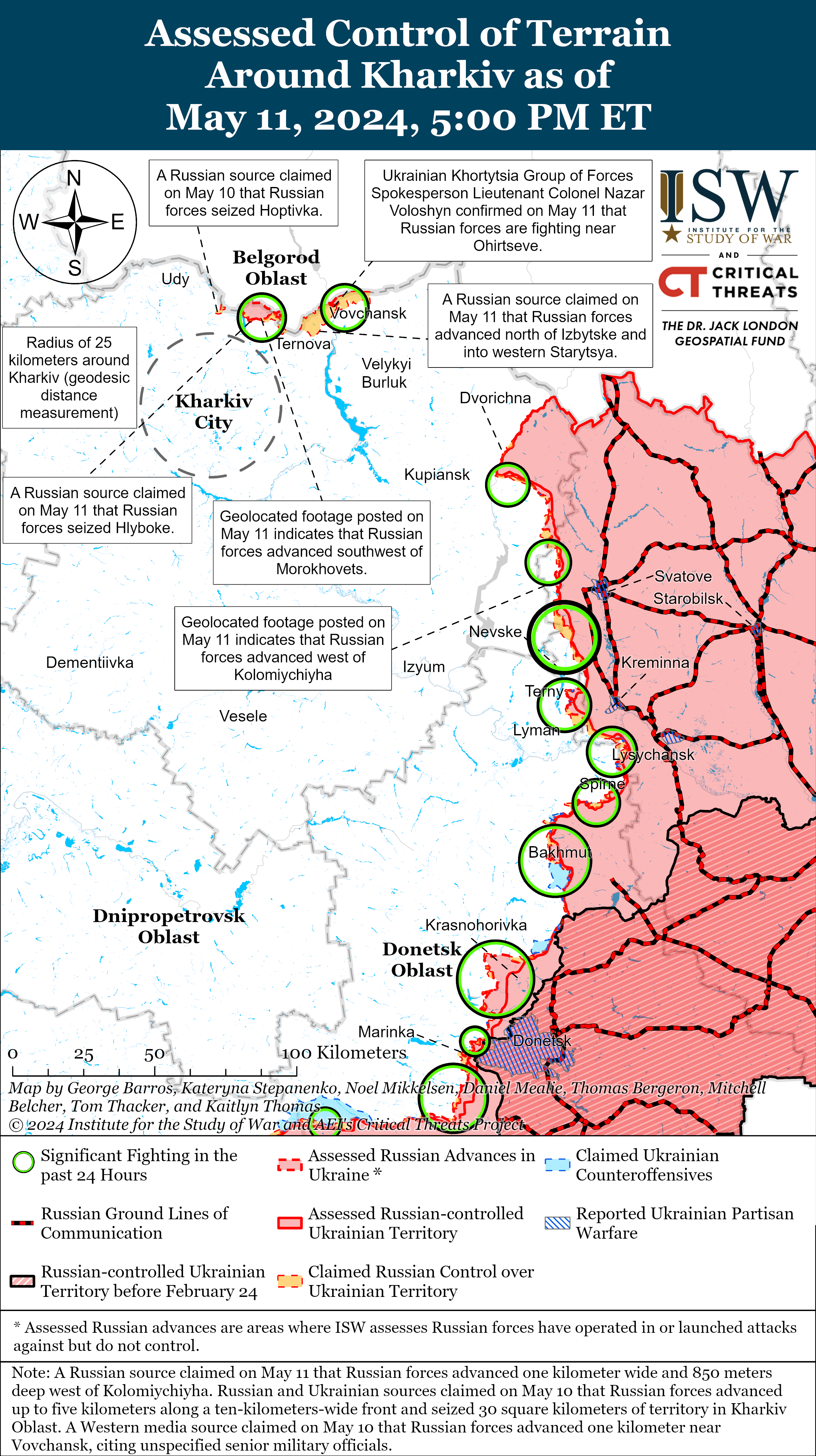
Russian forces reportedly launched offensive operations along the Russian-Ukrainian border in northern Kharkiv Oblast before they had completed bringing the Northern Grouping of Forces up to its reported planned end strength and have so far only committed a limited amount of combat power to offensive operations in the area. Ukrainian military observer Kostyantyn Mashovets stated on May 11 that Russian forces have committed up to two companies of the 7th Motorized Rifle Regiment (11th Army Corps [AC], Leningrad Military District [LMD]) and up to two battalions of the 18th Motorized Rifle Brigade (11th AC, LMD) to the ongoing operations in the Lyptsi and Vovchansk directions.[12] Ukrainian military observer Alexander Kovalenko stated on May 11 that elements of the 30th Motorized Rifle Regiment (72nd Motorized Rifle Division, 44th AC, LMD) and the 128th Motorized Rifle Brigade (44th AC, LMD) are also operating in the area.[13] Kovalenko stated that Russian forces have committed 2,000 personnel to the frontline along the border and have 1,500 to 2,000 personnel in immediate reserve.[14] Kovalenko stated that elements of the 44th AC are currently redeploying to Belgorod Oblast and that 3,750 additional Russian personnel from the 44th AC may arrive in the area within the next week.[15] Kovalenko stated that the Russian Northern Grouping of Forces has 30,000 to 35,000 personnel deployed along the entire border with Ukraine in Kursk, Bryansk, and Belgorod oblasts, a figure consistent with Ukrainian Main Military Intelligence Directorate (GUR) Deputy Chief Major General Vadym Skibitskyi’s May 2 report that Russian forces had roughly 35,000 personnel deployed to the international border area.[16] Skibitskyi stated that Russian forces intend to establish a grouping in the area that is between 50,000 and 75,000 personnel in size.[17] Ukrainian sources stated that Ukrainian forces have destroyed at least 20 Russian armored vehicles since Russian forces began offensive operations in the area on the morning of May 10, but Russian and Ukrainian sources continue to characterize Russian offensive operations along the border as consisting primarily of heavy infantry assaults.[18] Russian forces will likely introduce reserves to intensify ongoing offensive operations in the area in the coming days, however, the Russian forces lack the necessary manpower required to attempt a large-scale offensive operation to envelop, encircle, or seize Kharkiv City according to all available reports.
ISW continues to assess that the Russian offensive operations in northern Kharkiv Oblast likely aim to draw Ukrainian forces from other sectors of the front while allowing Russian forces to advance to within tube artillery range of Kharkiv City.[19] Russian forces are maintaining the tempo of their offensive operations along the Kupyansk-Svatove-Kreminna line, near Chasiv Yar, and west of Avdiivka, and the Russian military command likely hopes that operations in northern Kharkiv Oblast could cause the Ukrainian military command to dedicate manpower and materiel to the defense north of Kharkiv City that it could otherwise dedicate to defending in these other directions. A Russian advance towards Kharkiv City that would allow Russian forces to conduct effective and routine indirect fire would give Russian forces the capability to inflict significant damage to Kharkiv City in order to prompt mass migration from the city and set conditions for a larger offensive operation at a later date.[20] US National Security Council Spokesperson John Kirby stated on May 10 that Russian forces are preparing to use long-range fire capabilities within the radius of Kharkiv City and that this indicates that the Russian military is considering a larger offensive operation against Kharkiv City.[21] Russian long-range fire may similarly intend to set conditions for a subsequent offensive operation against Kharkiv City, and Kirby did not indicate that the White House believes that the Russian military is considering an immediate effort to seize Kharkiv City. The seizure of Kharkiv City most certainly is a desired operational objective for Russian forces, but not one that the Russian military appears to be pursuing in the near term.
Russian President Vladimir Putin and the Russian military command may be evaluating the risks, prospects, and timeline of offensive operations in northern Kharkiv Oblast based on the assumption that Ukraine cannot and will not be able to liberate territory seized by Russian forces. Putin’s and the Russian military command’s calculus about the threat of Ukrainian territorial gains is likely shaping Russia’s overall operational approach to seizing territory in Ukraine. The US Office of the Director of National Intelligence’s (ODNI) 2024 Annual Threat Assessment reported that Russian President Vladimir Putin “probably believes” that Russian forces have blunted Ukrainian efforts to retake significant territory and that US and Western support for Ukraine is “finite.”[22] Russia’s intended timeline for its ongoing offensive operations in northern Kharkiv Oblast remains unclear, but Russian forces may intend for their offensive operations in northern and northeastern Kharkiv Oblast to achieve their operational objectives long after summer 2024. The Russian military command may assume that Russian forces will be able to hold any limited gains they make in northern Kharkiv Oblast and other oblasts in perpetuity because they think that Ukrainian forces will be unable to launch successful counteroffensive efforts at any point in the future. Russian forces have made a series of tactically significant advances in Donetsk Oblast, particularly near Avdiivka, in recent months without Ukrainian counterattacks even momentarily pushing back Russian forces, and these recent unchallenged gains may be contributing to Putin’s and the Russian military command’s calculus.[23] Putin may believe that Russian forces can continue to make opportunistic and unchallenged advances throughout the frontline over the next months, or even years, and ultimately force Ukraine to submit to total Russian subjugation. Ukrainian materiel constraints due to delays in Western security assistance have prevented Ukrainian forces from launching significant counterattacks against Russian offensive operations, but the arrival of US security assistance to the front at scale will likely allow Ukrainian forces to resume counterattacks that threaten Russian forces’ ability to hold tactical gains.[24]
The limited Russian offensive operations in northern Kharkiv Oblast suggest that the resumption of US security assistance has not changed Putin’s calculus or that he launched the Kharkiv effort without reassessing the operation’s fundamental assumptions about Ukrainian capabilities in light of the resumption of aid. Russian forces are currently attacking with a force grouping well below its reported intended end strength, a risky decision if Putin and the Russian military command believed that there was a threat for Ukrainian forces to roll back any tactical gains that this understrength force could make before Russian forces staffed it to end strength. Russian forces are currently advancing in several areas that do not provide immediate avenues of advance toward Kharkiv City or other immediate operationally significant objectives. Russian forces may be advancing in these areas because they believe that they can hold any seized ground indefinitely and use that ground to launch subsequent operations to more operationally significant goals. Russian forces may also believe that they can pursue gradual creeping advances across a wide swath of territory in northern and northeastern Kharkiv Oblast for an extended period of time without achieving relatively rapid operationally significant advances but in a way that would disadvantage any future Ukrainian counteroffensive operations in the area.
It is imperative for Ukrainian forces to disrupt any such Russian calculations as soon as possible through both limited and large-scale counteroffensive operations that liberate Russian-occupied territory as soon as conditions permit. ISW has routinely argued that Ukrainian forces should contest the theater-wide initiative as soon as possible because ceding the theater-wide initiative to Russia into 2025 affords Russian forces the ability to determine the timing, location, and intensity of Russian attacks and control the resources that Ukrainian forces expend during this protracted period.[25] Ukrainian forces will not have a chance to liberate territory if they remain on the defensive for the foreseeable future, and remaining entirely on the defensive will only encourage Putin to continue grinding offensive operations indefinitely seeking complete victory over time. ISW has repeatedly assessed that the consistent provision of key Western systems to Ukraine will play a critical role in Russia’s prospects in 2024 and Ukraine’s ability to conduct future counteroffensive operations and liberate Ukrainian territory from Russian occupation.[26] The West must proactively and preemptively provide Ukrainian forces with the necessary equipment and weapons for their future counteroffensive operations if Ukrainian forces are to liberate significant swaths of occupied Ukraine and challenge Putin’s belief that Ukraine is and will remain unable to do so.
The directions of Russian offensive operations in the international border area suggest that Russia may be attempting to create a “buffer zone” to protect Belgorod City, as Russian and Ukrainian officials have recently stated. Russian officials, including Russian Vladimir Putin, have recently called for the creation of a “buffer zone” to protect Russia’s claimed and actual territories from Ukrainian strikes.[27] Although this stated goal is actually unachievable as long as an independent Ukraine with any strike capabilities and will to fight remains, Kremlin officials have explicitly listed Kharkiv City as a part of a hypothesized limited demilitarized zone aimed at protecting Belgorod City.[28] Western and Ukrainian media reported on May 10 that Ukrainian military sources stated that Russian forces intend to establish a 10-kilometer deep buffer zone along the northern border in Kharkiv Oblast.[29] This objective likely is intended not only to push Ukrainian tube artillery out of range of Russian military logistics in Belgorod Oblast, but also to bring Russian tube artillery within striking distance of Kharkiv City. Russian forces are currently conducting offensive operations near Hoptivka (northwest of Lyptsi), and it is notable that Russian forces are also attempting to advance in areas that are separate from the area north of Lyptsi where Russian forces have already made tactically significant advances. Russian forces are also notably conducting offensive operations north and west of Vovchansk on both sides of the Siverskyi Donetsk River, which would pose a significant obstacle to Russian forces on the east side of the river should they attempt to advance southwestward to Kharkiv City. These various directions of Russian offensive operations further suggest that Russian offensive operations in northern Kharkiv Oblast are not aimed at an immediate large-scale offensive operation to envelop, encircle, or seize Kharkiv City. Russian forces may, however, be aiming to seize a wide swath of Ukrainian territory in the area immediately south of the border with Belgorod Oblast, likely including Vovchansk, to create a “buffer zone.” Russian attempts to advance in an area that is relatively wide and not very deep along the border, especially in the area north of Hoptivka towards Kozacha Lopan, would further indicate that this is the Russian operational objective in the international border area.
Russian forces appear to be attempting to quickly isolate the battlespace east of the Siverskyi Donets River and seize Vovchansk, a direction of advance that Russian forces may believe could threaten the Ukrainian grouping defending in the Kupyansk direction. Geolocated footage published on May 11 shows a Russian strike destroying the Siverskyi Donets Dam bridge in Stary Saltiv (southwest of Vovchansk).[30] Footage published on May 11 purportedly shows Russian forces striking a bridge over the Vovcha River connecting Tykhe and Vovchanski Khutory (both west of Vovchansk).[31] Russian forces likely destroyed the bridges in an effort to isolate the Ukrainian forces operating on either side of the water features to prevent them from supporting Ukrainian forces defending against ongoing Russian attacks near Vovchansk. Russian attempts to destroy Ukrainian ground lines of communications (GLOCs) southwest and east of Vovchansk indicate that Russian forces will likely focus on seizing Vovchansk instead of attempting to bypass the settlement or expanding the front further east along the international border between Russia and Ukraine. Russian forces reportedly conducted at least 20 glide bomb strikes against Vovchansk on May 11 and are heavily focusing artillery, MLRS, and drone strikes on the settlement.[32] Russian forces may also intend to use offensive operations near Vovchansk to pressure the operational rear of Ukrainian forces defending against Russian attacks in the Kupyansk direction and draw away Ukrainian units defending in the Kupyansk area. A Russian foothold in Vovchansk does little to support a Russian effort to advance towards Kharkiv City, although Russian forces may imagine that a foothold in the settlement could allow Russian forces to launch offensive operations in the direction of Velykyi Burluk, a notable settlement in the rear of the Ukrainian grouping in the Kupyansk direction. Russian advances further south of Vovchansk would require long drives across open terrain, a capability that Russian forces have not shown in the past year and a half of fighting in Ukraine even during the period of most acute Ukrainian resource shortages.[33]
Donetsk People’s Republic (DNR) Head Denis Pushilin reiterated a series of Kremlin narratives intended to justify Russia’s invasion of Ukraine and attempted to flatter Russian President Vladimir Putin and the Russian military during an interview in honor of the 10th anniversary of the DNR’s founding, likely in an attempt to curry favor in the Kremlin. Pushilin claimed during an interview with Kremlin newswire TASS on May 11 that Russia must seize Kharkiv, Odesa, Dnipro, Sumy, and a number of other unspecified cities during its invasion of Ukraine and “liberate” all of the “Russian people” who live in these supposedly “Russian” cities.[34] Pushilin strangely claimed that his list of cities encompasses more than “real historical Russian cities.” Pushilin claimed that Russian President Vladimir Putin ordered Russian forces to not conduct strikes against Ukraine’s energy grid this past winter due to Putin’s great concern for Ukrainian civilians but also claimed that Russian forces should intensify their strikes against bridges and transportation hubs in Ukraine.[35] Pushilin claimed that Putin is the “main curator” of Donbas and Novorossiya and is “immersed” in the details of everything happening in occupied Ukraine and that the pace of Russian forces operation to seize the remainder of Donetsk Oblast is “adequate” and is not “too fast or too slow.”[36]
Ukrainian forces reportedly conducted successful drone strikes against a Russian oil refinery in Volgograd Oblast on the night of May 10 to 11. Sources in Ukrainian special services told Ukrainian outlet Suspilne that Ukraine’s Main Military Intelligence Directorate (GUR) conducted drone strikes against a Lukoil refinery in Volgograd Oblast and damaged the AVT-1 and AVT-6 oil processing facilities and control cables for the facility’s air coolers.[37] Volgograd Oblast Governor Andrei Bocharov claimed on May 11 that Russian forces intercepted a drone over Volgograd Oblast and that it did not damage any infrastructure.[38] Ukraine’s Security Service (SBU) reportedly conducted a drone strike against the same oil refinery on February 3.[39]
Russian Prime Minister Mikhail Mishustin submitted proposals on the composition of the new Russian government to the State Duma on May 11.[40] Mishustin proposed that current Minister of Agriculture Dmitry Patrushev become a Deputy Prime Minister and that current Kursk Oblast Governor Roman Starovoit become the Minister of Transport.[41] Mishustin also proposed that current Deputy Prime Minister and Minister of Industry and Trade Denis Manturov leave his position as Minister of Industry and Trade and become First Deputy Prime Minister. Mishustin nominated current Kaliningrad Oblast Governor Anton Alikhanov to replace Manturov as Minister of Industry and Trade. Dmitry Patrushev is notably the son of Russian Security Council Secretary Nikolai Patrushev, and this is the second recent case of nominations to high ranking positions for children of people in Russian President Vladimir Putin’s inner circle after Russian Federation Council Chairperson Valentina Matvienko nominated Boris Kovalchuk – the son of Putin’s “personal banker” Yuri Kovalchuk – as a candidate for the head of the Federation Council Accounts Chamber on May 10.[42]
Key Takeaways:
- Russian forces are conducting relatively limited offensive operations along the Russian-Ukrainian border in northern Kharkiv Oblast and continued to make tactically significant gains in likely less defended areas. The reported sizes of the Russian elements committed to these limited operations and of the Russian force grouping deployed along the border in northeastern Ukraine indicate that Russian forces are not pursuing a large-scale operation to envelop, encircle, or seize Kharkiv City at this time.
- Russian forces reportedly launched offensive operations along the Russian-Ukrainian border in northern Kharkiv Oblast before they had completed bringing the Northern Grouping of Forces up to its reported planned end strength and have so far only committed a limited amount of combat power to offensive operations in the area.
- ISW continues to assess that the Russian offensive operations in northern Kharkiv Oblast likely aim to draw Ukrainian forces from other sectors of the front while allowing Russian forces to advance to within tube artillery range of Kharkiv City.
- Russian President Vladimir Putin and the Russian military command may be evaluating the risks, prospects, and timeline of offensive operations in northern Kharkiv Oblast based on the assumption that Ukraine cannot and will not be able to liberate territory seized by Russian forces. Putin’s and the Russian military command’s calculus about the threat of Ukrainian territorial gains is likely shaping Russia’s overall operational approach to seizing territory in Ukraine.
- The limited Russian offensive operations in northern Kharkiv Oblast suggest that the resumption of US security assistance has not changed Putin’s calculus or that he launched the Kharkiv effort without reassessing the operation’s fundamental assumptions about Ukrainian capabilities in light of the resumption of aid.
- The directions of Russian offensive operations in the international border area suggest that Russia may be attempting to create a “buffer zone” to protect Belgorod City, as Russian and Ukrainian officials have recently stated.
- Russian forces appear to be attempting to quickly isolate the battlespace east of the Siverskyi Donets River and seize Vovchansk, a direction of advance that Russian forces may believe could threaten the Ukrainian grouping defending in the Kupyansk direction.
- Donetsk People’s Republic (DNR) Head Denis Pushilin reiterated a series of Kremlin narratives intended to justify Russia’s invasion of Ukraine and attempted to flatter Russian President Vladimir Putin and the Russian military during an interview in honor of the 10th anniversary of the DNR’s founding, likely in an attempt to curry favor in the Kremlin.
- Ukrainian forces reportedly conducted successful drone strikes against a Russian oil refinery in Volgograd Oblast on the night of May 10 to 11.
- Russian Prime Minister Mikhail Mishustin submitted proposals on the composition of the new Russian government to the State Duma on May 11.
- Russian forces recently made confirmed advances in northern Kharkiv Oblast; near Svatove, Chasiv Yar, Avdiivka, and Donetsk City; in western Zaporizhia Oblast; and in east (left) bank Kherson Oblast.
- The Russian Ministry of Defense (MoD) continues to highlight frontline Russian units fighting in Ukraine.
Go here to read the rest. Putin seems to be spreading out his advances rather than concentrating his offensive forces. Let’s see how that works out long term.


Unsubscribe me
Unsubscribe yourself.
The spirit of WFB enters the chat. Well done, Donald.
Frank, I would have wagered money that you would have been the one to pick up on that!
Seem to recall that Sun Tzu said something about spreading forces to attempt to strike the enemy in many places at once. He wasn’t much in favor of it.
Thank you, Sir. 😁
Donald:
That might work if you had first-rate special forces that you could move around. As I understand it, Putin doesn’t: either they’re dead or committed elsewhere. He also doesn’t have much new gear, pulling antiques out of storage instead. His advantages (as for Xerxes in Greece) are numbers and brutal, centralized control. Does not always work (see Xerxes).