
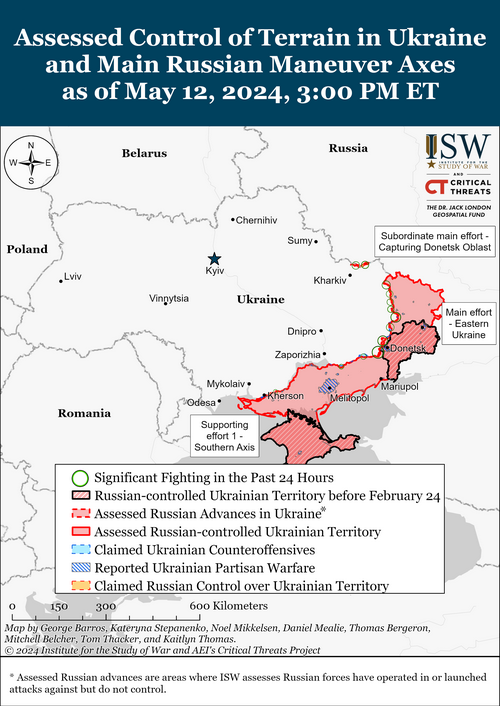
From The Institute for the Study of War:
Russian Offensive Campaign Assessment, May 12, 2024
Karolina Hird, Grace Mappes, Nicole Wolkov, Christina Harward, Kateryna Stepanenko, and George Barros
May 12, 2024, 8:15pm ET
Click here to see ISW’s interactive map of the Russian invasion of Ukraine. This map is updated daily alongside the static maps present in this report.
Click here to see ISW’s 3D control of terrain topographic map of Ukraine. Use of a computer (not a mobile device) is strongly recommended for using this data-heavy tool.
Click here to access ISW’s archive of interactive time-lapse maps of the Russian invasion of Ukraine. These maps complement the static control-of-terrain map that ISW produces daily by showing a dynamic frontline. ISW will update this time-lapse map archive monthly.
Note: The data cut-off for this product was 2pm ET on May 12. ISW will cover subsequent reports in the May 13 Russian Offensive Campaign Assessment.
Russian President Vladimir Putin replaced Sergei Shoigu with Andrei Belousov as Russian Minister of Defense on May 12, moving Shoigu to the position of Security Council Secretary in place of Nikolai Patrushev. These high-level reshuffles following the Russian presidential election strongly suggest that Putin is taking significant steps towards mobilizing the Russian economy and defense industrial base (DIB) to support a protracted war in Ukraine and possibly prepare for a future confrontation with NATO. The Russian Federation Council posted a list of Putin’s proposed cabinet ministers on May 12, which notably confirms that Putin has “proposed” Belousov as the new Minister of Defense (Putin’s proposals are orders).[1] Kremlin spokesperson Dmitry Peskov told Kremlin newswire TASS that Shoigu, who has served as Russian defense minister since 2012 — will assume the position of Security Council Secretary and act as Putin’s deputy on the Russian Military-Industrial Commission.[2] Peskov also announced that Putin dismissed Patrushev from his former position as Security Council Secretary “due to [his] transfer to another job,” which was not specified and that the Kremlin will announce his new role in the “near future.”[3] Peskov also noted that Army General Valery Gerasimov will remain Chief of the Russian General Staff, and a change in this position is not foreseen at this time.[4] Gerasimov is also currently the overall theater commander for Russian forces in Ukraine.
Belousov’s appointment to the position of Russian Defense Minister is a significant development in Putin’s efforts to set full economic conditions for a protracted war. Belousov has no military experience and is an economist by trade — he served as Russian Minister of Economic Development from 2012–2013, following a career in economic analysis and forecasting between 1981 and 2006.[5] His lack of military experience is not anomalous — Shoigu also lacked experience in uniform before he took over the Defense Ministry.[6] Belousov then served as First Deputy Prime Minister from 2020 until his new 2024 appointment.[7] Belousov is also a known advocate for greater government involvement in the economy.[8] Peskov announced Belousov’s appointment to state newswire TASS on May 12 and explained that “it is very important to fit the economy of the security bloc [domestic security power vertical] into the country’s economy,” suggesting that the Kremlin intends for Belousov to integrate and streamline the DIB and industries affiliated with Russia’s security and defense forces with wider domestic economic policy.[9] Several Russian insider sources similarly responded to Belousov’s new position and claimed that it shows that Putin has serious concerns over corruption levels and misuse of funds within the Russian military, conflicts between the military and the Russian DIB, and the perceived inefficacy of the Russian MoD as a whole.[10] An unnamed Russian federal official told Russian opposition outlet Vazhnye Istorii that Belousov will work in his new role to “competently organize work and logistics processes, ensure the necessary production and supplies, orient the economy towards the ‘special military operation,’ and squeeze the technological maximum out of the defense industry.”[11] A prominent Kremlin-awarded milblogger noted that Belousov’s new role “means the beginning of a large-scale audit and restructuring of all financial models” in the Russian MoD.[12]
Belousov’s nearly decade-long tenure as an economic minister in the Russian federal government and his more recent involvement managing various domestic DIB innovation and drone projects, prepare him well to lead the struggling Russian MoD apparatus. The Russian MoD under Shoigu struggled with allegations of high-level corruption and bureaucratic inertia, facing constant scathing critiques from Russian military commentators.[13] Belousov has a stronger reputation for being an effective technocrat, and insider sources have claimed that he has a positive relationship with Putin.[14] Belousov met with Putin in November 2023 to discuss DIB projects and technological cooperation and has spoken to Putin about issues with Russia’s domestic drone production.[15] Belousov also more recently highlighted a draft state order for 4.4 billion-rubles (roughly $48 million) for the production of drones until 2030, as well as plans to financially support drone producers and train drone developers and operators.[16] The focus on maximizing the technological innovation and output of the Russian DIB, particularly in the drone sphere, is likely to be extremely valuable to the Kremlin’s war effort —the Kremlin has recently had to reckon with a gap between Russian drone production and contemporary battlefield realities.[17] Belousov personally announced in January 2023 that Russia had finalized the “Unmanned Aircraft Systems” project, which provides 696 billion rubles (about $7 billion) for the production of 32,000 drones per year until 2030.[18] Putin likely intends Belousov to use his experience in a civilian government position to bridge federal economic policies with the Russian MoD agenda, thereby more fully mobilizing the Russian DIB at a larger and longer-term scale and integrating it with domestic economic policy. This effort sets conditions for a fuller economic mobilization, suggesting that the Kremlin continues to prepare for a protracted war in Ukraine.
Shoigu’s replacement of Patrushev as Security Council Secretary is in line with Putin’s general pattern of quietly sidelining high-level security officials by granting them peripheral roles within the Russian security sphere rather than simply firing them. The Russian Security Council is an advisory body that also plays a role in executing security-related policies and developing Russian strategic culture, making Shoigu’s appointment as Security Council Secretary and de facto demotion from the prestigious post of Russian Defense Minister less humiliating.[19] Putin has removed Shoigu from the direct MoD chain of command but granted him continued influence in the security space. Shoigu has remained an important and loyal subordinate, and sometimes a scapegoat, and Putin likely benefits from maintaining Shoigu’s leadership and experience in some official capacity. Shoigu’s removal also follows two high-profile incidents — the removal of his reported ally Deputy Defense Minister Timur Ivanov on corruption charges and Putin’s meeting with Shoigu’s political adversary and Tula Oblast Governor Alexei Dyumin to discuss DIB updates, which were likely leading indicators of the Kremlin’s preparations to remove Shoigu from his long-held position.[20]
Putin has previously similarly sidelined his failed generals by appointing them to peripheral security and defense related positions outside of the direct chain of command, sometimes allowing them to redeem themselves and return to Putin’s favor as ISW has assessed.[21] Putin’s removal of Patrushev from the Security Council is noteworthy, however, since several Western and Russian reports that Patrushev is a close personal ally of Putin—the Wall Street Journal alleged in December 2023 that Patrushev was the individual responsible for the assassination of Wagner Group financier Yevgeny Prigozhin in August 2023.[22] WSJ reported that Patrushev’s 2008 appointment as Security Council Secretary was largely a formality and that Patrushev serves as de facto head of all Russian security services, making him the second most powerful person in Russia.[23] WSJ also reported that Patrushev acts as a “hybrid intelligence official and diplomat” and routinely pays visits to world leaders on Putin’s behalf. ISW cannot yet confirm what Patrushev’s new role will be but considering Patrushev’s reported personal importance to Putin’s regime stability and Putin’s longtime tendency to balance Russian siloviki (strongmen with political influence) such as Patrushev within the power vertical, Patrushev’s next position will be an important reflection of Putin’s intent. The Kremlin may establish a new role or office for Patrushev to lead, such as establishing a higher-ranking position to manage the siloviki faction.
Aside from Patrushev’s dismissal, Putin largely reappointed the heads of core Russian security services, suggesting that he maintains a core cadre of loyal siloviki. Putin reappointed Vladimir Kolokoltsev as Minister of Internal Affairs, Sergei Naryshkin as Director of the Foreign Intelligence Service (SVR), Alexander Bortnikov as Director of the Federal Security Service (FSB), and Viktor Zolotov as Director of Rosgvardia.[24] ISW previously assessed that Russian security services and affiliated siloviki, particularly Bortnikov, were key constituencies for Putin’s election to his fifth term, and Putin has relied heavily on the work of the aforementioned security agencies to maintain regime stability, particularly following the failed Wagner Group rebellion.[25] Kolokolstev has been instrumental in coordinating the Kremlin’s migrant policy (which has been especially relevant in the aftermath of the March 22 IS attack on Crocus City Hall); Naryshkin has been an important player in establishing information conditions and propagating justifications for the war; Putin has personally praised Bortnikov and the FSB for protecting Russian sovereignty; and Zolotov has spearheaded efforts to absorb former Wagner Group fighters into Rosgvardia.[26] These siloviki form the backbone of Putin’s core cabinet, and their reappointment suggests that Putin will continue to rely on, and empower them, into his next term.
Russian offensive efforts to seize Vovchansk (northeast of Kharkiv City) are in large part a consequence of the tacit Western policy that Ukrainian forces cannot use Western-provided systems to strike legitimate military targets within Russia. Russian forces appear to be attempting to encircle Vovchansk as Russian forces approach city itself via Buhruvatka, Starytsya, and Izbytske to the west along the C-210817 road and via Vovchanskyi Khutory to the east along the O-210825 road.[27] The Russian seizure of any of these settlements would cut these Ukrainian ground lines of communication (GLOCs) to Vovchansk and make the remaining GLOCs (T-2104 highway) increasingly crucial to the city’s defense. Russian forces have also increasingly targeted bridges across nearby water features to isolate the Ukrainian defense of Vovchansk from other areas.[28] Ukrainian military observer Kostyantyn Mashovets assessed that Vovchansk is the main Russian effort in the northern Kharkiv Oblast direction and that Russian forces intend to bypass Vovchansk itself from the southwest and south.[29] Mashovets noted that Vovchansk’s proximity to the international border affords Russian forces “many opportunities,” including allowing Russian forces to conduct operations with limited forces and means to achieve a specific result; provides Russian forces with a “small shoulder of delivery” to allow stable control and fire support without moving their artillery; and allows for quick fuel and weapons deliveries to the frontline.

Russian forces are reaping the benefits of the West’s long-term restriction on Ukraine using Western-provided weapons to strike legitimate military targets on Russian territory — territory that Russian forces now depend on to sustain their offensive operations in northern Kharkiv Oblast. Western officials have prohibited Ukraine from using Western-supplied weapons to strike targets on Russian territory, and Ukrainian officials have repeatedly stated their adherence to this condition.[30] UK Foreign Minister David Cameron only recently greenlit Ukrainian forces to use UK-provided weapons to strike targets in Russian territory, but this is insufficient for Ukraine’s interdiction needs in Russian territory and came too late to allow Ukrainian forces to inhibit Russia’s ability to concentrate forces along the international border.[31] Ukrainian forces have previously used US-provided HIMARS to devastating effect, particularly in forcing Russian forces to withdraw from the west (right) bank of Kherson Oblast in November 2022 and continue to use HIMARS and other US- and Western-provided weapons to strike Russian force concentrations in rear and deep rear areas in occupied Ukraine.[32] Ukrainian forces regularly conduct drone strikes against infrastructure and airfields in Russia, but these lack the same interdiction effects that Ukrainian forces now need to generate to undermine the Russian offensive operations.[33] Ukrainian forces would greatly benefit from being able to use advanced long-range weapons systems to disrupt Russian logistics nodes and routes that are currently supplying the Kharkiv offensive but must instead rely on their limited and depleted stock of indigenous weapons.
Kremlin information operations encouraging Western self-deterrence likely aimed to allow Russian forces to build up and launch offensive operations without the threat of Ukrainian strikes against military and logistics assets. Russian President Vladimir Putin, senior Kremlin officials, and pro-Kremlin mouthpieces have regularly threatened Western states and accused them of “provocations” for continuing to provide military assistance to Ukraine.[34] Kremlin mouthpieces have maintained this rhetorical line even after the passage of a $61 billion dollar US military assistance package to Ukraine in late April, likely in support of an effort to prevent Ukrainian forces from using these weapons to degrade Russia’s various ongoing offensive efforts.[35] The Kremlin will likely continue to leverage this information operation as part of its ongoing reflexive control campaign to inhibit Ukraine’s ability to use all its available weapons to defend against the current Russian offensive operations in northern Kharkiv Oblast, forcing Ukraine to allocate other resources to a less effective defense and creating opportunities for Russian forces on other sectors of the front to exploit.[36]
Ukrainian forces continue to conduct repeat strikes on Russian oil and defense industrial infrastructure, prompting Russian milbloggers to complain about Russian forces’ clear and continued inability to defend against these strikes. Ukrainian outlets Ukrainska Pravda and RBK Ukraine cited sources in Ukraine’s Main Military Intelligence Directorate (GUR) as stating that the GUR conducted strikes with Ukrainian-made drones against the Kaluganefteprodukt oil depot in Kaluga Oblast, the Novolipetsk Metallurgical Plant in Lipetsk Oblast, and the Lukoil oil refinery in Volgograd Oblast overnight on May 11 to 12.[37] The Russian Ministry of Defense (MoD) claimed that Russian forces destroyed two drones over Lipetsk Oblast and one drone over Volgograd Oblast.[38] Volgograd Oblast Governor Andrey Bocharov claimed that a falling Ukrainian drone detonated and started a fire at the Volgograd oil refinery, and Lipetsk Oblast Governor Igor Artamonov claimed that Russian forces repelled a strike on infrastructure in the Lipetsk City industrial zone.[39] Russian opposition media published footage on May 12 of a fire at the Volgograd oil refinery.[40] ISW cannot independently verify the reported Ukrainian strikes against Kaluga and Lipetsk oblasts. Ukrainian forces reportedly struck the Lukoil Volgograd oil refinery on the night of May 10 to 11 and on February 3, struck the Novolipetsk Metallurgical Plant on the night of April 23 to 24 and February 23 to 24, and struck the Kaluganefteprodukt oil depot on April 28.[41]
A Russian milblogger extensively complained about Russian forces’ inability to repel Ukrainian strikes on Russian infrastructure, claiming that the Russian military command consistently underestimates Ukrainian capabilities and that Russian forces should learn from Ukraine’s ability to adapt to Russian strike methods.[42] The milblogger criticized the way Russian forces are trying to combat drone strikes with outdated Soviet-era weapons and without reconnaissance equipment. Another prominent, Kremlin-awarded milblogger agreed with the first milblogger, claiming that Russian forces lack an understanding of asymmetric warfare and that the Russian military command is slow to make changes.[43] The milblogger also blamed the issue on Russian military commanders who submit dishonest reports to the senior Russian military command — a common complaint among Russian milbloggers.[44] The milblogger claimed that Ukraine and the West are “more flexible, smarter, and more efficient” than Russian forces. The milblogger oddly and preemptively noted that this statement does not “discredit” the Russian military, which is a crime in Russia, but is instead an “adequate assessment” of the potential of the “enemy” that Russia is fighting.
Several German politicians from different political parties expressed support for using NATO air defense systems stationed in NATO member states to shoot down Russian drones over western Ukraine. German outlet Frankfurter Allgemeine Zeitung (FAZ) reported on May 11 that German Bundestag members Roderich Kiesewetter of the Christian Democrat Union Party, Agnieszka Brugger of the Green Party, and Marcus Faber of the Free Democratic Party expressed support for using NATO air defenses in countries bordering Ukraine, such as Poland and Romania, to intercept Russian drones over western Ukraine to allow Ukrainian air defenders to focus on protecting frontline areas.[45]
Key Takeaways:
- Russian President Vladimir Putin replaced Sergei Shoigu with Andrei Belousov as Russian Minister of Defense on May 12, moving Shoigu to the position of Security Council Secretary in place of Nikolai Patrushev. These high-level reshuffles following the Russian presidential election strongly suggest that Putin is taking significant steps towards mobilizing the Russian economy and defense industrial base (DIB) to support a protracted war in Ukraine and possibly prepare for a future confrontation with NATO.
- Belousov’s nearly decade-long tenure as an economic minister in the Russian federal government and his more recent involvement managing various domestic DIB innovation and drone projects, prepare him well to lead the struggling Russian MoD apparatus.
- Shoigu’s replacement of Patrushev as Security Council Secretary is in line with Putin’s general pattern of quietly sidelining high-level security officials by granting them peripheral roles within the Russian security sphere rather than simply firing them.
- Russian offensive efforts to seize Vovchansk (northeast of Kharkiv City) are in large part a consequence of the tacit Western policy that Ukrainian forces cannot use Western-provided systems to strike legitimate military targets within Russia.
- Ukrainian forces continue to conduct repeat strikes on Russian oil and defense industrial infrastructure, prompting Russian milbloggers to complain about Russian forces’ clear and continued inability to defend against these strikes.
- Several German politicians from different political parties expressed support for using NATO air defense systems stationed in NATO member states to shoot down Russian drones over western Ukraine.
- Russian forces recently made confirmed advances near Lyptsi and Vovchansk in northern Kharkiv Oblast.
- Former Roscosmos (Russian space agency) head and ultranationalist figure Dmitry Rogozin highlighted Russian forces’ continued difficulty repelling Ukrainian drones on the frontline.
Go here to read the rest. Putin has raised expectations with his Potemkin offensives. Let us see now if he can meet those expectations.

