
From The Institute for the Study of War:
Russian Offensive Campaign Assessment, May 14, 2024
Karolina Hird, Angelica Evans, Nicole Wolkov, Grace Mappes, and Frederick W. Kagan
May 14, 2024, 8:35pm ET
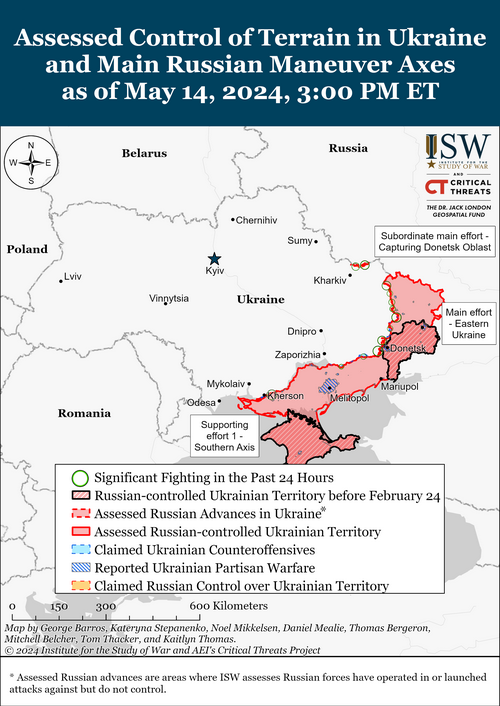
Click here to see ISW’s interactive map of the Russian invasion of Ukraine. This map is updated daily alongside the static maps present in this report.
Click here to see ISW’s 3D control of terrain topographic map of Ukraine. Use of a computer (not a mobile device) is strongly recommended for using this data-heavy tool.
Click here to access ISW’s archive of interactive time-lapse maps of the Russian invasion of Ukraine. These maps complement the static control-of-terrain map that ISW produces daily by showing a dynamic frontline. ISW will update this time-lapse map archive monthly.
Note: The data cut-off for this product was 3:15pm ET on May 14. ISW will cover subsequent reports in the May 15 Russian Offensive Campaign Assessment.
The pace of Russian offensive operations in northern Kharkiv Oblast appears to have slowed over the past 24 hours, and the pattern of Russian offensive activity in this area is consistent with ISW’s assessment that Russian forces are prioritizing the creation of a “buffer zone” in the international border area over a deeper penetration of Kharkiv Oblast. Several Ukrainian military officials reported on May 14 that they believe the situation in Kharkiv Oblast is slowly stabilizing — Ukraine’s Main Military Intelligence Directorate (GUR) Head Lieutenant General Kyrylo Budanov stated on May 14 that the situation in Kharkiv Oblast began stabilizing on the night of May 13 into May 14 as additional Ukrainian units deployed to the area and began defending against Russian advances.[1] The Ukrainian General Staff and Ukrainian Khortytsia Group of Forces Spokesperson Lieutenant Colonel Nazar Voloshyn noted that Ukrainian forces have begun to “clear” Vovchansk by targeting visible Russian assault groups in the settlement.[2] Several Russian and Ukrainian sources also reported that Russian forces are using new tactics in this direction — using smaller assault groups of no more than five people to penetrate Ukrainian positions before merging with other small assault groups to unite into a larger strike group.[3] Drone footage purportedly from Vovchansk shows Russian foot mobile infantry operating within the settlement in small squad-sized assault groups, consistent with Ukrainian reports.[4]
The use of small assault groups, however, may be contributing to higher Russian manpower and materiel losses and slowing the overall pace of the Russian offensive in this direction. One Russian military commentator, who previously served as a “Storm-Z” unit instructor, complained that footage of small Russian assault groups is indicative of poor training and preparation, not an effective new tactic.[5] Ukrainian military observer Kostyantyn Mashovets noted that growing Russian losses in this direction are leading to a decrease in the overall pace of offensive operations.[6] Ukrainian Chief of the General Staff Major General Anatoliy Barhylevych suggested that Russian forces have lost up to 1,740 soldiers in this direction over just the past day, which would be a very high rate of losses.[7] ISW cannot independently confirm this number, but the purported loss rate may be consistent with the generally slower rate of offensive operations observed on May 14. If the pace of Russian operations remains relatively lower, Russian forces will likely focus on consolidating new positions and building out a lateral salient in Kharkiv Oblast by merging the Lyptsi and Vovchansk efforts and creating a “buffer zone” in the border area, as opposed to pushing further into the oblast, as ISW has previously assessed.[8]

Russian President Vladimir Putin’s candidate for Russian Defense Minister Andrei Belousov outlined his and Putin’s intended priorities for the Russian Ministry of Defense (MoD) during a speech to the Russian Federation Council on May 14. Belousov stated that Putin has set two tasks for a Belousov-led Russian MoD – ensuring the full integration of the Russian military’s economy into the general Russian economy and making the Russian MoD as open to innovation as possible.[9] Belousov stated that the Russian MoD’s “most pressing issue” is equipping and supplying the Russian military with modern equipment, ammunition, missiles, communications equipment, drones, and electronic warfare (EW) systems. Belousov stated that his other top priorities are the implementation of the 2025 state defense order, the Russian MoD’s annual request for new weapons and equipment from the Russian defense industry, and recruitment efforts, but noted that there is no need to discuss “emergency measures” such as a partial or general mobilization of Russian citizens. Belousov noted that the Russian MoD must optimize its spending and gain greater control over the Russian defense industry. Belousov’s identified priorities are largely consistent with ISW’s assessment that Belousov’s appointment indicates that Putin is taking significant steps towards mobilizing the Russian economy and defense industry to support a protracted war effort in Ukraine and possibly prepare for a future confrontation with NATO.[10]
Russian authorities detained Russian Deputy Defense Minister and Russian MoD Main Personnel Directorate Head Lieutenant General Yuri Kuznetsov on May 13 on charges of accepting large-scale bribes. The Russian Investigative Committee and Russian media reported on May 14 that the Russian 235th Garrison Military Court detained Kuznetsov on suspicion of accepting a large bribe in the period 2021-2023 while serving as the head of the Russian General Staff’s 8th Directorate, which is in charge of the protection of state secrets.[11] The Russian Investigative Committee reported that authorities raided Kuznetsov’s home and discovered over 100 million rubles (about $1 million) worth of cash, including foreign currency, and luxury items. Moscow’s Basmanny Raion Court also detained Russian businessman Lev Martirosyan as part of Kuznetsov’s case.[12] Russian outlet Kommersant reported that Martirosyan bribed Kuznetsov with a total of 30.5 million rubles ($333,935) to help Martirosyan’s hotel companies win government contracts.[13] Kommersant reported that the same Investigative Committee department is investigating Kuznetsov’s and detained Russian Deputy Defense Minister Timur Ivanov’s cases and that the Investigative Committee is forming a special team to investigate similar cases involving high-ranking military personnel. Russian authorities detained Ivanov on April 24 on charges of accepting bribes.[14] Ongoing speculation about further changes within the Russian military and political leadership prompted Russian sources to speculate about the possible return of disgraced Wagner-affiliated Army General Sergei Surovikin to Russian President Vladimir Putin’s favor, but Russian sources concluded that insider reports that Surovikin is in Moscow are inaccurate.[15]
Putin appointed former Tula Oblast Governor Alexei Dyumin and former Security Council Secretary Nikolai Patrushev as his presidential assistants on May 14, further re-balancing his ministerial cabinet for his fifth term.[16] Kremlin Spokesperson Dmitry Peskov noted that Dyumin will oversee issues regarding the Russian defense industrial base (DIB), State Council, and sports policy, while Patrushev will oversee the strategic development of the Russian shipbuilding industry as well as “other areas, perhaps.”[17] Russian presidential assistants typically help the Russian president in the execution of their powers, including by preparing proposals for presidential work and by participating in official meetings alongside the president.[18] Presidential assistants may perform other tasks as the president orders. Dyumin’s appointment as Putin’s assistant on DIB issues is consistent with Putin’s apparent effort to restructure the Russian economy for a protracted war — Dyumin generally has a positive reputation amongst Russian commentators and is seen as a solid and effective professional, and Putin likely is hoping to leverage Dyumin’s good reputation to manage his own.[19]
Russian commentators received the news of Patrushev’s new position less certainly, however. Russian opposition outlet Meduza, citing sources close to the Kremlin, stated that its sources were “stunned” when they saw that Putin had removed Patrushev from the Security Council, and even more “shocked” that his new position is to be Putin’s assistant on shipbuilding.[20] Putin may have moved Patrushev to this new position in order to rebalance the siloviki-run power vertical that exists within the Russian security services, as ISW previously reported Putin tends to do with powerful siloviki.[21] Patrushev is reportedly a close Putin ally, the individual personally responsible for the assassination of Wagner Group financier Yevgeny Prigozhin, and Putin’s personal diplomat who frequently conducted diplomatic trips on Putin’s behalf, according to Western reporting.[22] Putin can continue to use Patrushev’s connections and experience even if Patrushev is nominally acting as an expert on “shipbuilding” strategy. The new position is nevertheless an obvious demotion.
The Georgian parliament passed Georgia’s Russian-style “foreign agents” bill in its third and final reading on May 14, amid continued protests against the bill in Tbilisi. The Georgian parliament passed the bill in an 84 to 30 vote, after which it will go to Georgian President Salome Zurabishvili to for final signature.[23] Radio Free Europe/Radio Liberty’s (RFE/RL) Georgian service reported that members of the European Socialist party and the People’s Force party, a breakaway party from the ruling Georgian Dream, supported the bill alongside Georgian Dream members.[24] Georgian President Salome Zurabishvili previously stated that she intended to veto the bill, although RFE/RL’s Georgian service noted that Georgian Dream has enough votes to override her veto.[25] Zurabishvili also proposed postponing the law’s entry into force until November 1, after the October 26 Georgian parliamentary elections.[26] Georgian opposition figures and Western officials have expressed concern that the Georgian government could also utilize the bill to target and justify domestic repression and that its passage could block Georgia’s path to joining the European Union (EU).[27] US Assistant Secretary of State for European and Eurasian Affairs James O’Brien previously met with senior Georgian officials and opposition members in Tbilisi on April 14. O’Brien stated that Georgian Dream party founder and former Georgian Prime Minister Bidzina Ivanishvili refused to meet with him because Ivanishvili claimed that the US had “de facto” sanctioned him, which O’Brien stated was false.[28] ISW has recently observed Ivanishvili and the Georgian State Security Service (SUS) intensifying their use of established Kremlin information operations and increasing rhetorical alignment with Russia against the West.[29] Georgian Dream actors likely intend to purposefully derail long-term Georgian efforts for Euro-Atlantic integration, which plays into continued Russian hybrid operations to divide, destabilize, and weaken Georgia.[30]
US Secretary of State Antony Blinken stated that the United States is interested in a bilateral security agreement with Ukraine during a visit to Kyiv on May 14. Blinken stated during a speech in Kyiv that more than 32 NATO states are negotiating 10-year bilateral security commitments with Ukraine, including nine states with completed agreements.[31] Blinken also reiterated the US commitment to supporting Ukraine’s military and industrial efforts. Blinken met with Ukrainian President Volodymyr Zelensky and Ukrainian Prime Minister Denys Shmyhal on May 14 and is expected to meet with Ukrainian Foreign Minister Dmytro Kuleba on May 15.[32] Zelensky and Blinken discussed the importance of newly arrived US security assistance in helping Ukrainian forces repel Russian attacks along the frontline and long-term security and economic support for Ukraine.
Likely Ukrainian actors conducted a strike against a Russian railway line in Volgograd Oblast on May 14. Geolocated footage published on May 14 purportedly shows the aftermath of a likely Ukrainian drone strike against a train in Samofalovka.[33] The train was allegedly transporting fuel.[34] Volga Railway’s Press Service stated that “unauthorized persons” derailed several cars of a freight train, and unspecified Russian operational services reported that the derailment and subsequent fire damaged almost 300 meters of railway tracks.[35]
Estonian Defense Minister Hanno Pevkur clarified that Estonia is not currently considering sending its forces to deep rear areas in Ukraine for non-combat roles.[36] Pevkur stated on May 14 that previous discussions about possibly sending troops to deep rear areas of Ukraine have not gained traction in either Estonia or the European Union (EU) and noted that Estonia would not take such a measure alone. Breaking Defense reported on May 13 that National Security Advisor to the Estonian President, Madis Roll, stated that the Estonian government is “seriously” considering sending Estonian troops to western Ukraine to take over non-combat roles in the rear from Ukrainian troops, allowing Ukrainian forces to deploy to frontline areas.[37] Roll clarified to Breaking Defense on May 14 that the discussion of sending Estonian forces to Ukraine in non-combat roles is “not dead” and “ongoing in Estonia in general.”[38]
Key Takeaways:
- The pace of Russian offensive operations in northern Kharkiv Oblast appears to have slowed over the past 24 hours, and the pattern of Russian offensive activity in this area is consistent with ISW’s assessment that Russian forces are prioritizing the creation of a “buffer zone” in the international border area over a deeper penetration of Kharkiv Oblast.
- Russian President Vladimir Putin’s candidate for Russian Defense Minister Andrei Belousov outlined his and Putin’s intended priorities for the Russian Ministry of Defense (MoD) during a speech to the Russian Federation Council on May 14.
- Russian authorities detained Russian Deputy Defense Minister and Russian MoD Main Personnel Directorate Head Lieutenant General Yuri Kuznetsov on May 13 on charges of accepting large-scale bribes.
- Putin appointed former Tula Oblast Governor Alexei Dyumin and former Security Council Secretary Nikolai Patrushev as his presidential assistants on May 14, further re-balancing his ministerial cabinet for his fifth term.
- The Georgian parliament passed Georgia’s Russian-style “foreign agents” bill in its third and final reading on May 14, amid continued protests against the bill in Tbilisi.
- US Secretary of State Antony Blinken stated that the US is interested in a bilateral security agreement with Ukraine during a visit to Kyiv on May 14.
- Likely Ukrainian actors conducted a strike against a Russian railway line in Volgograd Oblast on May 14.
- Russian forces recently marginally advanced near Lyptsi, Vovchansk, Svatove, Chasiv Yar, Avdiivka, Donetsk City, and Krynky.
- The Russian MoD is reportedly coercing Russian citizens and migrants into Russian military service through false job opportunities, likely as part of ongoing crypto-mobilization efforts.
- Ukrainian officials continue efforts to return forcibly deported Ukrainian children to Ukrainian-controlled territory from Russia.
Go here to read the rest. Putin is pondering what to do next as more Western weapons and ammunition reaches Ukraine. The Russians fight like hordes of bears drunk on vodka, but they prefer to think of themselves as chess players, and occasionally they are.


Did you hear? They say the reason the Russians were able to march so far into Northern Ukraine was that the funds (we gave them) for constructing the Kharkiv “first line of defense” (minefields, trenches, etc.) were diverted to “fake companies”!
https://humanevents.com/2024/05/14/funds-for-ukraine-war-diverted-to-fake-companies-report