
From The Institute for the Study of War:
Russian Offensive Campaign Assessment, May 13, 2024
Grace Mappes, Nicole Wolkov, Karolina Hird, and Frederick W. Kagan
May 13, 2024, 8:45pm ET
Click here to see ISW’s interactive map of the Russian invasion of Ukraine. This map is updated daily alongside the static maps present in this report.
Click here to see ISW’s 3D control of terrain topographic map of Ukraine. Use of a computer (not a mobile device) is strongly recommended for using this data-heavy tool.
Click here to access ISW’s archive of interactive time-lapse maps of the Russian invasion of Ukraine. These maps complement the static control-of-terrain map that ISW produces daily by showing a dynamic frontline. ISW will update this time-lapse map archive monthly.
Note: The data cut-off for this product was 2:45pm ET on May 13. ISW will cover subsequent reports in the May 14 Russian Offensive Campaign Assessment.
Russian forces continued to make tactically significant advances north and northeast of Kharkiv City on May 13 and currently appear to be prioritizing the rapid establishment of a “buffer zone” along the international border over setting conditions for deeper penetrations into northern Kharkiv Oblast. Geolocated footage published on May 13 shows that Russian forces have advanced into Hlyboke (north of Lyptsi) and raised a flag in the center of the village, but Russian sources claimed that Russian forces have not yet seized the entirety of Hlyboke and advanced west of the settlement along the west (left) bank of the Kharkiv River.[1] Additional geolocated footage shows that Russian forces advanced southwest of Oliinykove (northeast of Lyptsi) and north of Lukyantsi (northeast of Lyptsi and southeast of Oliinykove).[2] The Ukrainian General Staff reported that Russian forces achieved unspecified tactical success near Lukyantsi.[3] Russian milbloggers claimed that Russian forces entered Lukyantsi, but ISW has not observed visual confirmation of this claim.[4] Russian forces also continued attacking in the Lyptsi direction near Pylna (northeast of Lyptsi and Oliinykove), and the Russian Ministry of Defense (MoD) reported that Ukrainian forces counterattacked near Hlyboke.[5]
Geolocated footage published on May 12 shows that Russian forces seized the Vovchansk Meat Processing Plant in northern Vovchansk, and Russian milbloggers claimed that Russian forces also captured a shoe factory in northern Vovchansk on the morning of May 13 and advanced into central Vovchansk up to the northern (right) bank of the Vovcha River by the evening.[6] A Russian milblogger claimed that Russian forces are also clearing Starytsya and Buhruvatka (both west of Vovchansk on the C-210817 road) but that Russian forces do not control the settlements, and also advanced in a forest area further south of Ohirtseve (northwest of Vovchansk).[7] Russian forces also attacked on the Izbytske-Starytsya-Buhruvatka line west of Vovchansk and near Tykhe (east of Vovchansk), where the Russian MoD also reported Ukrainian counterattacks.[8] Russian sources claimed that fighting continued between the Lyptsi and Vovchansk salients near Zelene (on the international border between Lyptsi and Vovchansk) and that Ukrainian forces partially withdrew from Ternova (immediately southeast of Zelene).[9]
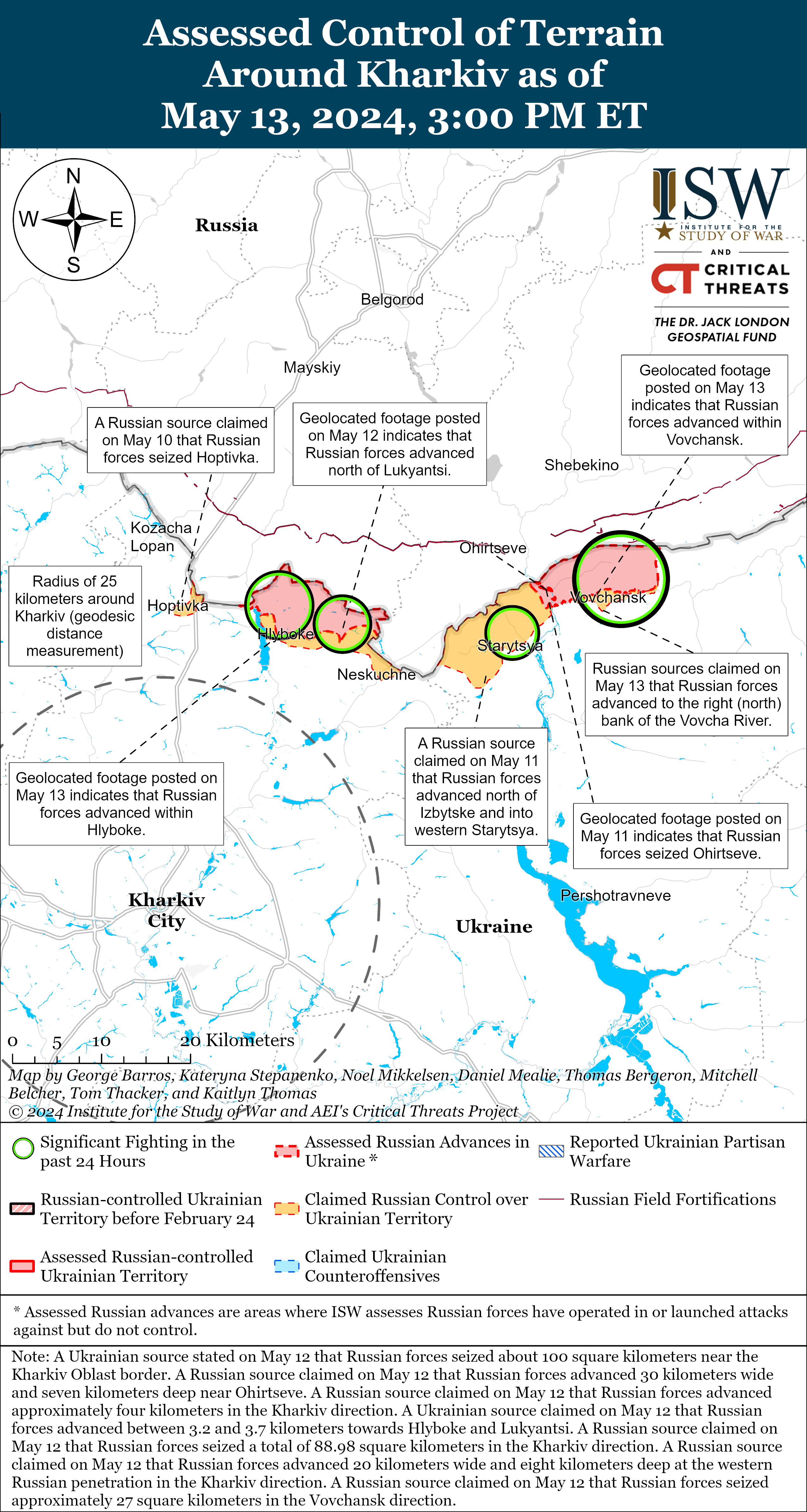
Russian forces’ relatively rapid rate of advances in Vovchansk and their reported destruction of several bridges across key waterways within the settlement suggest that Russian forces are prioritizing the creation of a “buffer zone” over a deeper penetration, as ISW previously assessed they would.[10] ISW has not yet observed claims or confirmation that Russian forces have crossed to the southern (left) bank of the Vovcha River in Vovchansk or its immediate environs. Russian forces notably conducted strikes against bridges over the Vovcha River immediately west and east of Vovchansk on May 12 and began targeting bridges over the river and logistics lines in Vovchansk itself on May 13, reportedly only leaving Ukrainian forces with two usable bridges over the Vovcha in Vovchansk.[11] It is unclear why Russian forces would largely target bridges they would need to cross and ensure stable logistics across the Vovcha River for offensive operations deeper into northern Kharkiv Oblast, so these strikes suggest that Russian forces may be prioritizing immediate gains in an unfortified area of northern Ukraine. Russian forces are also reportedly fielding armor in this area — Russian sources reported that Russian forces conducted a mechanized attack with an unspecified number of tanks against Vovchansk on the night of May 12 and continued armored attacks during the day on May 13.[12] The deployment of armored assets in this area suggests that Russian forces are seeking to make rapid gains, but they do not appear to be setting conditions at this time for such gains to be on the southern side of the Vovcha River deeper into northern Kharkiv Oblast. These indicators collectively suggest that Russian forces are likely trying to create the promised “buffer zone” in the border area instead of pursuing deeper gains into Kharkiv Oblast or towards Kharkiv City.
Russian President Vladimir Putin and other Kremlin officials have frequently suggested that Russia establish a “demilitarized buffer zone” in occupied Ukraine to protect Russian territory from Ukrainian strikes, and Russian Ambassador to the United States Anatoly Antonov directly connected this buffer zone with intensified Russian offensive operations south of Belgorod Oblast on May 13.[13] Ukrainian and Western officials have also recently stated that Russian forces intend to establish a 10-kilometer buffer zone in Kharkiv Oblast, and ISW has recently noted that this buffer zone would simultaneously bring Russian forces within tube artillery range of Kharkiv City and remove major Russian logistics hubs from Ukrainian tube artillery range.[14] A Ukrainian battlefield commander recently expressed concern that Ukrainian fortifications in northern Kharkiv Oblast are not along the immediate international border area, enabling Russian forces’ quick and relatively shallow advance.[15] More senior Ukrainian commanders have recently stated that Ukrainian forces have established a multi-layered defense-in-depth deeper in the oblast, which is congruent with the other battlefield commanders’ reports.[16] The current pace of Russian advances on this axis is not necessarily indicative of the further offensive capabilities of the Russian forces conducting the offensive operations, although Russia reportedly retains considerable reserves available to exploit initial successes on this axis.
Newly appointed Russian Security Council Secretary Sergei Shoigu participated in his first Security Council meeting as secretary on May 13, amid continued reports that Russian President Vladimir Putin is focusing on mobilizing the Russian economy and defense industrial base (DIB) to support a protracted war in Ukraine.[17] Kremlin Spokesperson Dmitry Peskov clarified that Shoigu will also be a “curator” of the Russian Military-Industrial Commission but will not lead it.[18] Russian opposition news outlet Meduza reported on May 13, citing its sources in the Russian government and presidential administration, that Shoigu’s alleged criticisms of Russian state-owned defense conglomerate Rostec General Director Sergei Chemezov for failing to provide a sufficient number of modern weapons to the Russian military for the past several months contributed to Shoigu’s removal from the Russian MoD.[19] This claim further emphasizes that Putin is focused on improving the Russian DIB’s capacity and ability to modernize and produce new technologies.[20] Several Russian milbloggers expressed hope that Shoigu’s removal as defense minister and Andrei Belousov’s appointment will improve the bureaucratic issues within the Russian Ministry of Defense (MoD) and the Russian DIB’s efficiency.[21] Russian milbloggers also largely attempted to alleviate concerns that Belousov’s lack of military experience would hinder his ability to effectively serve as defense minister and portrayed him as a competent manager who can root out corruption.[22] Belousov’s lack of military experience is not anomalous in the context of Putin’s ministerial management, and Shoigu also lacked military experience before becoming defense minister.[23] Putin has always appointed a civilian defense minister since firing Boris Yeltsin-appointed Defense Minister Marshal Igor Sergeyev in 2001.[24]
Putin’s decision to remove Shoigu from the Russian MoD appears to have also opened the door for the departure of certain Shoigu affiliates from the MoD, likely one of the intended effects of Putin’s recent cabinet reshuffles. Several Russian milbloggers and insider sources claimed on May 13 that two deputy defense ministers—Ruslan Tsalikov and Alexey Krivoruchko—submitted their resignations to Shoigu a week before Putin removed Shoigu as defense minister.[25] Russian milbloggers claimed that Tsalikov was “Shoigu’s right-hand man” for many years and oversaw troop support and the Russian MoD’s department on information policy and information warfare.[26] Krivoruchko is also reportedly close with Shoigu and oversaw military-technical support, weapons development, special equipment, and the implementation of state defense orders.[27] Russian sources claimed that both Tsalikov and Krivoruchko were embroiled in corruption scandals, and one Wagner Group-affiliated milblogger noted that frontline troops directly suffered as a result of their corrupt practices.[28] Russian insider sources claimed that Russian authorities questioned Tsalikov over possible corruption charges in late April, and suggested at the time that Tsalikov would be forced into retirement.[29] Russian authorities recently removed former Deputy Defense Minister Timur Ivanov, also a reported close Shoigu ally, from his position on corruption charges.[30] Tsalikov and Krivoruchko may have resigned in hope of receiving new positions outside of the MoD in order to avoid criminal prosecution on charges similar to Ivanov’s charges. Kremlin-awarded milblogger suggested that Tsalikov will also take a new role in the Russian Security Council following Shoigu.[31] Russian insider sources speculated that Belousov, as new defense minister, will only want to leave a maximum of two to three officials affiliated with Shoigu in the Russian MoD, suggesting that more Shoigu affiliates may still resign or be fired in the coming weeks.[32] One Russian milblogger speculated that Shoigu and his affiliates were part of the alleged “pro-China” party in the Russian MoD and suggested that other MoD officials associated with Russia’s China policy will be removed or resign alongside Shoigu, Ivanov, and others, although ISW cannot verify these speculations.[33] Putin likely used the constitutionally mandated ministerial resignations following his inauguration and subsequent nomination of new senior officials as a convenient moment to dismiss ineffective officials. Putin likely assessed that Shoigu’s constitutionally mandated resignation, almost a year after deceased Wagner Group financier Yevgeny Prigozhin’s rebellion to remove Shoigu and Russian Chief of the Army General Staff Valery Gerasimov from power, was the appropriate time to remove Shoigu from the Russian MoD without appearing to give in to Prigozhin’s demands.
Ukrainian forces reportedly conducted successful missile strikes against a Russian air defense base in occupied Crimea and successful drone strikes against Russian energy infrastructure in Russia. Russian opposition news outlet Astra reported, citing a source in the Crimean occupation Ministry of Emergency Services, that Ukrainian forces struck a Russian air defense base of the 3rd Radio Engineering Regiment (Russian Aerospace Forces’ [VKS] radio engineering troops) on Mount Ai-Petri in occupied Crimea on May 13, likely with several Storm Shadow missiles.[34] Astra reported that the strike killed an unspecified number of Russian personnel and likely the commander of the 3rd Radio Engineering Regiment. Ukrainian outlet Ukrainska Pravda reported on May 13 that one of its sources in the Ukrainian military confirmed the Mount Ai-Petri strike.[35] The Russian Ministry of Defense (MoD) claimed that Russian forces shot down four Storm Shadow missiles and seven drones over Crimea.[36] Ukrainian outlet Suspilne reported on May 13 that its sources in Ukraine’s Security Service (SBU) stated that the SBU conducted a drone strike against the Oskolneftesnabzheniye oil depot near Stary Oskol, Belgorod Oblast, and the Yeletskaya electrical substation in Lipetsk Oblast, which supplies traction substations to Russian Railways, the Stanovaya oil pumping station, and transit between Lipetsk, Oryol, and Bryansk oblasts’ power systems.[37] Lipetsk Oblast Governor Igor Artamonov claimed that Russian forces suppressed drones in Lipetsk Oblast and stated that a fire occurred at an electrical substation, presumably due to one of the Ukrainian drones.[38]
Breaking Defense reported on May 13 that Estonia may be considering sending its troops to Ukrainian rear areas in order to free up Ukrainian troops for redeployment to more critical areas of the theater.[39] National Security Advisor to the Estonian President, Madis Roll, told Breaking Defense that the Estonian government is “seriously” considering sending Estonian troops to western Ukraine to take over non-combat roles in the rear from Ukrainian troops, allowing Ukrainian forces to deploy to frontline areas. Lithuanian Prime Minister Ingrida Šimonytė noted on May 8 that the Lithuanian government has granted permission for Lithuanian troops to serve in similar non-combat rear area training roles in the future.[40]
Key Takeaways:
- Russian forces continued to make tactically significant advances north and northeast of Kharkiv City on May 13 and currently appear to be prioritizing the rapid establishment of a “buffer zone” along the international border over setting conditions for deeper penetrations into northern Kharkiv Oblast.
- Russian forces’ relatively rapid rate of advances in Vovchansk and their reported destruction of several bridges across key waterways within the settlement suggest that Russian forces are prioritizing the creation of a “buffer zone” over a deeper penetration, as ISW previously assessed they would.
- Newly appointed Russian Security Council Secretary Sergei Shoigu participated in his first Security Council meeting as secretary on May 13, amid continued reports that Russian President Vladimir Putin is focusing on mobilizing the Russian economy and defense industrial base (DIB) to support a protracted war in Ukraine.
- Putin’s decision to remove Shoigu from the Russian MoD appears to have also opened the door for the departure of certain Shoigu affiliates from the MoD, likely one of the intended effects of Putin’s recent cabinet reshuffles.
- Ukrainian forces reportedly conducted successful missile strikes against a Russian air defense base in occupied Crimea and successful drone strikes against Russian energy infrastructure in Russia.
- Russian forces recently made confirmed advances near Lyptsi and Vovchansk in northern Kharkiv Oblast.
- The Russian military may be intensifying efforts to recruit conscripts through the Russian Volunteer Society for Assistance to the Army, Aviation, and Navy of Russia (DOSAAF) as part of ongoing crypto-mobilization efforts.
Go here to read the rest. More NATO troops in Ukraine is a worrying trend if the goal is to prevent a wider war. I am sure that Biden will get right on this.

