
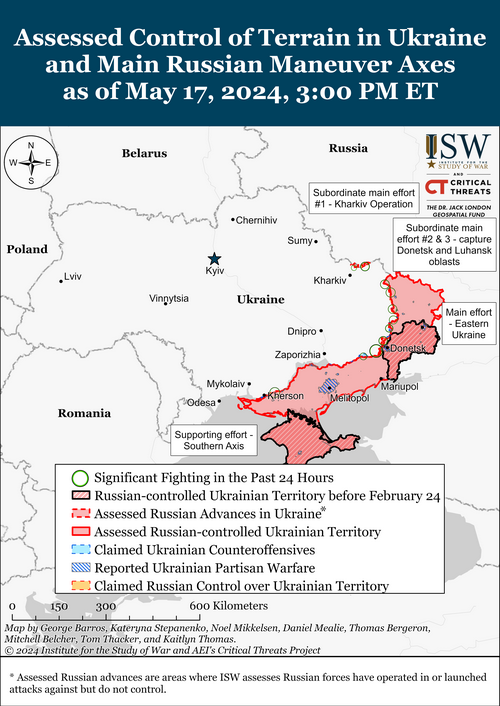
From The Institute for the Study of War:
Russian Offensive Campaign Assessment, May 17, 2024
Christina Harward, Angelica Evans, Riley Bailey, Grace Mappes, and Frederick W. Kagan
May 17, 2024, 6:35pm ET
Click here to see ISW’s interactive map of the Russian invasion of Ukraine. This map is updated daily alongside the static maps present in this report.
Click here to see ISW’s 3D control of terrain topographic map of Ukraine. Use of a computer (not a mobile device) is strongly recommended for using this data-heavy tool.
Click here to access ISW’s archive of interactive time-lapse maps of the Russian invasion of Ukraine. These maps complement the static control-of-terrain map that ISW produces daily by showing a dynamic frontline. ISW will update this time-lapse map archive monthly.
Note: The data cut-off for this product was 2pm ET on May 17. ISW will cover subsequent reports in the May 18 Russian Offensive Campaign Assessment.
Russian President Vladimir Putin framed Russian offensive operations in northern Kharkiv Oblast as part of Russian efforts to create a “buffer zone” to protect Russian border areas from Ukrainian strikes, confirming ISW’s previous assessments. Putin responded to a journalist’s question about Russian forces’ objectives in the Kharkiv direction, stating that Russian forces are achieving success “according to plan” and that Russian forces have no immediate plans to seize Kharkiv City.[1] Putin stated that Russian offensive operations in the Kharkiv direction are aimed at creating a “buffer zone” to protect Russian border areas, including Belgorod City, from Ukrainian strikes. ISW previously assessed that Russian forces appear to be prioritizing the establishment of a “buffer zone” along the international border over setting conditions for deeper penetrations into northern Kharkiv Oblast.[2]
Ukrainian President Volodymyr Zelensky stated that Ukrainian forces have stabilized the front in northern Kharkiv Oblast and that Russian forces have not reached Ukraine’s “concrete” and “most powerful” line of defense in the area.[3] Zelensky stated that Russian forces have currently reached the “first line” that Ukrainian forces built further from the border and that Ukrainian forces have also built a second and third line of defense. Zelensky described the third line of defense as the “most powerful” as it is further from the border and was not under threat of Russian shelling during its construction. Zelensky noted that Ukrainian forces have stabilized the situation in the area and that the deepest Russian forces have advanced is 10 kilometers, which is consistent with ISW’s assessment of Russian advances near Lyptsi. Western and Ukrainian media reported on May 10 that Ukrainian military sources stated that Russian forces intend to establish a 10-kilometer-deep buffer zone along the northern border of Kharkiv Oblast, and Russian forces will likely prioritize leveling the front in northern Kharkiv Oblast at this depth over deeper penetrations.[4]
Ukrainian Commander-in-Chief Colonel General Oleksandr Syrskyi stated that elements of the Russian military command strengthened the Northern Grouping of Forces with elements of the 6th Combined Arms Army and 11th and 44th Army Corps (all of the Leningrad Military District [LMD]), echoing previous statements from Ukrainian military observers about the Northern Grouping of Forces’ composition.[5] Syrskyi stated that Russian forces launched offensive operations in northern Kharkiv Oblast “well ahead of schedule” when Ukrainian forces were “turning over,” possibly referring to a Ukrainian troop rotation.[6] Russian forces made their narrow penetration towards Ocheretyne in late April by attacking during a Ukrainian brigade-level rotation on the frontline, and Russian forces may have sought to take advantage of similar situations to penetrate Ukrainian positions.[7]
Russian forces will likely be able to stretch Ukrainian forces along a wide front and fix Ukrainian troops in the international border area even as the tempo of Russian offensive operations in northern Kharkiv Oblast slows. Syrskyi stated that Russian forces have expanded the area of active hostilities by about 70 kilometers since starting offensive operations in northern Kharkiv Oblast and are trying to force Ukrainian forces to commit brigades from reserves to the frontline.[8] ISW continues to assess that Russian offensive operations along the Kharkiv international border likely have the strategic objective of drawing and fixing Ukrainian forces to this axis to enable Russian advances in other areas of eastern Ukraine.[9] Geolocated footage published on May 17 shows Ukrainian forces striking two Russian tanks moving towards the international border near Sumy Oblast.[10] Even limited Russian activity in other areas of the international border below the threshold of Russian offensive operations could have the effect of stretching Ukrainian forces along a wider front. Russian forces will be able to draw and fix Ukrainian forces to the border area as long as Russia sustains a presence in northern Kharkiv Oblast and threatens penetrations of other border areas. Russian forces have shown a propensity for conducting offensive operations along different sectors of the front in “pulses” with one sector decreasing in intensity as another increases, and Russian forces may slow offensive operations in northern Kharkiv Oblast for a time but resume the tempo at a later time of their choosing.[11]
Russian forces reportedly leveraged notable electronic warfare (EW) capabilities to support tactically significant gains during the first days of their limited offensive operation in northern Kharkiv Oblast. The Washington Post reported on May 17 that elements of a Ukrainian brigade operating in northern Kharkiv Oblast lost connection to drone and communications systems due to intense Russian EW jamming when Russian forces began their incursion into Kharkiv Oblast on May 10.[12] The Washington Post reported that the Ukrainian soldiers stated that the Russian EW jamming completely disrupted Ukrainian forces’ satellite internet connection via Starlink devices, reportedly the first time that Russian EW has completely knocked out Ukrainian Starlink connection since the start of the full-scale invasion.[13] A Ukrainian soldier told the Washington Post that these disruptions forced Ukrainian forces to communicate only through radio and phones and prevented Ukrainian forces from conducting basic reconnaissance.[14] Russian and Ukrainian forces have been in an offense-defense race involving EW systems and counter-EW adaptations, and it is notable that Russian forces were able to achieve such a widespread effect with their EW capabilities in northern Kharkiv Oblast.[15] Russian forces may have waited to deploy a new EW adaptation to achieve widespread disruptions during the beginning of their limited offensive operation in northern Kharkiv Oblast. Both Russian and Ukrainian forces have previously adapted quickly to changes in each other’s EW capabilities, and Russian forces may have decided that leveraging a new capability to make tactically significant gains at the outset of a new offensive operation would be the most worthwhile use of the capability’s novelty.[16]
Senior NATO military commanders confirmed ISW’s prior assessments that Russian forces do not have sufficient forces to achieve a “strategic breakthrough” in Ukraine. NATO Supreme Allied Commander Europe and US European Command Commander General Christopher Cavoli stated on May 16 that Russian forces do not have the necessary number of troops or the skill to conduct operations at the scale necessary to achieve and exploit a strategic-level breakthrough in Ukraine, and expressed confidence that Ukrainian forces will “hold the line” near Kharkiv City.[17] Cavoli noted that NATO member states have not observed Russian forces accumulate the resources required for such a breakthrough, further supporting ISW’s recent assessments that Russian forces are unlikely to make operationally significant gains against more well-provisioned Ukrainian forces during the Russian summer offensive effort.[18] NATO commanders also indicated that Russian forces are preparing for a longer-term war effort, however. Cavoli stated that Russian forces have improved in some unspecified areas but failed to improve in others, but that the Russian military has proven that it is a learning organization.[19] NATO Military Committee Chairperson Lieutenant Admiral Rob Bauer stated that the Russian defense industrial base (DIB) is more efficient than the Western DIB but that Russian forces still struggle with troop quality and training, all consistent with ISW’s longstanding assessments about Russia’s attempts to sustain its long-term war effort amid short to medium-term struggles with manpower and materiel.[20]
Ukrainian forces conducted a series of large-scale aerial and naval drone strikes against Russian energy and port infrastructure in Krasnodar Krai and occupied Crimea on the night of May 16 to 17. Ukrainian outlet Suspilne reported on May 17 that its sources in Ukrainian intelligence stated that Ukraine’s Main Military Intelligence Directorate (GUR) and Security Service (SBU) struck Russian military facilities in Novorossiysk and Tuapse, Krasnodar Krai and in occupied Sevastopol on the night of May 16 to 17.[21] The Ukrainian intelligence sources reportedly stated that the GUR and SBU targeted Black Sea Fleet (BSF) ships in Sevastopol and Novorossiysk. The Russian Ministry of Defense (MoD) claimed on May 17 that Russian forces destroyed 123 drones over Crimea and Krasnodar Krai and 25 unmanned boats in the Black Sea in the past day.[22] A prominent Russian milblogger claimed that Ukrainian forces launched over 140 drones and 20 unmanned boats in the overnight strikes on Sevastopol and Krasnodar Krai.[23] Russian and Ukrainian sources stated that Ukrainian forces struck a port and fuel terminal in Novorossiysk.[24] The Krasnodar Krai operational headquarters stated that falling drone debris caused a fire at an oil refinery in Tuapse on the morning of May 17, and Russian milbloggers and opposition media posted footage of the Ukrainian strike on the Tuapse oil refinery.[25] Reuters reported that two unspecified sources stated that Russian authorities conducted an emergency shutdown of the Tuapse oil refinery after the drones hit the facility’s liquified petroleum gas production unit but that the refinery will likely restart “relatively soon.”[26] The SBU reportedly struck the Rosneft oil refinery in Tuapse in late January 2024, and Reuters reported that the oil refinery resumed operations in late April 2024.[27] Sevastopol occupation governor Mikhail Razvozhaev stated that drone debris damaged a power substation near Sevastopol and caused partial blackouts in the city.[28]
US officials reiterated the White House’s unwillingness to support Ukraine’s use of US-provided weapons in strikes against military targets in Russia. US Defense Department Spokesperson Sabrina Singh stated on May 16 that the Biden Administration has not changed its position against Ukrainian forces using US weapons to strike targets within Russia and that the administration believes that the equipment should be used to liberate occupied Ukrainian territory.[29] ISW continues to assess that US and other Western limitations on Ukraine’s ability to strike military targets in Russia have created a sanctuary in Russia’s border areas from which Russian aircraft can conduct glide bomb and missile strikes against Ukrainian positions and settlements and where Russian forces and equipment can freely assemble before entering combat.[30] This US policy is severely compromising Ukraine’s ability to defend itself against Russian offensive operations in northern Kharkiv Oblast.[31]
Russian President Vladimir Putin attempted to further known Russian information operations intended to directly undermine Ukrainian President Volodymyr Zelensky’s legitimacy as president. Putin claimed during his press conference in Harbin on May 17 that the current Ukrainian government “has its origins” in a Western-facilitated coup d’état, referring to the Kremlin’s information operation falsely asserting that Ukraine’s Euromaidan Revolution in 2014 was an externally organized and funded coup against pro-Russian Ukrainian president Viktor Yanukovych that installed a series of pro-Western governments in Ukraine.[32] Putin additionally claimed that Ukraine’s political and legal systems must determine if Zelensky will still be considered Ukraine’s legitimate president when his first term technically expires on May 20. Ukraine would have held its presidential election on March 31 and would have begun a new presidential term on May 20 if Russia had not illegally invaded Ukraine.[33] Ukraine’s constitution permits postponing elections and allows a sitting president to continue to serve after the designated end of his term under martial law, and Zelensky’s decision not to hold elections given Ukraine’s ongoing existential defensive war is fully in accord with the Ukrainian constitution.[34] Ukrainian officials have repeatedly warned that the Kremlin is currently running a series of information operations aimed at undermining and questioning Zelensky’s legitimacy.[35]
Key Takeaways:
- Russian President Vladimir Putin framed Russian offensive operations in northern Kharkiv Oblast as part of Russian efforts to create a “buffer zone” to protect Russian border areas from Ukrainian strikes, confirming ISW’s previous assessments.
- Ukrainian President Volodymyr Zelensky stated that Ukrainian forces have stabilized the front in northern Kharkiv Oblast and that Russian forces have not reached Ukraine’s “concrete” and “most powerful” line of defense in the area.
- Russian forces will likely be able to stretch Ukrainian forces along a wide front and fix Ukrainian troops in the international border area even as the tempo of Russian offensive operations in northern Kharkiv Oblast slows.
- Russian forces reportedly leveraged notable electronic warfare (EW) capabilities to support tactically significant gains during the first days of their limited offensive operation in northern Kharkiv Oblast.
- Senior NATO military commanders confirmed ISW’s prior assessments that Russian forces do not have sufficient forces to achieve a “strategic breakthrough” in Ukraine.
- Ukrainian forces conducted a series of large-scale aerial and naval drone strikes against Russian energy and port infrastructure in Krasnodar Krai and occupied Crimea on the night of May 16 to 17.
- US officials reiterated the White House’s unwillingness to support Ukraine’s use of US-provided weapons in strikes against military targets in Russia.
- Russian President Vladimir Putin attempted to further known Russian information operations intended to directly undermine Ukrainian President Volodymyr Zelensky’s legitimacy as president.
- Russian forces recently marginally advanced near Avdiivka.
- Russian President Vladimir Putin attended the annual Russian-Chinese Expo and forum on interregional cooperation and visited Harbin Polytechnic University during the second and last day of his trip to the People’s Republic of China (PRC) on May 17.
- Ukrainian and Western sources continue to report that Russian forces are committing war crimes in newly occupied areas of Kharkiv Oblast.
Go here to read the rest. Russia is reportedly considering surrendering some of its far eastern territories in Siberia to China in payment of the industrial support Russia is currently receiving from China. Both Tsar Nicholas II and Stalin are turning over in their graves.


I’m imagining China made the “suggestion” first. That Russia would give up land in Asia (and to Asians) would be a startling reversal of expansion since the 17th century. Since it would be an admission of weakness and desperation Ukrainian media and propaganda would mock it savagely and Putin could even risk his head to the ultranationalists. I doubt anything comes of it.
Latest independent information is that Russian advances may have been at quite a cost. Over extension has increased casualties and continues to damage morale among soldiers, especially the draftees.