Independence Day
Fortnight For Freedom Day Nine: Top Ten Movies For the Fourth of July
Posterity! You will never know how much it cost the present Generation to preserve your Freedom! I hope you will make good use of it. If you do not, I shall repent in Heaven, that I ever took half the Pains to preserve it.
John Adams
Beginning for two weeks, up to Independence Day, the Bishops are having a Fortnight For Freedom:

We here at The American Catholic are participating in the Fortnight For Freedom with special blog posts on each day. This is the ninth of these blog posts.
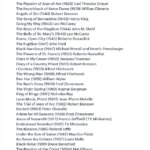
As we are embroiled now in a struggle to preserve our religious liberty, I think the Fourth of July is a good time to recall the price made to establish our liberties. A number of feature films and miniseries have been made about the events of the American Revolution. Here are my top ten choices for Fourth of July viewing:
10. Ben and Me (1953)- Something for the younger patriots. Disney put to film the novel of Robert Lawson, Ben and Me, which related how many of Ben Franklin’s bright ideas came from his mouse Amos. Quite a bit of fun. Not a classic but certainly an overlooked gem.
9. The Crossing (2000)-A retelling of Washington’s brilliant crossing of the Delaware on Christmas 1776 and the battle of Trenton. This film would rank much higher on my list but for Jeff Daniels’ portrayal of Washington as sullen and out of sorts throughout the movie. Washington had a temper, and he could give vent to it if provoked, although he usually kept it under control, but the peevish Washington portrayed here is simply ahistoric and mars an otherwise good recreation of the turning point of the Revolution.
8. John Paul Jones (1959) Robert Stack, just before he rose to fame in the Untouchables, is grand in the role of the archetypal American sea hero. Bette Davis is absolutely unforgettable as Catherine the Great. The climactic sea battle with the Serapis is well done, especially for those pre-CGI days. The only problem with the film is that many of the details are wrong. This is forgivable to a certain extent since scholarship on Jones was badly skewed by Augustus Buell in a two-volume “scholarly biography” which appeared in 1900. Buell was a charlatan who made up many incidents about Jones and then invented sources to support his fabrications. Buell was not completely exposed until Samuel Eliot Morison, Harvard professor of history, and an Admiral in the Navy, wrote his definitive biography of Jones. Here is a list of the fabrications of Buell compiled by Morison. Morison’s book appeared after the movie, which is to be regretted.
7. The Patriot (2000) Finally, a film which depicts the unsung contribution of Australians to victory in the American Revolution! Actually not too bad of a film overall. Heath Ledger is quite good as Gibson’s oldest son who joins the Continentals at the beginning of the war against his father’s wishes. Jason Isaacs is snarlingly good as the evil Colonel Tavington, very loosely based on Banastre Tarleton, commander of Tarleton’s Raiders during the Southern Campaign. The film of course allows Gibson to carry on his over-the-top vendetta against all things English. No, the British did not lock up American civilians in churches and burn them alive. However, the ferocity of the partisan fighting in the South is well depicted, and Banastre Tarleton at the Waxhaw Massacre earned a reputation for slaughtering men attempting to surrender. The final battle of the film is based on the battle of Cowpens where General Daniel Morgan decisively defeated Tarleton.
6. Drums Along the Mohawk (1939)-A John Ford classic starring Henry Fonda and Claudette Colbert. Through the eyes of a young newlywed couple, Fonda and Colbert, the American Revolution on the frontier is depicted in the strategic Mohawk Valley. Full of the usual Ford touches of heroism, humor and ordinary life. Continue reading
Happy Independence Day! (A Roundup)
Happy Independence Day, folks! — Here is a roundup of some choice reads as we commemorate the birth of our nation:
- Because it’s worth reading again: The Declaration of Independence – view high-resolution images of the original. (This is a part of the “Charters of Freedom”, an exhibit of the National Archives, on the documents that shaped our history.
- Catholic Sources and the Declaration of Independence by Rev. John C. Rager. The Catholic Mind XXVIII, no. 13 (July 8, 1930), looks at synergies between the thought of Aquinas and Bellarmine and that expressed in the Declaration, asking: “Did Jefferson know of Bellarmine?”? (In How Catholic is the Declaration of Independence?, Commonweal takes a look at the “Scholastic-roots-of-democracy theory”; and CatholicHistory.net provides a bibliography on Catholics and the American Founding).
- Learn about Charles Carroll — America’s Catholic Founding Father (Against The Grain).
- What do Pope John Paul II and Pope Benedict XVI think about the American Founding?.
- Discover the riches of The Federalist Papers – by way of a commentary by Paul Zummo (The Cranky Conservative), who maintains: “I absolutely believe that an understanding of the Federalist Papers is essential for understanding the U.S. Constitution and, therefore, understanding America.”
- Listen to Johnny Cash recite “I am the Nation”.
Following are two books which I heartily recommend for some engaging historical reading of the American Revolution and our founding fathers. Continue reading
God Bless America by Kate Smith
Kathryn Elizabeth “Kate” Smith (May 1, 1907 – June 17, 1986) was an American singer, best known for her rendition of Irving Berlin‘s “God Bless America“. Smith had a radio, television, and recording career spanning five decades, reaching its pinnacle in the 1940s.
Smith was born in Greenville, Virginia. Her professional musical career began in 1930, when she was discovered by Columbia Records vice president Ted Collins, who became her longtime partner and manager. Collins put her on radio in 1931. She appeared in 1932 in Hello Everybody!, with co-stars Randolph Scott and Sally Blane, and in the 1943 wartime movie This is the Army she sang “God Bless America”.
Late in the following video you’ll see a young Lt. Ronald Reagan make a cameo. 39 years later President Ronald Reagan awarded Kate Smith the Presidential Medal of Freedom America’s highest civilian honor.
Happy Independence Day!
America! America!
God mend thine every flaw,
Confirm thy soul in self-control,
Thy liberty in law!
As we celebrate our Independence from the British Empire, let us remember our total dependence on God.
Ending the Revolution
The 4th of July is the primary patriotic holiday of our country, and yet the event it commemorates (the publication of the Declaration of Independence) was just the first step on our road to nationhood. Although the Second Continental Congress ratified the Declaration of Independence in 1776, the Articles of Confederation were not adopted until November of 1777 and were not ratified until March of 1781 — the year that the Revolutionary War was finally won, with the surrender of General Cornwallis in Yorktown. Yet the Articles turned out to be a fairly unworkable practical form of government, and Shay’s Rebellion of 1786-1787 demonstrated that to many of the new country’s citizens, armed revolt was still a standard form of political expression.
The ratification of the US Constitution in March of 1789 represented a significant step, creating a stronger central government with more clearly defined powers, and a model for federal constitutions to this day. Yet, whether the words on paper could be translated into a lasting and stable government remained yet to be seen.
To my mind, one of the major milestones was reached in 1794, when President Washington put down the Whiskey Rebellion.


(3 minutes ago)
(7 minutes ago)
(24 minutes ago)
(30 minutes ago)
(1 hours ago)
(1 hours ago)
(1 hours ago)
(1 hours ago)
(1 hours ago)
(1 hours ago)
(2 hours ago)
(2 hours ago)
(2 hours ago)
(2 hours ago)
(2 hours ago)
(3 hours ago)
(3 hours ago)
(3 hours ago)
(3 hours ago)
(3 hours ago)
(4 hours ago)
(4 hours ago)
(4 hours ago)
(4 hours ago)