
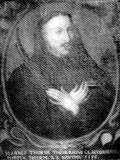
Richard Whiting is seen on the Tapestry holding a rope, indicating the manner of his death.
His brother monks, Roger James and John Thorne, standing beside him, shared the same fate.
It was during the Wars of the Roses, probably A.D.1460 that Richard Whiting was born of a family settled on the Abbey estates near Wrington. His early life was uneventful, but it must have been coloured by the wonderful traditions of the abbey, where his education was begun. After his Ordination at Wells he taught in the abbey School, and among his pupils would have been Richard Bere (nephew of Abbot Bere), later a Carthusian martyr.
Abbot Bere, the last abbot but one, died in 1525. The community, after deciding to give up their right of choosing their future abbot, agreed to request Cardinal Wolsey to make the choice. He nominated Richard Whiting, then chamberlain of the abbey, describing him as “an upright and religious monk, a provident and discreet man, and a priest commendable for his life, virtues and learning”. Abbot Whiting ruled the monastery in peace for nearly ten years, appearing from the State Papers to be a careful overseer of his abbey, and winning the esteem of all for his learning, piety and discreet administration.
Meanwhile, in January 1533, King Henry VIII had gone through a form of civil marriage with Anne Boleyn. In May, Cranmer declared that Henry’s marriage with Catherine had never been a marriage, and pronounced his marriage with Anne good and lawful.
The Act of Succession, passed in 1534, entailed the Crown on the children of Anne Boleyn, and an oath was drawn up to be exacted of every person of lawful age. It was the refusal to take this oath, the preamble of which declared Henry’s marriage with Catherine null from the beginning, which sent Thomas More and Bishop Fisher to the block in 1535.
Thomas Cromwell, a layman, was appointed vicar-general to rule the English Church in the King’s name. In August 1535 Dr. Layton, least scrupulous of Cromwell’s inquisitors, arrived at Glastonbury Abbey, hoping in vain for evidence to justify the end in view. He was annoyed to find everything in order at Glastonbury, and no grounds for calumny. Even so he complained, “there is nothing notable: the brethren be so straight kept that they cannot offend”.
This temporary failure of the Royal Visitors served as a warning to Richard Whiting that his abbey would be “visited” again. He remained quietly at home among his people, ever employed in the duties of his charge, going on as if all were well. He excused himself from attending the Parliament of 1539; he doubtless anticipated what its business would be. He cannot have been astonished when in April a law was passed which not only granted to the King the greater monasteries which he had illegally seized, but also “all which should hereafter happen to be dissolved, suppressed, renounced, relinquished, forfeited, given up or come into the King’s highness”.
One by one the monasteries of Somerset went down until at last Glastonbury was the sole survivor. Then on 19th September 1539 the royal commissioners, Layton, Moyle and Pollard arrived at Glastonbury without warning. The Abbot being at his Grange at Sharpham, they hurried there and carried him back to the Abbey, where they proceeded during the night to ransack his papers and search his apartments. “But we could not,” they write, “find any letter that was material”. And so, “with as fair words as they could, he being but a very weak man and sickly”, they sent him up to London, to the Tower for Cromwell to work his will on him. Within six weeks the royal commission had completed its task. The booty noted in the Lord Privy Seal’s manuscript, “Remembrance”, was listed thus:
Go here to read the rest.


Ghastly deaths and so unjust. Where was “social justice” for the 3? Ha.
Of course, the monks’ reward was the Beatific Vision.
I don’t know why the 40 Holy Martyrs of the British Isles interest and bother me so much. Is it because of my New England father’s totally English line? My ancestors were surely once English Catholics before the Dissolution. Or because as a child I visited Glastonbury Abbey and the ruins of other once magnificent houses of God? Because I wonder what happened to all the manuscripts carefully stored for centuries in those buildings? The gold and silver and jeweled Communion plate, although they once contained the Body and Blood of our Savior, are only things. While the lost illuminated manuscripts are histories of a living Church. As a young adult I attended Vespers at Canterbury Cathedral. It was a beautiful service and after visited Thomas a` Becket’s crypt ( martyred by an earlier English king, Henri II, who too thought he was above Church law.) However the Cathedral made me sad because I thought that holy place should be ours, Roman Catholic.
Here in the US on my father’s side there are Catholic converts, including my father at age 55. and some cradle Catholics in my generation, the grandchildren and great grandchildren. However there are still anti-Catholic feelings among several cousins even though their children converted.
Please excuse my Sunday morning ramblings, it must be the wind and grayness..