Donald R. McClarey
Cradle Catholic. Active in the pro-life movement since 1973. Father of three, one in Heaven, and happily married for 43 years. Small town lawyer and amateur historian. Former president of the board of directors of the local crisis pregnancy center for a decade.
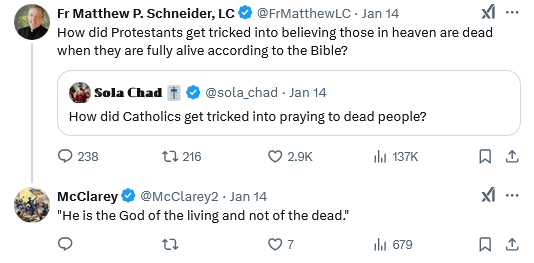



Donald, I have often quoted Luke 20:38, Matthew 22:31-33, and Mark 12:27 to Protestant Evangelicals and Pentecostals when discussing why the Saints are not dead, and sadly, the explanation falls on dead ears every time (pun intended). So opposite Democrat atheists, they are just like them, incapable of any critical thinking. I think these people believe that praying to the saints is idolatry. They cannot understand the difference between prayer (petitioning or asking) and worship (which they don’t have because they got no Eucharist, no Holy Sacrifice of the Mass which is the ultimate worship). So everything in their theology is completely screwed up, whether they are Calvinist or Arminian, cessationist or charismatic, complimentarian or egalitarian, Dispensationalist or amillenialist, etc.
In my interactions on X with this subject, there seem to be three major streams of objections.
The first is this one, where the saints are “dead.” If one then presses them they will *usually* (although not always) disavow soul sleep, but are unable to articulate a coherent way in which the saints are “alive.” They would, presumably, agree with St. James that the prayer of a righteous man is powerful and effective, yet will not allow that to go beyond this vale of tears to have the most righteous saints pray for us.
The second is what I would tongue-in-cheek call the “Bruce Almighty” objection, in which the saints hearing prayers is impossible because they are not omnipresent and cannot hear everyone’s prayers at the same time. A common thing I’ve seen is something like “Mary cannot hear billions of prayers at once since she is not omnipresent.” Since only God is omnipresent, the argument goes, hearing prayers is thus a divine attribute. It’s an odd objection since it seems to envision God’s hearing of prayers almost entirely along the lines of how Bruce Almighty does. Further, it seems to link physical proximity to an individual to the ability to hear their prayers (hence the need for omnipresence), which is also very odd, and completely misunderstands both prayer and what omnipresence actually means.
The third is that Jesus is the only mediator, and thus praying to the saints invalidates this intercession or (given the premises of #2) sets them on an equal level with Jesus. When pressed on how we can then ask other members of the Church Militant to pray for us without invalidating this singular intercession, some version of the first objection will then be raised. I often note that Jesus is said to stand at the right of hand of the Father to intercede for us, and those in heaven have their wills perfectly aligned with Jesus and would thus (presumably) do the same in imitation of their Lord. I also point out that those in the Body of Christ are said to have the “mind of Christ;” even more so the saints in heaven. I’ve found that at this point deflections are generally made to “worship” and “idolatry,” which are also often misunderstood concepts as LCQ noted.
I think a commonality in all three streams is a built-in and probably unconscious nominalism at the root of most forms of Protestant thought, which then leads to a seriously denuded or non-existent conception of what the Body of Christ and thus the Communion of the Saints entails. The “great cloud of witnesses” that St. Paul speaks of in Hebrews 12:1 become just a crowd in the stands, not a “communion.”
Jason has got the situation with Protestants exactly right! Well said!
Nothing to add except to note that LQC and Jason have related the same experience I had for years as an RCIA instructor and amateur apologist. But even when we don’t see results, the seeds we plant can and do grow into conversion for some. So don’t stop!
Addendum: Jason correctly pointed out that a Protestant objection against praying to Mary and the Saints is the fact that only God is omnipresent. But I was thinking about this and came to realize that the Protestant problem is the fact that their theology is stuck in time. You see, space and time are created things subject to the laws of physics in this universe, and after death, the soul or spirit which isn’t subject to such laws (because the soul or spirit isn’t material) goes to where there is neither space nor time. Protestant thinking is always very linear, and Protestants cannot conceive that just as God lives in the eternal now of heaven, so also do those souls or spirits who die in a state of grace. They are outside time and space, so the idea of them having to be omnipresent to hear all our prayers is a non sequitur. We are the ones in time who would need to be omnipresent, not they. Now how this works with the resurrection of the body and all that I do not know. The Bible says that God will create a new Heaven and a new Earth, so I assume that that new creation would be subject to a different set of laws of physics from what governs this universe. For example, the Second Law of Thermodynamics would no longer apply, and time would not have the arrow that it does have in this universe. I have been told by those who are Aquinas scholars that St. Thomas Aquinas had some insight into these matters, but I don’t know. All I am saying is that most Protestants regard time as uncreated in their theology even though they don’t say so. And this error messes them up in everything from the Incarnation to praying to the saints to the Parousia and beyond. Their foundation is false, so all their thinking is false.
LCQ- excellent observation in respect to “space and time.” I’ve had similar experiences in that respect without satisfactory responses beyond the obligatory “but where does the Bible say?”
I would also add that I’ve found what I would call an “atomization” in respect to being a part of the Body of Christ that even continues conceptually into the eschaton. To be fair, this may be more indicative of evangelicalism, which might be pithily summarized in the notion of “me and Jesus.” Under such a conception there is no real, actual bond within the Body of Christ or the Communion of Saints beyond a vague notion of being “saved” or potentially believing the same things.
I have often heard, in respect to the Intercession of the Saints, that they would be too enraptured by the beauty of Heaven to care about what happens on earth. I don’t dispute that they would be enraptured by the beauty of heaven and the Beatific Vision, but that rapture would be wholly predicated on the alignment of the will with our Lord, who does intercede for us in heaven.
I think a lot of the atomization stems from the nominalism of Protestantism’s foundations, and since in this conception there do not exist essences outside of the mind, when filtered through a religious framework it turns into an atomization which reduces everything to the relation of one’s mind or feelings to the object in one’s mind or feelings, and often without well-defined distinctions. This naturally obviates the metaphysical reality of secondary causes, hence the intercession of the saints seeming to them, at best, a superfluous gesture that would violate (in this view) the principle of parsimony. And finally the rejection by at least some threads of Protestantism of actual infused righteousness transforms justification and salvation into a transactional notion, with traditional categories of union and theosis rendered obsolete and (to them) smacking of blasphemy.
Existence plays a role in one of the names of God. God’s relationship with creation plays a part in another of God’s names. I saw a video presentation by a rabbi where he goes through an explanation of the names of God. This was part of a larger presentation on the Exodus and the Ten Plaques of Egypt. The original videos are no longer available, but there is a downloadable PDF online that covers the material:
*
https://staff.ncsy.org/education/education/education/education/material/C8HxYivMlL/exodus-from-egypt:-the-hidden-agenda/
*
The names of God starts on page 6 of the PDF. He says that YHVH in the original language is an amalgam of the three Hebrew words for existence. In the PDF it says that: ‘It describes his essence. The Hebrew words for existence are “Haya”, “Yiheeyeh”, and “Hoveh” Was, Will be, and Is. If you take these words and overlay it with each other, you will get “Yud-Kay- and Vuv-Kay”. We are talking about a simultaneous existence. It is experiencing time in another way we cannot imagine. It exists but not in this world. It exists outside of time, outside of our world, outside of our universe.’
*
The PDF also says: ‘What does “Kel” mean? It means “to” and it also means power. We see this by Lavan when he says “I have it in me to do evil to you”. “Elokim” means judges, we find the weird commandment- not to have other gods in front of you, it means powerful beings, other levels of authority, an example would be the sun itself, as one knows it is very powerful. We also view God’s names as different types of traits. Elokim would signify God as judge, as a power.’
*
Kel-Shakei (El Shaddai) was another name of God that was covered in the PDF that says: ‘What about the other names? Shaki, what does this mean? Any other words in the Hebrew language which seem similar? The Medresh tells us that it is a contraction for a serious of words “She-amer liolamo die”, he said to his world “enough”. What does that mean? Not so sure we do know. There was a development in the world in creation and God said at a point that it was enough’