Donald R. McClarey
Cradle Catholic. Active in the pro-life movement since 1973. Father of three, one in Heaven, and happily married for 43 years. Small town lawyer and amateur historian. Former president of the board of directors of the local crisis pregnancy center for a decade.
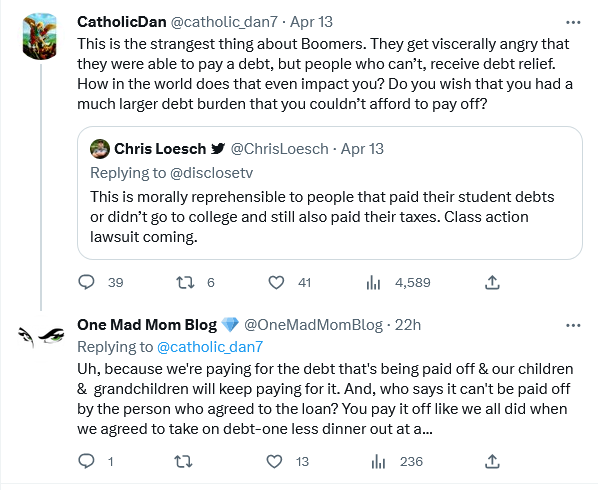



Nothing is stopping rich leftists from helping people pay off student loan debt and/or starting a charity people who wish to help can donate. But this is about forcing their will on others and creating division.
Don’t know much about Catholicity.
Don’t know much Christianity.
But I do know one and one is three,
‘Cuz I learned that in CCD.
What a wonderful wise man is me.
What a freaking a$$. Hey, “CatholicDan,” you don’t get to have MY tax money to pay YOUR self-incurred debt! Frack you and the horse you rode in on.
Happy Tax Day Monday!
Evidently [the receipts are everywhere], boomers’ median IQs are 50 or 60 points higher than succeeding groups.
For one thing Chinese Biden’s handlers deployed the student debt forgiveness scam to buy on my dime 2022 votes.
It would tend to exacerbate already very-high college/university cost inflation and add to the national debt.
According to publicized statistics the national debt is about $31,500,000,000,000, which works out to just under $247,000 per US taxpayer.
The US federal deficit [spent more than tax receipts] for the first six months of FY 2023 was $1,000,000,000,000.
Rewarding bad behavior is garbage policy.
The educational loan industry is more predatory than some loan operations from organized crime groups. Let’s start with dismantling that.
Colleges and universities charge too much for tuition and paying for a dorm room is a ripoff.
It is possible to go to college online. If one lives in a major metropolitan area, a community college is almost always available and so is a main or branch campus of a public university.
I paid for my own tuition with a part time job and lived at home. College was NEVER fun for me. Almost all of my memories and experiences of college are crappy, but I persevered, got my bacherlor’s degree and found a job after having to move almost 400 miles away, but life isn’t easy and that is that.
” but I persevered, got my bacherlor’s degree and found a job .” Now a masters degree will not get you a job. My daughter tells me this is because the universities are grooming cogs in the workforce.
Yeah they don’t get that nothing is “free” and that if they aren’t paying for it then someone else is. My husband had the backend of his HECs debt when we got married. We couldn’t wait to pay it off. That whilst taking on a mortgage. And we aren’t classified as “Boomers” per say.
Also, Millennials need to think twice about the degree they choose to do, because if it’s not going to eventually earn them enough post graduation to put aside to repay back their student loan as they earn, then they shouldn’t be doing the degree. That includes those silly liberal arts degrees which don’t qualify you for anything. Take some accountability.
if it’s not going to eventually earn them enough post graduation to put aside to repay back their student loan as they earn, then they shouldn’t be doing the degree
This disqualifies the majority of degrees, including most STEM degrees (when one factors in how most STEM graduates cannot get a job in a field related to their degree.)
I do put my money where my mouth is. When a younger relative asks me about college I say “you probably shouldn’t go, and if you DO go, make sure to do your first two years at a community college.” But inevitably everyone else tells them that they need to go to college starting from a four university, with some vague advice about getting a “good paying” degree without giving any concrete career path.
The problem has been the ever expanding segment of each birth cohort which tromps through tertiary schooling. About 45% of each cohort today cadges a baccalaureate degree; about 25% did so in 1969; roughly 6% did so in 1928 (or obtained a professional-school degree w/o getting a baccalaureate degree).
In our time, about 2/3 of these degrees are in occupational subjects, about 1/3 in academics and the arts. Some occupational degrees are largely composed of nonsense (teacher-training, social work, library administration). Some academic degrees make you more interesting to an employer for reasons over and above having merely obtained a four-year degree (economics, chemistry, computer and information science &c).
You can see the problems. One is that the incremental effect of a degree on your earning power declines as degrees are more prevalent. The other is that training costs formerly borne by employers are now borne by employees. The costs are manifest in debt.
We would benefit as a society if we restructured primary, secondary, and tertiary schooling. Have youths under 10 sorted into the 85% receiving basic schooling (literacy, numeracy; and the fundamentals of American history, geography and civics) and the 15% receiving remedial schooling adapted to their specific deficits. Sort youths between the ages of 10 and 14 into three categories: those receiving instruction in specific academic subjects, those continuing to be drilled in basic education, and those receiving remedial education. Sort those between the ages of 14 and 18 into three segments: those receiving instruction in specific academic subjects, those receiving vocational-technical instruction, and those receiving remedial schooling and life-skills training. Among youths between the ages of 14 and 18 about 40% of the students would be enrolled in academic courses, about 40% in vocational-technical courses, and about 20% in remedial courses. Your accomplishments would be tracked with regents examinations held at least annually. At age 18, guaranteed public financing of your schooling ends and you receive a book of certificates for the examinations you’ve passed between the ages of 5 and 18. Any further schooling occurs in the tertiary system, where berths are rationed and fees are charged.
You figure about 1/3 of each cohort eschews tertiary schooling. Another 20-25% limits their tertiary schooling to second chance high schools where they can finish uncompleted courses of study or receive vocational training in a new trade. You figure about 30% enter occupational schools which have focused courses of study which can be completed in a calendar year or two academic years and which may or may not require a preparatory certificate in a menu of academic courses. You figure maybe 15 percent enrolls in universities or the equivalent where they receive focused academic instruction and / or training in the fancy professions. The academic instruction could consist of one, two, or three year courses of study in a single subject, with perhaps 4% of each cohort having the full three years.
If the foregoing were in effect, much of the population could avoid the half-assed academic instruction high schools currently offer and we could reduce the length of a bog standard tertiary program from four years to 2 1/2 years.
I do put my money where my mouth is. When a younger relative asks me about college I say “you probably shouldn’t go, and if you DO go, make sure to do your first two years at a community college.” But inevitably everyone else tells them that they need to go to college starting from a four university, with some vague advice about getting a “good paying” degree without giving any concrete career path.
IMO, the community college system is a hash and you can skip it unless it offers a complete credential. It might be worthwhile if you enroll in a four year institution which is generous about allowing you to apply community college credits to your graduation requirements.
This disqualifies the majority of degrees, including most STEM degrees (when one factors in how most STEM graduates cannot get a job in a field related to their degree.)
Academic degrees by definition do not map to particular fields apart from teaching and research. In re occupational degrees, the ratio of extant practitioners to new entrants tends to be about 23-to-1. The young would benefit from much more assiduous vocational counseling than they currently receive. The U.S. Department of Labor has some useful publications on trends in various segments, but no clue how often the young are exposed to these by parents or counselors.
Art- So in summary are you proposing the academic ability of primary/high school students is tracked and consequently they are given an education fit for their academic ability? That way you see where the talent lies and then students are better equipped to be channeled into a degree which suits their academic ability.
They do something similar in The Netherlands. You are categorised by the time you get to high school into classes which fit your academic ability so by the time you pick a university degree, it’s determined who is fit to be a doctor, lawyer or engineer as an example because they have the academic strength to do so. As a result you don’t get doctors changing careers to artist 20 years into their degrees or engineers suddenly wanting to be lawyers 10 years into the workforce, and it’s a red flag for employers. Being “multi-skilled” doesn’t fly with employers. Your trade is your trade for life.
I’m afraid, your solution flies in the face of a current culture which tells kids they “can do what they want and be what they want”. You can’t tell a kid with 2 left feet you aren’t fit to be a professional dancer. Kids are taught to dream big without reality check.
I’m afraid, your solution flies in the face of a current culture which tells kids they “can do what they want and be what they want”. You can’t tell a kid with 2 left feet you aren’t fit to be a professional dancer. Kids are taught to dream big without reality check.
The examinations could sort the young incrementally between the ages of 5 and 14. You’d have about four paces of instruction manifest in the examination questions. Since you always have edge cases, some students move up a pace and some down a pace every year. Some of the students in remedial instruction could be placed in basic education classes, primarily immigrant children in English-immersion classes and students remanded to day detention for behavioral problems who are otherwise roughly normal and capable of controlling themselves on return. High school students (14-18) would need to complete their basic education before they could enroll in vocational technical or specialized academic classes. Students whose performance in primary school was below the 55th percentile would be discouraged but perhaps not debarred from taking enrolling in any academic classes. Students above the 55th percentile would be generally permitted to follow a menu of 3 or 4 course of study of their own choosing between ages 14 and 18, perhaps including a vocational course among them and cross enrolling. The diversified academic program – mathematics and related, history and related, literature, a foreign language, and a set of the natural sciences – would be characteristic only of those students who could handle the rapid pace, and that might be 12% of the student population.
As for tertiary schooling, common-and-garden occupational schools might require a certain number of secondary certificates completed in one or another academic subject or they might not. You have the 2d chance high schools for that. The screen for university-based professional schools might be a preparatory certificate at a tertiary institution which would in turn require some time in a 2d chance high school. There would be necessary bar to changing careers. Usually cost considerations would inhibit it as they inhibit everything else. IMO, it would be socially beneficial of about 1/3 of the students enrolled in tertiary schooling were over the age of 25. In regard to tertiary schooling in academic subjects, as recently as 1969, only about 12% of each cohort was earning a BA degree in an academic subject or the arts; that typically meant a minimum of 42 credit-hours in their major subject. Academic instruction does not map to careers. It’s liberal education. We can IMO provide some of that on the tertiary level but without padding it with a lot of junk as is the mode for undergraduate education in this country. You are willing and able to study history, you spend one, two, or three years taking history courses. (Research degrees would also be available for a few).
It’s an intelligent solution you are proposing because it caters to the child and their academic ability. It benefits the student and evens the pressure on the education system by organically placing children to “fit” where they are best-suited based on their ability.
The current academic solution is a one-size fits all with mainly public schools providing extra classes with those struggling. There is little focus on the 10% who are capable except for “gifted” work (and I don’t think there is a program in schools where I’m from, it’s just extension work as the teacher sees fit). It’s not until they get into their last 2 senior years, when they choose their HSC elective subjects for their final exams, when they begin to taper out into extension or basic subjects. For your solution to work, it’s a matter of institutions getting over a mentality which exists in educational bureaucracy of this one-size-fits-all education for every child. And kids need to see and accept their ability from a young age and be channeled into tertiary course which fit their ability.