
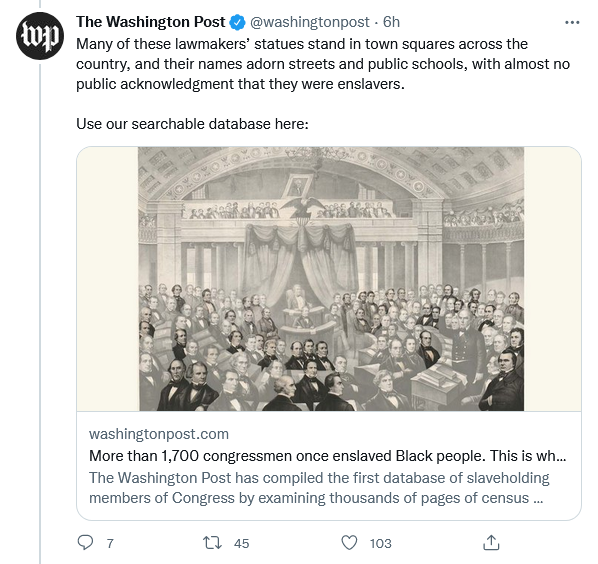
The Washington Post has published a database of 1700 Congress critters who at one point in their lives owned slaves. Next they will be doing a dramatic expose on water being wet and fire being hot. The story is behind a paywall, but one factoid stuck out at me, the claim that 606 slaveholders were Democrats and 481 Republicans. 481 slave holding Republicans? Sure you would have some who had owned slaves before they saw the light, but 481? Since almost all Republican members of Congress came from the non-slaveholding North, I suspect what they have probably done is to lump Jefferson’s Democrat-Republican party in with the anti-slavery Republican party that came into existence in the mid 1850s. If so, this indicates sloppy research or an attempt to make the slaveholding Democrats not seem so bad if almost as many Republicans were slave holders. If anyone can shed light on this, let us know in the comboxes.


They also claimed some years back that the Bureau of Justice Statistics was incapable of counting the number of police killing. Don’t hire okupiers.
It has always seemed ironic to me that we “moderns” are so willing to sit in judgment of people who lived in a different era two hundred years ago when over sixty million preborn babies have been legally slaughtered since 1973. Incidentally, when looking at percent of population, a disproportionate number of those babies have been black.
Poking around for cached copies, the article itself has very little meat. Here’s this:
And this:
Which means that they definitely included people who inherited slaves and either freed them or (when that was illegal, because they were elderly) took care of them.
Oh– just realized, that tactic would also include people who used the well-known tactic of buying slaves in order to free them– which is still commonly in use today.
👍🏻 im too sick and tired to write all the things that could be ssid
Good points well taken previous commentors
Those numbers are quite possible, considering that of the New England States only Vermont and Massachusetts-Maine had early. laws abolishing slavery and were enforced. Enforcement being a key word. Also indentured for life was oftened used interchangeably with enslaved. Pennsylvania was actually the first to abolish slavery.
New Hampshire formally abolished slavery in 1857 also it seems that the last slave had either died or was manumitted ten years before the law was enacted.
Rhode Island first aboltion law enacted in 1652 was superceded by a legalization of slavery in 1703. Newport was the largest slave market in North America.
New Jersey abolished slavery by an amendment to the state constitution in Jan. 23, 1866.
New York 1830 census listed 75 slaves.
Connecticut by the Revolutinary War had the most slaves in New England. Slav es were given their freedom after they reached 25 years according to a law of 1784.
Several states had Gradual Emancipation laws on the books.
Delaware had 2000 slaves in 1860. In 1901 the state assemble ratified the 13th Amendment 36 years after the rest of the nation.
By the Washington Post’s sloppy standards, the Catholic Church could also be accused of centuries of keeping slaves. After all, Orders like the Knights of St. John, the Templars, and especially the Mercedarians bought them— in bulk.
Of course, what those religious were doing was buying Christians who had been enslaved by Muslims, whether in war or by raiding. The slaves were then brought back home, freed.
By the Post’s dubious research standards, however, the Church was up to Her ears in centuries of slave trading…
Those numbers are quite possible, considering that of the New England States only Vermont and Massachusetts-Maine had early. laws abolishing slavery and were enforced. Enforcement being a key word.
No, they aren’t. The slave population of the northern colonies and states was tiny. And, again, the Republican Party was founded in 1854. The number of man-years logged by Republican members in Congress between the party’s foundation and the abolition of slavery in December 1865 was about 1,155. Even if every member served only two years, you’d still have 578 members, so you’re saying the vast majority of Republicans in Congress during those years were drawn from the north’s tiny slaveholder population. Also, a typical member of Congress ca. 1861 would have been a middle aged man, born ca. 1810. The last slave in New York was manumitted in 1827.
While the project is a great idea, I don’t “get” what the overall purpose of it is.
Puts on librarian’s cap
For blog readers in the metro DC area, you can register for a free 7 day digital pass from the “Washington Post” through your local public library system. Check if it’s among your library’s e-resources offerings. (Note: If you’re using a public computer and looking at the newspaper listings on the library’s website, you’ll be directed to the Post website from there)
Holding my breath_for the Post’s articles on, and comprehensive lists of 1. Pedophiles in Congress, Senate, Presidency, and Supreme Court, and political icons, activists, leaders; 2. Pederasts in Congress, etc; 3. Adulterers, Congress etc.; 4. Statutory rapists, Congress, etc.; 5. Philanderers, Congress, etc.; 6. Rapists [of all persuasions and inclinations], Congress, etc. Guy, Texas
If the Washington Post was anything but a promoter and purveyor of the lies of the Devil, they would post the millions upon millions of both white and black slaveholders as slavery was as normal as breathing for all of recorded history until the moral principles of Christianity finally got through to the masses and rulers and was the real cause of the end of slavery.
We know they will never tell this truth so who cares what they say?
Which Republican Party is the Post article referencing?
The National Republican Party, also known as the Anti-Jacksonian Party or simply Republicans, was a political party in the United States that evolved from a faction of the Democratic-Republican Party that supported John Quincy Adams in the 1824 presidential election. The National Republican Party was dissolved in 1834.
The Democratic-Republican Party, also referred to as the Jeffersonian Republican Party and known at the time under various other names,[a] was an American political party founded by Thomas Jefferson and James Madison in the early 1790s that championed republicanism, agrarianism, political equality, and expansionism. The party became increasingly dominant after the 1800 elections as the opposing Federalist Party collapsed. The Democratic-Republicans later splintered during the 1824 presidential election. The majority faction of the Democratic-Republicans eventually coalesced into the modern Democratic Party, while the minority faction ultimately formed the core of what became the Whig Party.
Which Republican Party is the Post article referencing?
Jefferson’s outfit was the Republican Party, which fell apart into regional factions in 1824. The terms ‘Democratic-Republican’ and ‘National Republican’ emerged in 1828 as monikers for factions which emerged. The terms were only in use for a half-dozen years or so. Many history books anachronistically refer to Jefferson’s outfit as ‘Democratic-Republican’ to distinguish it from the 1854 foundation. This generates confusion.