
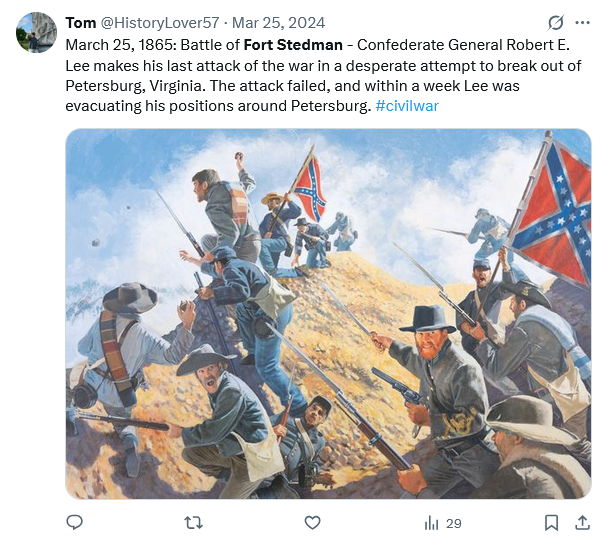
Few generals in American history have been as aggressive as Robert E. Lee. Faced with a hopeless military situation in March of 1865, he decided that he had no alternative but to launch an attack. His starving army was down to 50,000 men, and with the lines around Petersburg and Richmond so extensive, when Grant began to move with an army nearly three times the size of Lee’s it did not take a military genius to realize that he would break Lee’s lines. However, if Lee could break Grant’s lines first, it might buy Lee time. Grant would perhaps consolidate his lines around the breakthrough and delay his Spring offensive. That might give General Joseph E. Johnston sufficient time to march up ahead of Sherman from North Carolina and link up with Lee. At that time Lee could attempt to defeat Sherman and then Grant seriatim. The plan relied far too much on hopes and wishes, but other than surrender, it was the best of the bleak options facing Lee.
Lee ordered General John B. Gordon, commander of the II Corps, to examine the center of the Union lines and to determine if the lines could be breached by a sudden Confederate attack. Gordon determined that Fort Stedman on the Union lines could be taken, and he recalled in his 1903 memoirs how he came to his decision to attack Fort Stedman.
The decision as to the most vulnerable point for attack involved two additional questions of vital importance. The first was: From what point on my own intrenchments could my assault-
ing column rush forth on its desperate night sally, with the least probability of arousing the sleeping foe? The second was : How many intervening ditches were there, and of what width and depth, over which my men were to leap or into which they might fall in the perilous passage? All these points considered, I decided that Fort Stedman on Grant’s lines was the most inviting
point for attack and Colquitt’s Salient on Lee’s lines the proper place from which to sally. This point in our lines took its name from my lifelong friend, General Alfred Holt Colquitt of Georgia, whose memory will live in Southern hearts, as fresh and green as the fadeless verdure of the pines which now grow upon the salient’s embankment, striking their roots deep into the earth
which was reddened by the blood of his stalwart Georgians. These men stood and fought and suffered there, commanded by this superb officer, who won by his brilliant victory in Florida the proud title, ” Hero of Olustee.” General Colquitt lived long after the war closed, giving conservative counsel to his people, recognized as the friend of both races, and serving with distinction as governor of his State and as United States senator. He died at his post of duty in Washington in 1893.
The plan of the attack on Fort Stedman was fully developed in my own mind; and whether it was good or bad, the responsibility for it was upon me, not because there was any indisposition on General Lee’s part to make a plan of his own and order its execution, but because he had called me from the extreme right to his centre at Petersburg for this purpose. With him was
the final decision — approval or rejection.
A supply depot was supposedly located behind Fort Stedman, and if it could be taken havoc could be wreaked with Union logistics. Lee reluctantly gave his approval for the attack on the evening of March 23. The attack was scheduled to begin in the early morning hours of March 25.
On March 25, 1865, the Army of Northern Virginia embarked on its last offensive. Here is the account of John B. Gordon, who commanded the assault on Fort Stedman:
My troops stood in close column, ready for the hazardous rush upon Fort Stedman. While the fraternal dialogue in reference to drawing rations from the cornfield was progressing between the Union picket and the resourceful private at my side, the last of the obstructions in my front were removed, and I ordered the private to fire the signal for the assault. He pointed his rifle upward, with his finger on the trigger, but hesitated. His conscience seemed to get hold of him. He was going into the fearful charge, and he evidently did not feel disposed to go into eternity with the lie on his lips, although it might be a permissible war lie, by which he had thrown the Union picket off his guard. He evidently felt that it was hardly fair to take advantage of the generosity and soldierly sympathy of his foe, who had so magnanimously assured him that he would not be shot while drawing his rations from the little field of corn. His hesitation surprised me, and I again ordered :
“Fire your gun, sir.” He at once called to his kind- hearted foe and said : ” Hello, Yank ! Wake up ; we are going to shell the woods. Look out; we are coming.” And with this effort to satisfy his conscience and even up accounts with the Yankee picket, he fired the shot and rushed forward in the darkness.
As the solitary signal shot rang out in the stillness, my alert pickets, who had crept close to the Union sentinels, sprang like sinewy Ajaxes upon them and prevented the discharge of a single alarm shot. Had these faithful Union sentinels been permitted to fire alarm guns, my dense columns, while rushing upon the fort, would have been torn into fragments by the heavy guns. Simultaneously with the seizing and silencing of the Federal sentinels, my stalwart axemen leaped over our breastworks, closely followed by the selected 300 and the packed column of infantry. Although it required but a few minutes to reach the Union works, those minutes were to me like hours of suspense and breathless anxiety ; but soon was heard the thud of the heavy axes as my brave fellows slashed down the Federal obstructions. The next moment the infantry sprang upon the Union breastworks and into the fort, overpowering the gunners before their destructive charges could be emptied into the mass of Confederates. They turned this captured artillery upon the flanking lines on each side of the fort, clearing the Union breastworks of their defenders for some distance in both directions. Up to this point, the success had exceeded my most sanguine expectations. We had taken Fort Stedman and a long line of breastworks on either side. We had captured nine heavy cannon, eleven mortars, nearly 1000 prisoners, including General McLaughlin, with the loss of less than half a dozen men. One of these fell upon the works, pierced through the body by a Federal bayonet, one of the few men thus killed in the four years of war. I was in the fort myself, and relieved General McLaughlin by assuming command of Fort Stedman.
***************************
Daylight was coming. Through the failure of the three guides, we had failed to occupy the three forts in the rear, and they were now filled with Federals. Our wretched railroad trains had broken down, and the troops who were coming to my aid did not reach me. The full light of the morning revealed the gathering forces of Grant and the great preponderance of his numbers. It was impossible for me to make further headway with my isolated corps, and General Lee directed me to withdraw. This was not easily accomplished. Foiled by the failure of the guides, deprived of the great bodies of infantry which Lee ordered to my support, I had necessarily stretched out my corps to occupy the intrenchments which we had captured. The other troops were expected to arrive and join in the general advance. The breaking down of the trains and the non-arrival of these heavy supports left me to battle alone with Grant’s gathering and overwhelming forces, and at the same time to draw in my own lines toward Fort Stedman. A consuming fire on both flanks and front during this withdrawal caused a heavy loss to my command.
Confederate losses in this fiasco were around 4,000 as opposed to 1,000 Union. The attack made so little impression on the Union high command that Lincoln referred to it as a “little rumpus”.
The next day General Lee wrote to Davis indicating that with the defeat at Fort Stedman it was inevitable that his army would have to withdraw from the Richmond and Petersburg lines
My dispatch of yesterday [March 25, 1865] to the Secretary of War will have informed you of the attack made upon a portion of the enemy’s lines around Petersburg, and the result which attended it. I have been unwilling to hazard any portion of the troops in an assault upon fortified positions, preferring to reserve their strength for the struggle which must soon commence, but I was induced to assume the offensive from the belief that the point assailed could be carried without much loss, and the hope that by the seizure of the redoubts in the rear of the enemy’s main line, I could sweep along his entrenchments to the south, so that if I could not cause their abandonment, Genl Grant would at least be obliged so to curtail his lines, that upon the approach of Gen Sherman, I might be able to hold our position with a portion of the troops, and with a select body unite with Gen Johnston and give him battle. If successful, I would then be able to return to my position, and if unsuccessful I should be in no worse condition, as I should be compelled to withdraw from James River if I quietly awaited his approach. But although the assault upon the fortified works at Hair’s Hill was bravely accomplished, the redoubts commanding the line of entrenchments were found enclosed and strongly manned, so that an attempt to carry them must have been attended with great hazard, and even if accomplished, would have caused a great sacrifice of life in the presence of the large reserves which the enemy was hurrying into position I therefore determined to withdraw the troops, and it was in retiring that they suffered the greatest loss the extent of which has not yet been reported. I fear now it will be impossible to prevent a junction between Grant and Sherman, nor do I deem it prudent that this army should maintain its position until the latter shall approach too near…
If Gen Grant wishes to unite Sherman with him without a battle, the latter after crossing the Roanoke has only to take an easterly direction towards Sussex, while the former moving two days march towards Weldon, provided I moved out to intercept Sherman, would render it impossible for me to strike him without fighting both armies.
I have thought it proper to make the above statement to your Excellency of the condition of affairs, knowing that you will do whatever may be in your power to give relief.


On to Five Forks, and then the end.
Excellent summation of the final campaign. A review of the previous four years leads to the question of whether the Confederacy would have had more success by going into a completely defensive posture. Such a position would have at least partially offset Union superiority in numbers and material as the general rule of offensive requires superiority by a factor of two or three to be successful. Sun Tzu always favored stealth and cunning by the attacker when it did not have superiority in numbers. Lee did have the sense to know when it was time to go to Appomattox.