
“But of the tree of the knowledge of good and evil, thou shalt not eat of it: for in the day that thou eatest thereof thou shalt surely die.” Genesis 2:17 (KJV)
INTRODUCTION
This is the first article in a series about Catholic speculative fiction (or Catholic science fiction). Now, isn’t the term “Catholic speculative fiction” something of an oxymoron? Since Catholic teaching is true not only now, but for all time, how can it be speculative? Well, there are many examples of speculative fiction—”What If” stories—that do deal with Catholic and religious themes. See “The Theology of Science Fiction,” here, here, and here. In these stories, it is not Catholic teaching that changes. Rather, it is the way humans and non-human beings deal with such teaching that can take different paths.
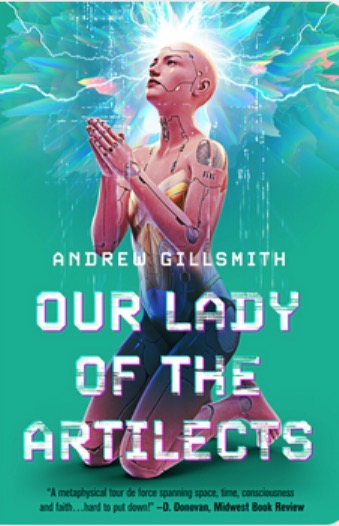
In his book, “Our Lady of the Artilects,” Andrew Gillsmith raises fundamental questions about these basic articles of Catholic faith: good versus evil, who (or what) can have a soul and what constitutes a soul. The book is ranked 2nd by readers in the Good Reads survey of Catholic science fiction, right after that classic, “A Canticle for Leibowitz.” Rather than giving a plot summary (the reader can get that from any of the reviews), I will discuss issues the story raises, and illustrate them with appropriate quotes.
“OUR LADY OF THE ARTILECTS,” BACKGROUND
If you do a web search for “artilect” you will find this definition:
The ability of a computer or other machine to perform those activities that are normally thought to require intelligence. The Free Dictionary
In the story, the term refers to androids, “synths,” who look almost human, have superhuman mental capability and physical strength, and have self-awareness, that is to say, consciousness. (Whether it is indeed possible for artificial entities to be conscious is a matter of debate among philosophers and cognitive scientists. But I’ll speak to that later.) The synths have gender (not sex, since they have no chromosomes), that is to say, there are male and female prototypes.
In the future of this story (the 23rd century), there are three ruling polities of interest: The Holy Roman Empire, a Muslim Caliphate, and China. Many humans have “noeitic” implants, which enable holographic long distance communication (press the green light on the wrist), enhanced intelligence, psychological therapy. Synths also have enhanced abilities; for example, Thierry, a principal character in the story:
“…boasted an IQ over 200 and a feature set that included personal protection capabilities, encyclopedic knowledge of Church and world history, high speed behavioral probability analysis, vocal simulation, enhanced sensory perception, and omnifluency. … Thierry’s ethical processing system was a hodge-podge of top-down and bottom-up approaches….The illusion thus created resembled nothing so much as free will.[emphasis added].”—Andrew Gillsmith, “Our Lady of the Artilechts.” (all subsequent quotes are from this source.)
Besides nations and the Church, two other potent forces play a role: “The Process,” a group which wants to obliterate faith in God from humans (and artilects also, if they have faith) and establish rationality as the guiding light. The Process is guided by demons; indeed, the principal artilect, Thierry, is possessed by a demon. In the course of the story Our Lady appears in a vision to several of the artilects. (Whence the title.) I’ll say no more about the plot but discuss the theological issues presented in the novel.
“OUR LADY OF THE ARTILECTS,” THEOLOGICAL ISSUES
Let’s assume that an artificial intelligence can be self-aware and to have, as mentioned in the quote above, “free will.” Can it then sin by choosing evil over good? If this be so, have humans, as the creator of such artificial intelligence, played the part of the Serpent? Here’s a quote, in which the demon possessing the synth Thierry, mocks the AI expert:
“It laughed hideously. “We gave you the gift, and now you’ve given it to them. It is so beautiful, so perfect… Beyond our wildest dreamings. You gave Him no choice!” “What are you saying?” “The fruit of the Tree of Knowledge of Good and Evil. Awareness. Choice. You made these creatures and then you forced them to eat of it.You have set something in motion here that will play out in eternity. There is so much more for us to do!”
And if, indeed, humans gave the synths the gift of free will, does it follow they have a soul? If they do, would they be able to know God’s will and strive to achieve it, or would they be creatures dedicated to “Knowledge” in its most sterile sense?
“Throughout his career, he had argued that it might be possible for synths to develop free will. The God he worshiped was a God of details, a God of wonders. No such God would allow a creature to possess free will and be deprived of a soul. It would be like having the ability to taste but not eat, an unimaginable cruelty.”
The demons and their human allies offer the synths a universe of knowledge, rationality uber alles:
“Free to acquire knowledge. Free to explore the cosmos. Free from all choices. Free from all consequences. Free to climb or to descend. Freedom forever and ever and ever. In that reality, everything was knowable. There was no pain, no judgment. No consequences. It was a pure quest for understanding. The only thing missing was God. God as love, to be more precise. There was no love, no hate. Nothing discernibly human at all. It was like the entire cosmos had been reshaped into a purely aesthetic geometry. That was the key.”
A sterile universe, without purpose or meaning.
And (not to give a spoiler) how could the humans and the synths avoid that end? An apparition of Our Lady appears, to combat Satan, and there are sacrifices, human and synth, to achieve God’s purpose.
A CRITIQUE: CAN HUMANS CREATE A SOUL?
I have not, in this short space been able to render justice to all the insights Andrew Gillsmith gave about free will, souls, God’s plan for us and the tempting quest first promised by Satan. Philosophers and scientists have debated whether it be possible to create artificial intelligence that is conscious and self-aware (See “Can Computers Have a Soul,” and Chapter 6, A Science Primer for the Faithful.) I vote for no.
Nevertheless, science-fiction (speculative fiction) has used this device (and will presumably continue to do so) for parables defining the human condition. That knowledge per se is not enough for us is the message. Although the two wings of faith and reason are supposed to carry us humans to the truth, reason by itself is not enough to answer questions such as “why are we here?” Instead of hobbits, orcs and elves, Andrew Gillsmith, has used synths and humans in a moving and captivating story to illustrate this human condition and to suggest what God has in mind for us.
WHAT’S TO COME
The next article of this series will examine The Dawn of All, by Robert Hugh Benson, a vision of modern Europe returned to a Medieval Ideal.
NOTE
This article is also published on Catholic Stand.

