
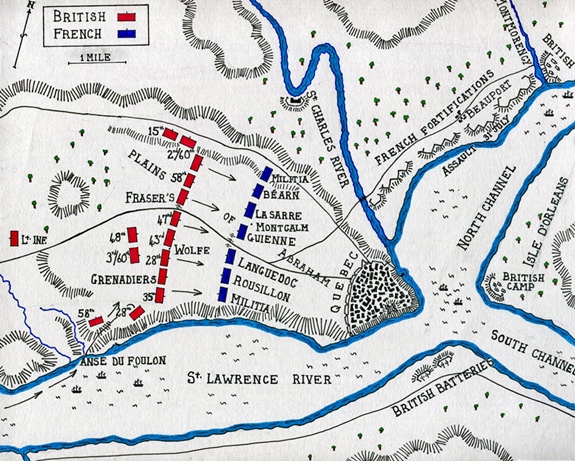
The Death of General Wolfe by Benjamin West is a painting which has always fascinated me. Wolfe’s victory at the Plains of Abraham in 1759 sealed the doom of New France and also the doom ultimately of British rule in the 13 colonies. Freed from the menace of their ancestral enemy, the colonists were also free to rethink the ties that bound them to the British crown. West’s painting captures a pivotal moment in American history. Not only is Wolfe dying, but an old order in America, not only for France but also for Great Britain, is mortally stricken. American independence would have appalled James Wolfe, who had little love for Americans, but it is given to none of us to know the impact of our lives after our deaths. Wolfe of course had a death of legend, as the great historian of the struggle between New France and the British, Francis Parkman details:
They asked him [Wolfe] if he would have a surgeon; but he shook his head, and answered that all was over with him. His eyes closed with the torpor of approaching death, and those around sustained his fainting form. Yet they could not withhold their gaze from the wild turmoil before them, and the charging ranks of their companions rushing through the line of fire and smoke.
“See how they run.” one of the officers exclaimed, as the French fled in confusion before the leveled bayonets.
“Who run?” demanded Wolfe, opening his eyes like a man aroused from sleep.
“The enemy, sir,” was the reply; “they give way everywhere.”
“Then,” said the dying general, “tell Colonel River, to cut off their retreat from the bridge. Now, God be praised, I die contented,” he murmured; and, turning on his side, he calmly breathed his last breath.


I was always rather taken with the story of Wolfe discussing Gray’s Elegy, then recently published during the nigh advance on the Heights of Abraham.
Typical of the English at that time….find someone else’s colony and harass it or invade it and take it.
IIRC, Quebec was permitted to remain Catholic while it was illegal to be Catholic in the rest of His Majesty’s empire. The book 1775, which my wife bought for a dollar, pointed out that almost all of Europe was antagonized by Great Britain at the time. Thus, there was no shortage of potential American allies, and their religious differences mattered not.
If New England were not permeated with virulent anti Catholics at the time, Quebec might have well joined the Revolution.
Stupid American anti Catholicism gave rise to the San Patricios, the Irish Americans who switched sides in the Mexican American War, but that is a subject for another time.
“Typical of the English at that time….find someone else’s colony and harass it or invade it and take it.”
The English and the French had been fighting to be dominant in North America for more than 75 years before the battle of Quebec. France was an aggressive power, hence the fact that Great Britain never lacked for European allies to lead against France. After France was taken down a notch after the French and Indian War, public opinion in Europe turned against Britain. The pendulum swung back with the French Revolution.
“If New England were not permeated with virulent anti Catholics at the time, Quebec might have well joined the Revolution.”
I doubt it. Most of the French Canadiens simply wanted to be left alone and did remarkably little fighting for either side. The French alliance, as did the American Revolution as a whole, helped to diminish anti-Catholicism in the colonies. George Washington, as he did in so many spheres for his countrymen, led the way in regard to religious tolerance, attending religious services at all Christian denominations during the conflict, including attending Mass.
In regard to the San Patricios, it was money and beauty that largely explained their fighting for Mexico. Religion played a small role for that largely mercenary band.
https://www.youtube.com/watch?v=xSd1FH-KT3w
He had been given a copy of Gray’s Elegy by his fiancée. Reciting lines from it prior to the battle he told his officers he would have rather written those lines than take Quebec:
The boast of heraldry, the pomp of pow’r,
And all that beauty, all that wealth e’er gave,
Awaits alike th’ inevitable hour:
The paths of glory lead but to the grave.
San Patricios– money, sure, plus the fact the WASP officer corps treated the Irish like shit, a good summary here:
https://youtu.be/W7Ldi7cCzHU
The Army was a hard life for every one in the 19th century. Most West Pointers left the Army after their initial service obligation was fulfilled, and the Army always had a high desertion rate among the enlisted. The mainstay of the Army were the non-coms and many of them were Irish.
Most of the San Patricios were not Irish, although most of them were deserters from the US Army and most were Catholics.
Donald R McClarey quoted
“The boast of heraldry, the pomp of pow’r,
And all that beauty, all that wealth e’er gave,
Awaits alike th’ inevitable hour:
The paths of glory lead but to the grave.
Bravo!
Here is another unsolicited book recommendation: Northern Armageddon – The Battle of the Plains of Abraham by D. Peter MacLeod. It is a full account of the battle/campaign (total war; it would have made Hitler smile) and a good read.
The plurality, likely at least 40% of the San Patricios were Irish; there were also assorted Poles, Germans, and others, but the majority of the group was certainly Catholic.
And rather than give you simply my opinion I’ll let Penn State history prof Amy Greenberg, author of a book on the war I’m reading explain:
Another historian and expert in Irish immigration at U Missouri claims: “The San Patricios were alienated both from American society as well as the US Army. They realized that the army was not fighting a war of liberty, but one of conquest against fellow Catholics such as themselves.”
When these brave men were finally defeated in what US Grant called “a wicked war,” a war Lincoln (who some on this blog hold in very high regard!) thought to be unnecessary and wrong, Colonel William Selby Harney infamously punished thirty captured San Patricios by timing their hanging (including that of Francis O’Connor, who had lost both legs to cannon fire and had to be propped up on the gallows) to coincide with the raising of the American flag over Chapultepec castle following its reduction.
So yes, while, as with all men in all times, mixed motives were present, it does not detract from the essential facts that the US Army was an unfriendly place for new Catholic immigrants in the 1840s in a time when know-nothingism was rampant, especially among the Northeastern WASP establishment that peopled a greater part of the officer corps, and that many of these immigrants who joined up didn’t feel either strongly attached to the US or morally bound to participate in an unjust war against a manifestly innocent, Catholic Mexico.
Oh I don’t deny that anti-Catholicism was rife in America in the 1840s and I have written about it. I simply think there were other factors that were far more important to the recruitment of the San Patricios than concern for religion. In regard to the execution of some of the San Patricios, these were the ones that deserted to the Mexican Army during time of War. They paid a just penalty for their treason. San Patricios who deserted prior to the War received the usual punishment for desertion: 50 lashes, branding with the letter D and imprisonment until the end of the War. All of this was quite in accord with the standards for military justice at the time world wide. When you decide to desert one army to fight for its adversary, you are taking a big roll of the dice, and the 85 San Patricios, fifty of whom were executed, had the dice turn up poorly for them.
Ah, treason, which according to a certain wag who was instrumental in founding our nation, “is a charge invented by winners as an excuse for hanging the losers.” I can imagine circumstances under which fighting for one’s country would be immoral enough to justify committing what would then become the mere legal infraction of “treason.”
Interesting facts: the US violated its own military justice code by hanging the men; death by firing squad was the legal method for the offense of desertion during time of war. The killing of the San Patricios was the largest mass execution in US history, followed by the mass execution a few years later of another unfavored group, the killing of 38 Sioux by order of Lincoln following the Dakota uprising of 1862. While there were over 9,000 desertions during the war, only the San Patricios were punished by hanging.
“Ah, treason, which according to a certain wag who was instrumental in founding our nation, “is a charge invented by winners as an excuse for hanging the losers.””
Ben Franklin never said that Tom, although the Ben Franklin character in the play 1776 did.
“I can imagine circumstances under which fighting for one’s country would be immoral enough to justify committing what would then become the mere legal infraction of “treason.””
Treason is defined in the Constitution Tom as waging war against the US and that is precisely what the members of the San Patricios did.
“the US violated its own military justice code by hanging the men; death by firing squad was the legal method for the offense of desertion during time of war.”
They weren’t mere deserters Tom. They joined the enemy and fought against their comrades, betraying the oath they voluntarily took when they joined the Army. They did not deserve the honorable death by firing squad, but rather
had earned the death of criminals.
“the killing of 38 Sioux by order of Lincoln following the Dakota uprising of 1862.”
After Lincoln commuted the death sentences of 262 other Indians even though he knew, as was the case, that his Republican party would suffer at the polls in Minnesota, which the party did. The Indians executed were not slain as a result of being part of an unfavored group but as a result of committing crimes such as murder and rape.
“While there were over 9,000 desertions during the war, only the San Patricios were punished by hanging.”
Only they joined the enemy to fight against the Stars and Stripes. As previously noted, San Patricios who deserted prior to the War were punished as deserters: branded with a D, 50 lashes and imprisonment until the end of the War.
Listen to Ian and Sylvia sing “Brave Wolfe,” depicting this battle and his death. A poerful song.
Close to the Minnesota River bridge that connected Mankato and N. Mankato was an historical marker that noted the site of the 39 Indians that were hung. That marker is no where to be found these days. Some of my ancestors were in New Ulm when the Lakotas came over the stockade twice. At one point my widowed great great grandfather with his family returned to PA for a few years until it was safe to return to Minnesota. Yet my grandparents, parents and families from Sts Peter and Paul’s Church in Mankato donated to the Lakota missions, especially St. Joseph Indian School in S. Dakota