Donald R. McClarey
Cradle Catholic. Active in the pro-life movement since 1973. Father of three, one in Heaven, and happily married for 43 years. Small town lawyer and amateur historian. Former president of the board of directors of the local crisis pregnancy center for a decade.
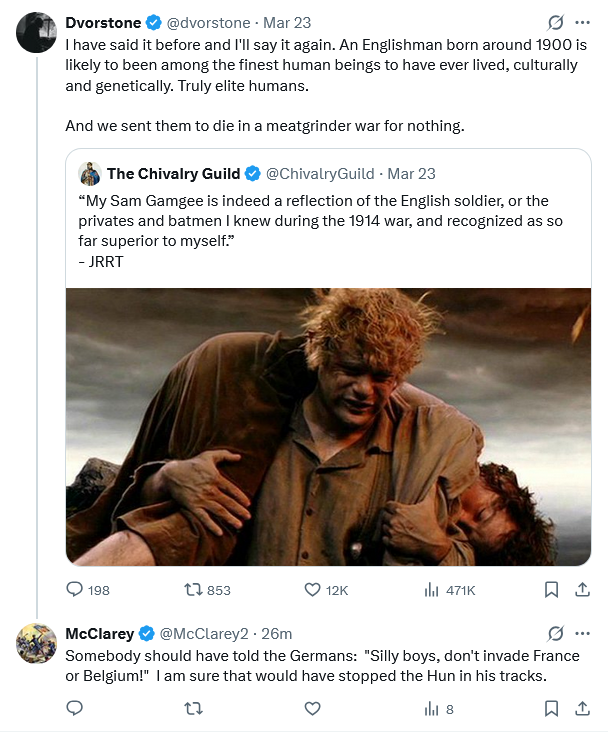



“Why are we English no longer the finest most elite on the planet?”
-mind searches for answers and recoils with horror from the present reality of their country putting Christians in jail for praying and allowing the systematic rape of thousands of their young women…
“Because we sent our best to die in a meat grinder for nothing in 1914.”
-distant past irreality is easier for the mind to hide behind.
Note Dvorstone’s criteria for elite humans – cultural and genetic.
No mention of spiritual.
Why? Because that decline was already well underway by that time. The French had had their godless Revolution. Darwin, Marx, and Malthus had already appeared, and been revered. Secular humanism had entered its current stage of secular hubris.
We forget that Germany was a cultural leader in Europe throughout the 19th and early 20th century: art, music, philosophy, science, new endeavors like cinema and psychology. Universities like Heidelberg and Humboldt produced Nobel Prize winners hand over fist. I read a stat that more Germans than Frenchmen had college degrees at the start of WWI.
(Pop culture note: how many movies (even B-movies and comedies) into the 1950s featured a scientist or doctor with a German or Germanic name?)
Yet Germany was the intellectual home of both extreme nationalism and totalitarian ideas like Marxism and Nazism. As I’ve posted: these things came from the academy (now giving us DEI), they didn’t crawl from some gutter.
Yet Germany was the intellectual home of both extreme nationalism and totalitarian ideas like Marxism and Nazism.
==
Germany was hit with a severe set of stressors during the period running from 1914-1932.
==
Prior to 1914, public support for volkisch parties bounced around 2% of the vote. During most of Weimar, they bounced around 3%, though you could argue that volkisch sentiment accounted for part of the National People’s Party’s base. The Communist Party had a notable base during Weimar (12%). The thing is, France and Czechoslovakia had vigorous Communist parties as well during the inter-war period (commanding 9% and 10%). By the end of the inter-war period, Hungary, Roumania, and Finland had developed volkisch-type parties which were stronger than their German counterparts had been prior to 1930.