Donald R. McClarey
Cradle Catholic. Active in the pro-life movement since 1973. Father of three, one in Heaven, and happily married for 43 years. Small town lawyer and amateur historian. Former president of the board of directors of the local crisis pregnancy center for a decade.
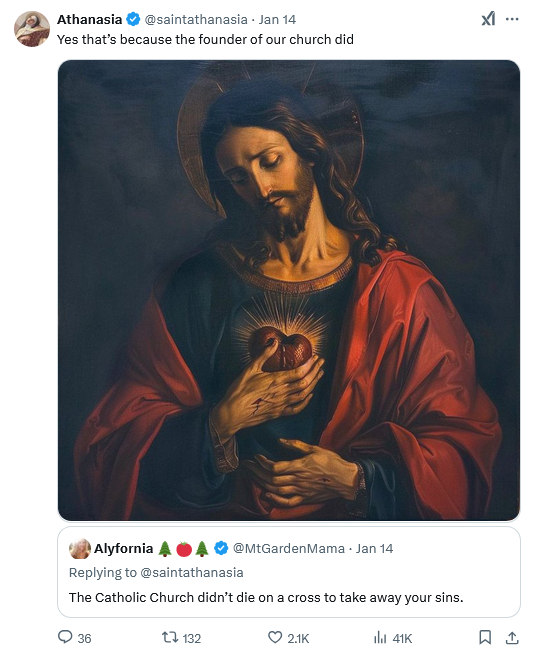



This is why Protestant theology’s utterly denuded conception of the Church as the Body of Christ leads to so many conceptual errors further downstream. They ultimately do not have a clear or coherent understanding of what the Body of Christ is or what it means to be incorporated into His mystical Body, which derives (in respect to continental Protestantism and its children) from the transactional conception of imputation, itself predicated on a prepositional nomainlism.
Of course the Church didn’t die on the cross to take away our sins, but St Paul specifically says that Christ delivered Himself up “for it,” which means His sacrificial death was for the Church, His union to which St Paul uses as a metaphor for the union of husband and wife. St Paul also says that the Church shares in His sufferings, which he makes a corollary to sharing in His glory. There is thus a deep connection between Christ’s suffering and His Church since the latter is His mystical Body, so much so that St Paul speaks of how he bears the marks of Christ’s wounds in his body. In his case it might also mean he was so united to Christ’s sufferings so as to have the stigmata. At any rate, it is because of this deep union in the sufferings of Christ that he can state that he makes up what is lacking in Christ’s suffering for the sake of the Church.
In my experience as a former Protestant, at least of the evangelical variety, I found there was no conceptual categories for these things, precisely because there is no coherent notion of the Church as the Body of Christ. The end result is to make the Church practically optional, even though Christ gave up His life for her sake, which evangelical theology tends to reduce to meaning each individual person standing atomized from every other believer, perhaps united by a fuzzy “mere Christianity” but certainly not part of a Body.