
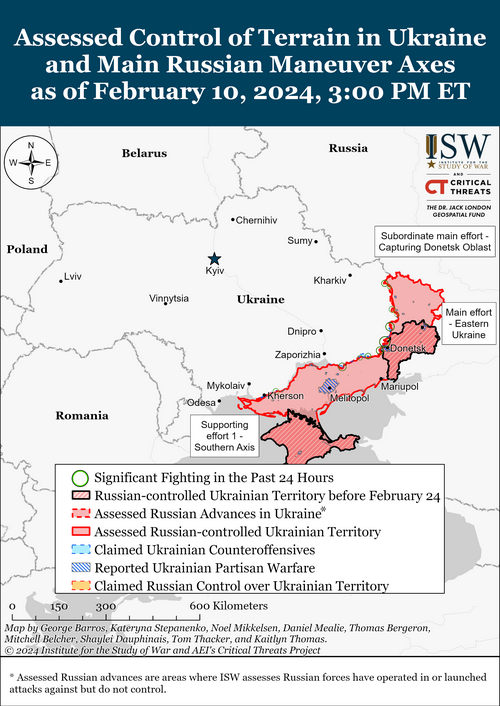
From The Institute for the Study of War:
Russian Offensive Campaign Assessment, February 10, 2024
Christina Harward, Angelica Evans, Grace Mappes, Riley Bailey, and Fredrick W. Kagan
February 10, 2024, 6:10pm ET
Click here to see ISW’s interactive map of the Russian invasion of Ukraine. This map is updated daily alongside the static maps present in this report.
Click here to see ISW’s 3D control of terrain topographic map of Ukraine. Use of a computer (not a mobile device) is strongly recommended for using this data-heavy tool.
Click here to access ISW’s archive of interactive time-lapse maps of the Russian invasion of Ukraine. These maps complement the static control-of-terrain map that ISW produces daily by showing a dynamic frontline. ISW will update this time-lapse map archive monthly.
Note: The data cut-off for this product was 1:15pm ET on February 10 ISW will cover subsequent reports in the February 11 Russian Offensive Campaign Assessment.
Delays in Western security assistance may lead to significant Ukrainian air defense missile shortages that could allow Russian forces to bomb Ukrainian forces or even front-line cities more aggressively. The New York Times reported on February 9 that American officials assess that Ukrainian air defense missile stocks will run out in March 2024 without further replenishment by Western security assistance.[1] Ukrainian officials have recently warned that Ukraine is facing a “critical shortage” of air defense missiles as delays in Western aid continue to force Ukraine to husband materiel.[2] Russian forces have routinely pressured Ukraine’s limited air defense umbrella through missile and drone strikes integrating Iranian and North Korean weapons with Russian systems against rear Ukrainian areas in an effort to force Ukrainian forces to expend air defense missiles and to draw and fix Ukrainian air defense systems away from the frontline.[3] Ukrainian forces previously shot down tactical Russian aircraft in Kherson Oblast in December 2023, which had a temporary chilling effect on Russian aviation support for Russian ground operations throughout the theater.[4] Ukrainian forces also shot down a Russian A-50 long-range radar detection aircraft on January 14 which similarly led to a temporary decrease in Russian aviation operations over the Sea of Azov.[5] The intensification of the Russian strike campaign in recent weeks likely further pressured Ukraine’s air defense umbrella and may have forced Ukraine to redeploy air defenses that were previously able to place constraints on Russian tactical aviation operating along the front and in the Russian rear.
Russian aviation reportedly intensified operations supporting Russian offensive operations in eastern Ukraine in January 2024, particularly near Avdiivka, suggesting that limited Ukrainian air defense missile stocks may be giving Russian aviation more opportunities to attack.[6] Critical Ukrainian shortages of air defense missiles could permit Russian forces to operate aircraft, especially manned aircraft that generally carry heavier payloads, closer to and beyond the current frontline in Ukraine at scale. The Russian military has yet to conduct consistent large-scale aviation operations supporting Russian ground offensives in Ukraine, and the intensification of Russian aviation operations at scale would represent a significant threat to Ukraine.
Ukrainian President Volodymyr Zelensky appointed Major General Anatoliy Barhylevych as Chief of the Ukrainian General Staff, replacing Lieutenant General Serhiy Shaptala.[7] Zelensky noted on February 10 that Ukrainian Commander-in-Chief Colonel General Oleksandr Syrskyi recommended Barhylevych, and Syrskyi congratulated Barhylevych on his appointment.[8] Zelensky appointed Colonel Vadym Sukharevskyi as the Deputy Commander-in-Chief responsible for unmanned systems and Colonel Andriy Lebedenko as the Deputy Commander-in-Chief responsible for innovation.[9] Zelensky also appointed Brigadier General Volodymyr Horbatiuk as the Deputy Chief of the General Staff responsible for operations, planning, and management; Brigadier General Oleksii Shevchenko as the Deputy Chief of the General Staff responsible for logistics; and Brigadier General Mykhailo Drapatyi as the Deputy Chief of the General Staff responsible for training.[10]
Russian drone footage published on February 9 showed Russian forces executing Ukrainian prisoners of war (POWs) near Klishchiivka in the Bakhmut direction.[11] The footage shows a Russian soldier executing an unarmed Ukrainian prisoner surrendering with his hands raised and killing a second Ukrainian prisoner after throwing a grenade into a dugout. The Ukrainian Prosecutor General’s Office has started a pre-trial investigation and criminal proceedings. Attacking soldiers recognized as hors de combat, specifically including those who have clearly expressed an intention to surrender, is a violation of Article 41 of the Geneva Convention on the Protection of Victims of International Armed Conflict.[12] Similar previous footage has shown Russian forces executing Ukrainian POWs near Robotyne in western Zaporizhia Oblast and near Stepove in the Avdiivka direction in December 2023.[13] The Russian Southern Grouping of Forces is responsible for the Bakhmut and Avdiivka directions, and a separate unnamed Russian grouping of forces is responsible for western Zaporizhia Oblast, indicating that the practice of executing Ukrainian POWs is not limited to a single sector of the front or an area under one Russian grouping of forces.
Russian President Vladimir Putin and Foreign Minister Sergei Lavrov reiterated several Kremlin narratives aimed at justifying Russia’s war in Ukraine and threatening the West at a ceremony honoring Diplomats’ Day on February 10. Putin claimed that one of the Russian Ministry of Foreign Affairs (MFA) priorities is to “unite the multinational and multi-confessional Russian World (Russkiy Mir) by supporting [Russia’s] compatriots abroad.”[14] The Kremlin had repeatedly claimed that the Russian World, which is vaguely defined as including ethnic Russians and Russian speakers abroad, includes Ukrainians and that Russia’s invasions of Ukraine were allegedly in the defense of “compatriots abroad” in Ukraine.[15] Putin’s calls for the unification of the multinational and multi-confessional Russian World are at odds with Russian authorities’ actual persecution of ethnic groups and religions, including some Christian sects, in Russia and occupied Ukraine.[16] Kremlin officials and mouthpieces have also recently invoked the idea of Russia’s “compatriots abroad” and intensified rhetorical attacks surrounding Soviet historical monuments in neighboring states to set information conditions to justify possible future Russian aggression abroad.[17] Putin’s speech indicates that these efforts will likely remain a Kremlin priority going forward.
Lavrov also spoke on Diplomat’s Day and reiterated Kremlin narratives about the emergence of a new multipolar world.[18] Lavrov continued to sharply criticize the West for trying to “impose an unjust unipolar neocolonial model” on the world. Lavrov claimed that the West objects to Russia’s support of the principles of international law, especially the principle of the sovereign equality of states, despite the fact that Russia has repeatedly undermined and attacked Ukraine‘s independence, statehood, and sovereignty, all of which it specifically guaranteed in 1991 and 1994.[19] ISW previously observed Kremlin attempts to appeal to wider audiences that likely do not identify with the ideology of the Russian World, and Lavrov’s statements are likely intended for an international audience, especially in those countries that Lavrov listed as having growing ties with Russia, including Syria, Cuba, and Venezuela as well as Iran and North Korea.[20]
Kremlin mouthpieces reiterated ongoing Russian narratives blaming the West, specifically the United States, for the absence of constructive peace negotiations to end Russia’s invasion of Ukraine, despite numerous Russian statements indicating that Russia is not interested in good-faith peace negotiations with Ukraine. Kremlin Spokesperson Dmitri Peskov claimed on February 10 that the Kremlin has not seen any indications of America’s desire or political will for peace negotiations with Russia.[21] Russian Ministry of Foreign Affairs (MFA) Spokesperson Maria Zakharova similarly claimed that the prospects of dialogue between Russia and the US depend entirely on American willingness to negotiate “on the basis of mutual respect.”[22] Russian Deputy Foreign Minister Mikhail Galuzin also reiterated Kremlin claims that the West does not want peace in Ukraine and wants to inflict a strategic defeat on Russia.[23] Peskov’s and Zakharova’s emphasis on negotiations with the United States are part of ongoing Kremlin efforts to frame the West as the only meaningful negotiating partner in Ukraine in order to convince the West to accept the Kremlin’s premise that Ukraine has no independent agency and to gain concessions from the West that undermine Ukrainian sovereignty and territorial integrity. Russian President Vladimir Putin attempted to further the long-standing Kremlin information operation that falsely asserts that Russia is interested in a negotiated end to its war in Ukraine during a February 8 interview but instead illustrated throughout the interview that Russia has no interest in good faith negotiations, as ISW continues to assess.[24] Putin and other Russian officials have repeatedly signaled and at times openly stated that Russia has not abandoned its maximalist objectives in Ukraine, which ISW assesses amount to full Ukrainian and Western capitulation.[25]
The Russian State Duma is considering a bill aimed at further censoring actors designated as “foreign agents,” likely aimed at censoring dissent from opposition media outlets and prominent information space voices. Head of the Russian State Duma Commission on Investigations of Foreign Interference in Internal Affairs Vitaly Piskarev stated on February 10 that the Duma has prepared and is considering a bill that will ban Russian citizens and companies from advertising on platforms owned by entities designated as “foreign agents.”[26] Russian State Duma Chairperson Vyacheslav Volodin added that Russia should prevent foreign agents from earning any income in Russia.[27] This bill will heavily impact Russian opposition media sources, many of which are legally designated as foreign agents. These media outlets may have to shutter their operations or move primary operations outside of Russia to maintain their sources of income, which may impact their ability to reliably report on news in Russia. Other information space actors, such as opposition-leaning media outlets without the foreign agent label or fringe ultranationalist milbloggers who rely on advertising revenue from their Telegram channels, may further self-censor their content to avoid earning the foreign agent designation and maintain sources of income. The Kremlin is notably cracking down on dissent in and consolidating control over the Russian information space ahead of the March 2024 elections, and this bill likely aims to severely restrict opposition media sources while reinforcing pressures to self-censor in the Russian information space.
Key Takeaways:
- Delays in Western security assistance may lead to significant Ukrainian air defense missile shortages that could allow Russian forces to bomb Ukrainian forces or even front-line cities more aggressively.
- Ukrainian President Volodymyr Zelensky appointed Major General Anatoliy Barhylevych as Chief of the Ukrainian General Staff, replacing Lieutenant General Serhiy Shaptala.
- Russian drone footage published on February 9 showed Russian forces executing Ukrainian prisoners of war (POWs) near Klishchiivka in the Bakhmut direction.
- Russian President Vladimir Putin and Foreign Minister Sergei Lavrov reiterated several Kremlin narratives aimed at justifying Russia’s war in Ukraine and threatening the West at a ceremony honoring Diplomats’ Day on February 10.
- Kremlin mouthpieces reiterated ongoing Russian narratives blaming the West, specifically the United States, for the absence of constructive peace negotiations to end Russia’s invasion of Ukraine, despite numerous Russian statements indicating that Russia is not interested in good-faith peace negotiations with Ukraine.
- The Russian State Duma is considering a bill aimed at further censoring actors designated as “foreign agents,” likely aimed at censoring dissent from opposition media outlets and prominent information space voices.
- Russian forces made confirmed advances near Kreminna and Avdiivka.
- The relatives of mobilized Russian soldiers continue to protest throughout Russia despite previous Kremlin efforts to censor similar protests and suppress any possible resurgence of a broader social movement in support of mobilized Russian soldiers.
- Russian and occupation officials continue to set conditions for the deportation of Ukrainian children from occupied Ukraine through educational and extracurricular schemes.
Go here to read the rest.
From Strategy Page:
February 11, 2024: One generally ignored reason for the poor performance of Russian troops in Ukraine is the endemic corruption in the Russian military. These wasteful practices have been around for a long time and explain the tradition of poor performance by the Russian military. Young men from wealthy families can buy their way out of dangerous situations, like being sent to a combat zone. That costs about $500. If you do end up in a combat zone, paying the right person over $10,000 will get you a certificate of combat injuries and a medical certificate that gets you out of the military. If you stay in uniform, you can obtain various forms of special treatment by paying bribes. It costs nearly a thousand dollars to get extended leave from military service to visit family and friends. While in uniform you can pay bribes to obtain promotions, certificates of physical fitness or a military driver’s license for those who really don’t know how to drive. Bribes will get you out of trouble for being caught with a cell phone in a combat zone. If you are caught drunk on duty, a few hundred dollars to whoever caught you to make the problem go away.
Go here to read the rest. As the saying goes, rich man’s war, poor man’s fight.

