
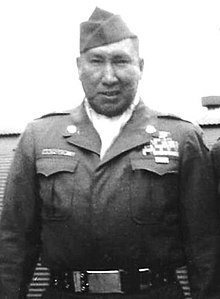
Born in poverty in 1917 in South Dakota, Woodrow W. Keeble, was a Sioux and had little reason to love the US, but he did. A giant of a man and a superb athlete, he was being recruited by the Chicago White Sox, when his National Guard unit, the North Dakota 164th Infantry Regiment was called up for active duty in February of 1941. Assigned to Company I, Keeble served in combat on Guadalcanal, Bougainville and the Philippines. He was discharged in 1946, having spent most of his time in service overseas and in combat. He was wounded three times.
Having seen enough combat to last a man a lifetime, no doubt he sighed when his National Guard regiment was reactivated for the Korean War. Acting as a temporary platoon leader, Master Sergeant Keeble became a legend in hellish fighting on October 20, 1951. From his Medal of Honor citation:
Master Sergeant Woodrow W. Keeble distinguished himself by acts of gallantry and intrepidity above and beyond the call of duty in action with an armed enemy near Sangsan-ni, Korea, on October 20, 1951. On that day, Master Sergeant Keeble was an acting platoon leader for the support platoon in Company G, 19th Infantry, in the attack on Hill 765, a steep and rugged position that was well defended by the enemy. Leading the support platoon, Master Sergeant Keeble saw that the attacking elements had become pinned down on the slope by heavy enemy fire from three well-fortified and strategically placed enemy positions. With complete disregard for his personal safety, Master Sergeant Keeble dashed forward and joined the pinned-down platoon. Then, hugging the ground, Master Sergeant Keeble crawled forward alone until he was in close proximity to one of the hostile machine-gun emplacements. Ignoring the heavy fire that the crew trained on him, Master Sergeant Keeble activated a grenade and threw it with great accuracy, successfully destroying the position. Continuing his one-man assault, he moved to the second enemy position and destroyed it with another grenade. Despite the fact that the enemy troops were now directing their firepower against him and unleashing a shower of grenades in a frantic attempt to stop his advance, he moved forward against the third hostile emplacement, and skillfully neutralized the remaining enemy position. As his comrades moved forward to join him, Master Sergeant Keeble continued to direct accurate fire against nearby trenches, inflicting heavy casualties on the enemy. Inspired by his courage, Company G successfully moved forward and seized its important objective. The extraordinary courage, selfless service, and devotion to duty displayed that day by Master Sergeant Keeble was an inspiration to all around him and reflected great credit upon himself, his unit, and the United States Army.
Keeble was wounded twice during the Korean War. Discharged due to his wounds in 1952, Keeble was finally done with combat. His remaining years were plagued with ill health. Diagnosed with tuberculosis soon after he got back from the States, one of his lungs had to be removed. He suffered a series of strokes and it was something of a miracle that he lived to see 64, dying in 1982. A sustained campaign in North Dakota and South Dakota ended in success when Keeble was granted posthumously in 2008 a very well earned Medal of Honor.


The man needs a statue. He’d probably have declined, but still.
As a South Dakotan, thanks. The Lake Traverse Reservation he is from is an area of glacial lakes in the north east corner of the state. South Dakota has several Medal of Honor winners. MSG Keeble, Captain Joe Foss, and Spc Fitzmaurice are the three I am most familiar with.
Thank you for posting the bio MSG Keeble, MOH. The Korean War is overlooked. In 1990 the bases I visited had manned tanks posted at the gates with “READY FOR WAR” banners. I remember being surprised at how close Seoul was to the 38th parallel. At the time Seoul was off limits because ROK army had found new tunnels the N Koreans had dug past the 38th.