Donald R. McClarey
Cradle Catholic. Active in the pro-life movement since 1973. Father of three, one in Heaven, and happily married for 43 years. Small town lawyer and amateur historian. Former president of the board of directors of the local crisis pregnancy center for a decade.
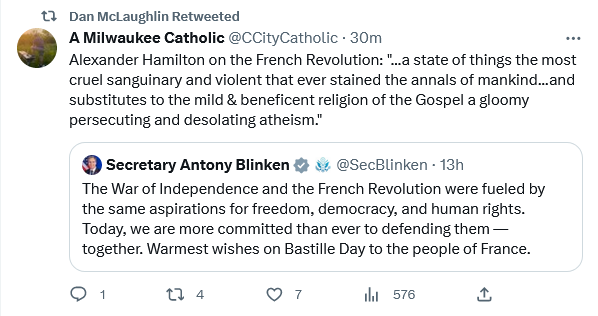



Internally, the period running from 1792 to 1796 was ghastly in places (the Vendée, principally). The attempt on the part of the Convention, the Directory, and Napoleon to conquer much of Europe over a period of 23 years was something which one could condemn.
The thing is, France in 1786 could have benefited from a reconstruction of its social order in general and its political society in particular. I’m not sure that was something that could be had for free, though there were things which happened over the succeeding six years you might wish they’d had the sense to avoid (principally the enactment of the Civil Constitution of the Clergy). Napoleon’s regime had a number of accomplishments in the realm of law and public administration which have endured, though you might wish they’d been modified later in favor of more local and regional self-government.
Good points Art. I always separate Napoleon from the Revolution. In many ways he was a traditional ruler of France in the mode of Louis XIV. I always have thought the Sun King and the Emperor must have had some interesting conversations in the world beyond. DeGaulle was very much in that mode as ruler.
It seemed to me that Great Britain avoided that bloody clash party because the middle classes already had access to Parliament and partly because the British idea of peerage (as opposed to Continental nobility) made it easier for the upper and middle classes to form ties of common interest. The older nobility did not complain when the kings created new peers (as after the 1707 Act of Union). Younger sons of earls and barons, who did not sit in the Lords, could enter the Commons, marry the daughters of wealthy gentry or even merchants (and Jane Austen speaks of this often).
In France the nobility was very jealous, did not intermarry with the bourgeois and the state remained autocratic to the end. What cannot bend often breaks.
I thought Blinken’s statement was fine. Two sentences, no lies, no allies offended or enemies bolstered. It wasn’t supposed to be a dissertation.
Full of lies Pinky. The French Revolution ushered in the first totalitarian state and was notable for the absence of liberty, equality or fraternity.
I’m not versed enough in the French Revolution to know what the people were fighting for, but I’d wager it wasn’t even close to what they ended up with … except for maybe freedom from religion.
I thought Blinken’s statement was fine. Two sentences, no lies, no allies offended or enemies bolstered. It wasn’t supposed to be a dissertation.
It’s shot through with humbug and for that reason did not need to be said. And, of course, Blinken’s a functionary of one of the most abusive regimes this country has seen yet.
The French Revolution ushered in the first totalitarian state and was notable for the absence of liberty, equality or fraternity.
Not sure which of the succession of governments France had between 1792 and 1815 qualifies as ‘totalitarian’ in your mind. It was certainly bloody between 1792 and 1796, but that’s not a novelty. I don’t think European governments had the administrative resources to manufacture a totalitarian regime on the scale of a country like France. One of the better examples of totalitarianism in the 19th century was Paraguay (1814-70). Paraguay had a six-digit population.
Art:
What they really lacked was modern communication and transport technology. Once intelligence and orders could move point to point over the wire, and troops by the thousands on trains, totalitarianism became practically possible. Nevertheless, if Napoleon was not a totalitarian, his state was their grandfather.
“but I’d wager it wasn’t even close to what they ended up with”
Napoleon gave them the Code Napoleon and probably the best government France had since Louis XIV. But for the constant wars, a big but, the French were better off under Napoleon than under Louis XVI.
“qualifies as ‘totalitarian’ in your mind.”
The Terror. The Directory which followed was a squalid oligarchy.
Come on, counsel. Being fueled by aspirations isn’t the same thing as ushering in. If he said that the French Revolution resulted in nothing but gum drops and unicorns, then it’d be false, but he didn’t say that.
He drew the comparison between our revolution and the French one, which is rather like comparing John Wayne to John Wayne Gacy.
Come on, counsel. Being fueled by aspirations isn’t the same thing as ushering in. If he said that the French Revolution resulted in nothing but gum drops and unicorns, then it’d be false, but he didn’t say that.
They weren’t ‘fueled by the same aspirations’. That he didn’t say something completely puerile doesn’t justify what he did say. This isn’t that difficult.
which is rather like comparing John Wayne to John Wayne Gacy.
😀 😀 😀 !!
I don’t see how you’re taking this position. I know that there’s a risk generalizing across all Enlightenment philosophers, and that the French Enlightenment was different from that in the English-speaking countries, but “freedom, democracy, and human rights” is a reasonable summary of Enlightenment thinking. Those were the ideas behind both the American and French Revolutions. Right? That strikes me as the most non-controversial historical statement a person could make. The Americans and French were both anti-clerical, they wanted to replace a monarchy with a voting system, and they read and were influenced by each others’ writings. It seems to me that if you can criticize Blinken’s statement as ahistorical, then you can criticize anything.
I don’t see how you’re taking this position.
People can explain something to you. They cannot comprehend it for you.
I know that there’s a risk generalizing across all Enlightenment philosophers, and that the French Enlightenment was different from that in the English-speaking countries, but “freedom, democracy, and human rights” is a reasonable summary of Enlightenment thinking.
It isn’t.
Those were the ideas behind both the American and French Revolutions. Right?
Wrong.
That strikes me as the most non-controversial historical statement a person could make.
Well, stop being obtuse.
The Americans and French were both anti-clerical,
Wrong.
they wanted to replace a monarchy with a voting system,
Wrong also.
and they read and were influenced by each others’ writings.
No, Benjamin Franklin was not influenced by Georges Jacques Danton. Franklin died in April of 1790, before anyone outside a tiny circle had heard of Danton.
It seems to me that if you can criticize Blinken’s statement as ahistorical, then you can criticize anything.
It seems to me that if you can criticize Blinken’s statement as ahistorical, then you can criticize anything.
This is tiresome.
I was really more talking to Don. But ok, if you could sum up Enlightenment thinking in a phrase, say a list of three things, what would it be?
Considering the Rein of Terror the French Revolution could be summed up by the liberty(of death), the equality(of death), and the fraternity(of death). I don’t recall the American Revolution having such bloodletting or fratricide in the ranks of the revolutionaries. The First Amendment to the Constitution demonstrated a recognition of a religious component in society.
Jefferson’s flowery language aside, the actual purpose of the Declaration of Independence was to declare independence. The American “revolution” wasn’t a revolution at all; it was simply a secession. Afterwards life went on in America pretty much as it had before. France, on the other hand, went through several periods of utter insanity, and hasn’t fully recovered yet.
“Those were the ideas behind both the American and French Revolutions. Right?”
No. The primary goal of the Americans was liberty from Britain, the freedom to rule themselves. The French Revolution swiftly became an excuse for a mass fratricidal blood letting in France, especially against believing Catholics.
The Americans and French were both anti-clerical
No, the Americans were against an established church, and that is not anti-clerical. The Brits often referred to the black regiment of clergy that supported the American Rebellion. Religious minorities, especially Jews and Catholics, were notable for their support of the American Revolution. The French Revolution was virulently anti-Catholic, symbolized by a ceremony placing a prostitute as an avatar of the goddess of Reason on the altar at Notre Dame. The persecution of Catholics was the worst since the days of the Roman Empire.
It seems to me that if you can criticize Blinken’s statement as ahistorical, then you can criticize anything.
Blinken’s statement was historical junk. You are wasting your time trying to defend it.
I was really more talking to Don. But ok, if you could sum up Enlightenment thinking in a phrase, say a list of three things, what would it be?
Why would I do that?
The salient feature of Enlightenment thinking was the rejection of religiously informed modes of thought in natural philosophy and social philosophy. I don’t think you could call the men of letters who produced this body of thought after 1640 to be advocates of liberty in any unqualified way when they turned their attention to political topics. Thomas Hobbes produced an apologia for royal absolutism and Rousseau’s notion of the ‘General Will’ is antithetical to free government. 18th century European despots were admirers of Voltaire; he was not their critic. If I’m not mistaken, close students of American politicians of the ‘founding era’ identify Montesquieu as the most salient figure in their thinking.
One can look at the political disorders of 17th century Britain as a vigorous and ultimately successful defense by Britain’s civil society of medieval institutions contra the ascendant royal absolutism. Locke’s writings provided an apologia for that.
Parallel to that you have the establishment and extension of British colonies in North America with their own elective conciliar bodies. The colonies themselves had a social order quite dissimilar to that of the mother country, one whose development was regulated by large quantities of open land and the almost complete absence of the formal orders of British society. North of the Mason-Dixon line, America was a society of yeoman farmers appended to which was a modest population of merchants, artisans, and tradesmen in town. South of the Mason-Dixon line, it was part that and part a plantation economy run with slave labor, which also had no analogue in Britain. (Most slaves in 1790 lived on plantations with fewer than 20 slaves).
What you had after 1763 was a neuralgic reaction on the part of colonists to the metropole’s effort to exert its authority. This included a denial that the British parliament had any such authority. Restrictions on westward settlement, excises, mercantile regulations, revocation of colonial charters were all points of controversy. They were all defenses of extant practices contra assertions of authority which were novel in practice. You can trace the genealogy of institutions with the federal constitution inspired by state constitutions inspired by colonial charters inspired by British municipal corporations. The common law remained in place. The colonial religious establishments lost certain privileges over the period running from 1774 to 1833, but they weren’t subordinated to the state governments, their property wasn’t seized, and they were compelled to submit to oaths. The number of United Empire Loyalists who settled in New Brunswick and Nova Scotia after the war amounted to < 2% of the pre-war population of the British colonies if I’m not mistaken.
You could read the cahiers produced by local meetings at the time of the election of the Estates-General in 1789 to get a sense of what the extant resentments were. Public finances in France at the time were parlous, its institutional architecture was a mess, it’s economic life a stew of rent-seeking. The closest analogue to the controversies in British North America was the attempt by some in the nobility to re-impose feudal dues which had fallen into deseutude.
Again, France was a society of orders. British North America had a hard caste distinction and had people living under contracts of indenture, but the European orders of clergy, nobility, burgesses, and peasants were absent. Fee simple tenures were the norm, rather than the complicated feudal / manorial tenures of Europe. Any project to re-invigorate the French political economy was bound to break the nobility’s rice bowls. However, the most intense point of conflict was derived from the National Assembly’s assault on the Church in 1789-90.
So you don’t find Himmelfarb’s approach more persuasive?
So you don’t find Himmelfarb’s approach more persuasive?
Approach to what?