
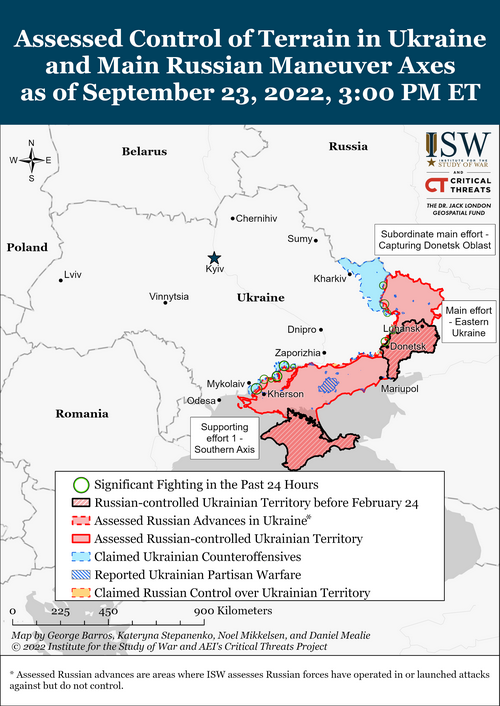
From The Institute For The Study of War:
Kateryna Stepanenko, Katherine Lawlor, George Barros, and Frederick W. Kagan
September 23, 10:00 pm ET
Click here to see ISW’s interactive map of the Russian invasion of Ukraine. This map is updated daily alongside the static maps present in this report.
The Russian mobilization system is struggling to execute the task Russian President Vladimir Putin set and will likely fail to produce mobilized reserve forces even of the low quality that Putin’s plans would have generated unless the Kremlin can rapidly fix fundamental and systemic problems. Putin and Defense Minister Sergey Shoigu announced that the Russian Armed Forces would mobilize combat-ready reservists to quickly stabilize the frontlines and regain the initiative on the battlefield.[1] Milblogger and social media reports, however, show that Russian military recruitment centers, enlistment officials, and local administrations are mobilizing men who do not meet the Kremlin’s stated criteria, especially Shoigu’s promise that mobilization would prioritize men with “combat experience.” Russian opposition outlets and Telegram channels leaked information suggesting that the Kremlin aims to complete this partial mobilization by November 10 and that the Kremlin is seeking to mobilize 1.2 million men instead of the publicly announced 300,000.[2] ISW cannot verify these reports, but significant available information suggests that this mobilization campaign (the first in post-Soviet Russia) is overwhelming an ineffective and unmotivated bureaucratic system and could fail to generate the much-needed combat-ready reserve force in a short time or at all.
Russian pro-war milbloggers and social media users are raising concerns about unlawful mobilization practices and showcasing many serious Russian mobilization problems on the second day of the mobilization effort. Russian milbloggers reported receiving numerous complaints from social media users that older men, students, employees of military industries, and civilians with no prior military experience are receiving illegal mobilization notices.[3] Shoigu and other officials have repeatedly stated that these categories of individuals would be exempt from this partial mobilization. Other sources reported that Russians are mobilizing airport and airline employees and workers from other industries.[4] The Russian government FAQ portal also indicated that local mobilization-enforcing officials may mobilize part-time students, despite the Kremlin’s declaration that no students will undergo mobilization.[5]
Some milbloggers noted that Russian enlistment personnel are assigning men with prior military service to very different specializations from those in which they served, while other sources recounted instances of military recruitment centers mobilizing men with chronic illnesses.[6]
The quality of Russian bureaucrats and military trainers are also raising fears among the Russian pro-war crowd that the partial mobilization effort may not succeed. Milbloggers noted that employees of the military enlistment centers are unmotivated and underpaid, reducing their enthusiasm to adhere to the envisioned mobilization plan. Milbloggers also pleaded with officers and commanders in charge of preparing mobilized men for war to train them before deployment.[7]
Challenges and errors in the first days of executing a large-scale and demanding partial mobilization in the midst of a failing war are not necessarily surprising, although they suggest that the Russian military mobilization infrastructure was not better prepared for a major war than the Russian armed forces themselves. It is nevertheless conceivable that the Russian Ministry of Defense will address some of the worst problems and get the mobilization effort on track. It is also possible, moreover, that much of the partial mobilization is proceeding more or less as planned and that social media and the milblogger community are highlighting problems that are serious but not necessarily pervasive. Some of the reports suggest, however, that regional mobilization officials have been given quotas to fill and received pressure to fill them in ways that are more likely to cause errors than to reward adherence to the stated principles and the needs of an effective, combat-ready reserve force.
Divergences from the mobilization decree and from Putin’s and Shoigu’s statements about the categories of men who are exempt from mobilization are also causing anger and mistrust toward Russian federal subjects and the Kremlin itself. Some social media footage already shows mobilized men fighting with enlistment officers, arguing with mobilization representatives, and refusing to serve under unlawful orders.[8] Some milbloggers claimed that some of the discontented men who have been wrongfully mobilized would have accepted their fate if they had actually met the mobilization criterium.[9] The Kremlin is thus committing unmotivated and potentially angry men to war with the task of regaining the initiative in an offensive war in a foreign land on a battlefield far from home.
The highly nationalist and pro-war milblogger community is calling on the Kremlin to address these mobilization issues rapidly, but the Kremlin is unlikely to be able to meet their demands. Russian milbloggers express cautious optimism that partial mobilization will reinforce degraded combat units and allow Russian forces to advance in Donetsk Oblast, but are concerned that the Kremlin’s failures to enforce mobilization according to the law and stated policies will create political unrest.[10] One milblogger stated that the Kremlin’s poor handling of the partial mobilization is giving rise to “separatist movements” and opposition media.[11] Another milblogger noted that the Kremlin’s failure to fix mobilization practices within the military recruitment centers may shatter Russians‘ trust in the military-political leadership.[12] A failed or badly flawed partial mobilization campaign may risk further alienation of the Russian nationalist crowd that has been supportive of the war and mobilization.
Disparate mobilization processes across different regions may exacerbate social tensions in Russia already raised by perceived inequalities in the creation of volunteer battalions. Chechen leader Ramzan Kadyrov stated in a live TV broadcast that the Republic of Chechnya will not conduct mobilization because the Republic has already exceeded an unspecified force generation plan by 254 percent.[13] Kadyrov added that Chechnya has already deployed 20,000 servicemen to war since February 24. Kadyrov threatened to mobilize any protesters in Chechnya and send them to the front, however. Kadyrov then seemingly modified his statements by encouraging those opposing mobilization to respect Russian sovereignty instead of using the constitution to avoid service.[14] Kadyrov’s initial statement, addressed to the Chechen public, may be an attempt to both address and discourage criticism of mobilization, the war, and himself within the Chechen community. Kadyrov’s statement could also be a worrisome indicator for the Kremlin—if one of the war’s most vociferous and aggressive advocates feels the need to refuse to mobilize his people, at least publicly, that could indicate that even Kadyrov senses the popular resentment the partial mobilization will cause and possibly even fears it.
Key Takeaways
- Russian partial mobilization efforts are suffering from serious and systemic problems in their first days, generating popular resentment and setting conditions to produce a mobilized reserve force incapable of accomplishing the tasks Russian President Vladimir Putin has set for it.
- Protests, attacks against recruiting centers, and vandalism have occurred across Russia in the first 48 hours after the announcement of partial mobilization.
- Ukrainian forces continued to advance north and northwest of Lyman.
- Ukrainian forces continued their interdiction campaign in Kherson Oblast and maintained operational silence regarding Ukrainian progress on the axis.
- Russian forces continued to launch unsuccessful assaults near Bakhmut and northwest of Donetsk City.
- Ukrainian forces reportedly shot down an Iranian-made Mohajer-6 drone in an unspecified area of the Black Sea, likely near Odesa.
- Russian occupation authorities began the voting period for their sham annexation referenda on September 23 with overt coercion and falsified turnout numbers.
- Russian occupation authorities remained on high alert to prevent partisan attacks against sham election workers, polling stations, and government facilities.
Go here to read the rest.
From Strategy Page:
The Ukrainian military did not accept much change after Ukraine became independent of the Soviet Union, and Russia, in 1991. The Ukrainians had to accept the fact that they could not afford to maintain a large peacetime military. Russia’s seizure of Crimea and Donbas in 2014 was a wakeup call. The Russians had used KGB tactics, developed during the decades of communist rule that often used subversion and surprise to overthrow vulnerable governments. This included most East European countries who spent four decades under communist rule and Russian influence because of these tactics. The Russians tried to use these methods in Ukraine after 2000 and ran into resistance from many Ukrainians. After 2014 more Ukrainians were willing to accept advice from the Americans, who sent special forces and military advisors versed in CALL knowledge and willing to share with Ukrainians who were prepared to adapt. Initially it was Ukrainian military leaders and eventually political leaders, like current Ukrainian president Zelensky, who was elected in 2019 to make needed changes. That included lots of reforms to the Ukrainian military.
What happened in 2014 scared Ukrainians because they had agreements with Russia that were supposed to keep Ukraine intact. The Russians violated their written promises and the Ukrainians realized they had to prepare for the worst, which the Russians were openly discussing. The worst came in February 2022 when Russia invaded. The Ukrainians had changed and adapted while the Russians had not. The result was a striking Russian defeat which many Russian leaders still don’t understand. The most important lesson was that you don’t invade a neighboring country expecting your attack if they are better prepared to deal with it. The Ukrainians had developed new tactics and used new weapons to defeat the invasion. Most Russian troops were not told they were conducting an invasion because their officers were assured that there would not be any effective resistance. There was effective resistance and many Russian troops abandoned their armored vehicles and fled once they realized what they were up against. That resulted in about half the Russian tanks and other armored vehicles lost being abandoned intact by their crews.
The Ukrainians quickly developed procedures to adapt their vehicles to their own use with new insignia and some new communications equipment. The Ukrainians also used their newly acquired tanks more effectively than their former owners. Ukraine, like the Russians, still used the same Cold War era tanks as the Russians, but were more aware of the vulnerabilities of these Russian designed tanks. For example, even the Russians didn’t realize how vulnerable their tanks were to turret penetration by anti-tank weapons. Russia had made some changes to defeat the Western Cold War development of top attack anti-tank weapons. These weapons were not used against Russian attacks often enough, until 2022, to demonstrate that Russian tanks were extremely vulnerable because Russian tanks had been using an auto-loader since the late 1960s. This replaced the human loader but put a dozen or more tank gun rounds in the turret at all times. If one of those rounds was detonated by an anti-tank weapon penetrating the turret, all those “ready rounds” exploded, destroying the turret and the tank as well as killing the entire crew. As soon as Russian tank crews understood this, they were quick to abandon their tanks as soon as enemy fire began blowing tanks up. Western tank designers were aware of this problem and never adopted the autoloader because of it. There was never more than one shell exposed in the turret at a time. The other shells were kept in a separate armored container with blow out panels. If those protected shells exploded the armored container quickly blew apart from the inside, leaving the crew unharmed and the tank reparable.
The Russians officially called their invasion a special operation meant to liberate the Ukrainians from neo-Nazi and NATO influence. Most Russian troops soon realized that the Ukrainians were more enthusiastic and determined to defend their country from foreign invaders and wanted to join NATO to discourage Russian attacks. Government corruption and inept military leadership meant the Russian troops were poorly supplied with food, medical care and ammunition. New recruits were not trained or paid the cash bonuses promised. Troop morale plummeted because of this and soon Russia found it could not obtain enough troops to keep the special operation going. The Ukrainians went on the offensive in late August and rapidly drove the Russians out of much of the Ukrainian territory they had conquered in 2014 and early 2022. The Russian government did not want to admit they were losing but were unable to convince enough Russian soldiers to resist or Russians and Ukrainian collaborators living in the occupied territories to stay. The civilians fled and the Russian troops numbers dwindled All this had nothing to do with foreign observers asserting that tanks were obsolete and warfare had changed dramatically. Neither was true but the reality was less newsworthy so the situation was not reported accurately. The Ukrainians kept attacking Russian logistics (supplies for the troops) while improving their own. This was the key to victory but made for dull headlines.
Go here to read the rest. Like victory, defeat is usually earned. The Russians earned defeat by learning little from their post World War II combat experiences, and embarking on Putin’s Ukrainian Adventure as if they still had a World War II military that could quickly overrun the Ukraine. The Russians still have learned almost nothing. Putin is acting as if the Russians have not been humiliated on the battlefield and that minor reinforcements will set everything to rights. We live in an age of make believe where individuals and societies engage in flights from reality. The most dangerous place to engage in this very bad habit is on the battlefield.


Historical Note: Russian forces mobilized in 1914 were part of the regular army. After the defeat by the Germans at Tannenburg, replacements were taken from farms and unskilled city dwellers and engaged in no major offensives. They were relegated to a holding position, experiencing a steady flow of casualties. This lasted until March 1917 when the Czar abdicated, and in turn replaced by the Soviets in Oct 1917. It is not likely that the Russian people’s attitude toward steady influx of dead bodies to no purpose has changed.
and engaged in no major offensives.
Russia engaged in many offensives after Tannenberg, culminating with the initially successful Brusilov Offensive in June to September 1916. Brusilov was probably the best Russian general of World War I and the Communists used his talents from 1920 until his death in 1926.