
From The Institute For The Study of War:
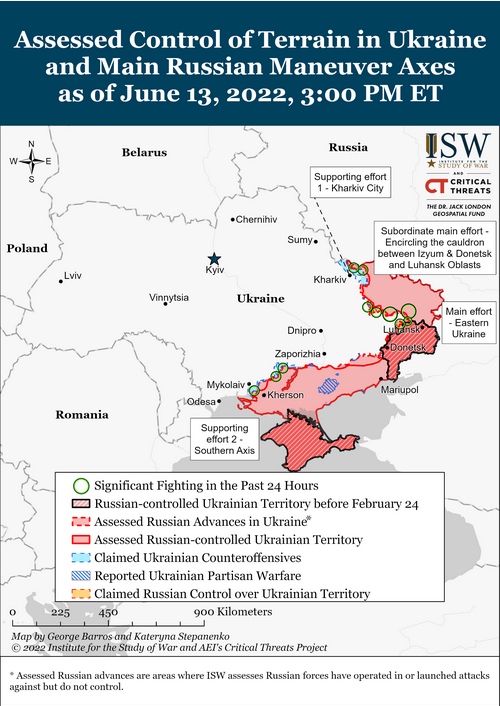
Russian Offensive Campaign Assessment, June 13
Kateryna Stepanenko, Mason Clark, George Barros, and Grace Mappes
June 13, 7:30pm ET
Click here to see ISW’s interactive map of the Russian invasion of Ukraine. This map is updated daily alongside the static maps present in this report.
Kremlin-sponsored outlet Izvestia published and quickly removed an appeal by the First Deputy Head of the Russian Presidential Administration Sergey Kirelenko for Russia to rebuild the Donbas on June 12 and blamed hackers for what they (likely falsely) claimed was a “fake publication.” Izvestia likely intended to save the article for a later date to set informational conditions for Russian annexation of Donbas. Kirelenko’s appeal stated that Russia will restore the Donbas regardless of high costs or if doing so lowers the standard of living in Russia.[1] Izvestia blamed unknown hackers for publishing a “fake article,” but it is possible that hackers instead released an article Izvestia had prepared to publish at a later date. The Kremlin previously published and removed an article prematurely celebrating a Russian victory over Ukraine in late February and discussing the capture of Ukraine in past tense in anticipation of Ukraine’s capitulation during the first Russian-Ukrainian negotiations in Belarus.[2] Unnamed Kremlin officials previously identified Kirelenko as the future head of a new Russian federal district, which would encompass Donbas, and occupied settlements in Kherson and Zaporizhia Oblasts.[3]
Russia continues to deploy insufficiently prepared volunteer and reserve forces to reinforce its ongoing operations. Kremlin-sponsored outlet Izvestia released footage showing Russian artillery reservists undergoing training with old D-20 howitzers reportedly within 10 days of their deployment to Ukraine.[4] The reservists focused on learning how to operate hand-held weapons, despite being reportedly only days away from deploying. Social media footage also showed Russian forces transporting Russian volunteer and reserve units with T-80BV tanks (a variant produced in 1985, as opposed to the modernized T-80 BVM operated by the 1st Guards Tank Army) and BMP-1 armored personnel carriers (which have largely been phased out in favor of the BMP-2) to Belgorod Oblast on June 9.[5] Additional social media footage showed Russian forces transporting T-80BV tanks removed from storage in Moscow Oblast on June 9.[6]
Key Takeaways
- Russian forces pushed Ukrainian defenders from the center of Severodonetsk and reportedly destroyed the remaining bridge from Severodonetsk to Lysychansk on June 13, but Ukrainian officials reported that Ukrainian forces are not encircled in the city.
- Russian forces carried out unsuccessful ground assaults in an attempt to sever Ukrainian ground lines of communications (GLOCs) near Popasna and Bakhmut.
- Russian forces launched unsuccessful offensive operations southeast of Izyum and north of Slovyansk, and are likely setting conditions for an assault on Siversk and northwestern Ukrainian GLOCs to Lysychansk.
- Russian forces are likely conducting a limited offensive directly northeast of Kharkiv City in a likely attempt to push Ukrainian forces out of artillery range of Russian rear areas and secured some successes.
- Russian and Ukrainian forces are engaging in ongoing fighting for Davydiv Brid in northwestern Kherson Oblast.
- Russian occupation authorities likely staged terrorist activity in Melitopol and Berdyansk for Russia Day on June 12.
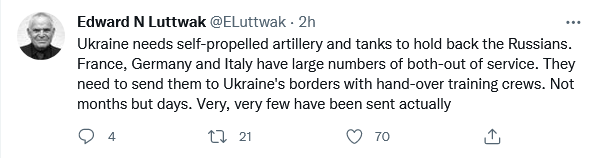
Go here to read the rest. I agree with Edward Luttwak. NATO has talked a good game but the actual turn over of advanced artillery and tanks to the Ukrainians has been minimal.


The ISW article notes that the Russian military is reactivating much older 1980’s-era (or before) BMP-1’s (The initials “BMP” are for the Russian translation of “infantry fighting vehicle”)—-which many NATO and other military analysts have pointed out is essentially a death trap for the 14 soldiers it is meant to carry. Three of the principal drawbacks, almost typical to Russian armored vehicles, are (1) fuel tank stored directly behind the driver and gunner; (2) an infamous Russian-style autoloader prone to breakdowns, and ammunition stored directly in the personal area with no armor or blast shield protection; and (3) Two flimsy highly vulnerable rear doors of thin metal that can easily be penetrated even by Afghan-era “dumb-guided” RPG weaponry. Russian troops really would be much better to ride to the battle front on a supply truck. This is an evident sign that the Russians are beginning to “scrape the bottom of the barrel.”
Putin should be required to ride one into battle. Fat chance.
By the way, reports are surfacing from a firmer Russian deputy opposed to the war relying on a source in Sevastopol, that all the survivors of the sunken Russian frigate “Moskva” are in the brig/military jail somewhere in the Crimea: The families have been trying to find them, but the Russian high command has decided that (1), they don’t want the true facts to be known that the Russian navy’s most advanced ship was “easily” sunk by a Ukrainian Neptune missile, and (2) they want to pin the blame on the crew, which was almost entirely composed of conscripts (the captain went down with the ship) for the disaster.
Typical Russian treatment of their own personnel .
Ukrainian blogger Denys Davidov confirms the ISW report above that the Russians are trying to move inyo an area near Kharkhiv again, but Davidov says It is because Ukrainian artillery is threatening their supply lines to (apparently) Lyman and Izium, two rail hubs where they are trying to build an offensive to move south to take Slovyansk.
However, he also says a Russian column that moved forward to take a small village on the way, Bohorodychne, but the terrain, which is heavily forested and broken, favors the Ukrainians and they were savagely beaten back with heavy Russian losses. The war of attrition continues.
Davydov says that very likely the Ukrainian military will withdraw soon from Severodonetsk— But despite a request by the Ukrainian government to all civilians in the area to withdraw over a month ago, many civilians have gone to take refuge in one of the old mostly bombed-out factories including about 250 children. He says the civilians probably didn’t want to leave because they had valuable farm animals, and very little to go to if they left, except the clothes on their back. He predicts a controlled withdrawal by the military to the other side of the Seversky Donets river, where the Ukrainian forces have artillery set up at Lysychansk on the high ground there, to pin down the advancing Russian forces – – provided they aren’t taken out by Russian rockets or aviation. But the fate of the civilians is bleak if they continue to refuse to leave.
However, a possible bright spot: as predicted by some, it appears the Russians are out of main supply of heavy long-range rockets, and are trying to concentrate their remaining stock. They have had plentiful targets available recently but haven’t resorted to the heavy rocket attacks as readily as in the first 30 -60 days.
Considering the length and cost of this “operation” to the Russians, it is truly a wonder that the delusional and paranoid Putin has not been given the same treatment as Kruschev for his failures by now.