
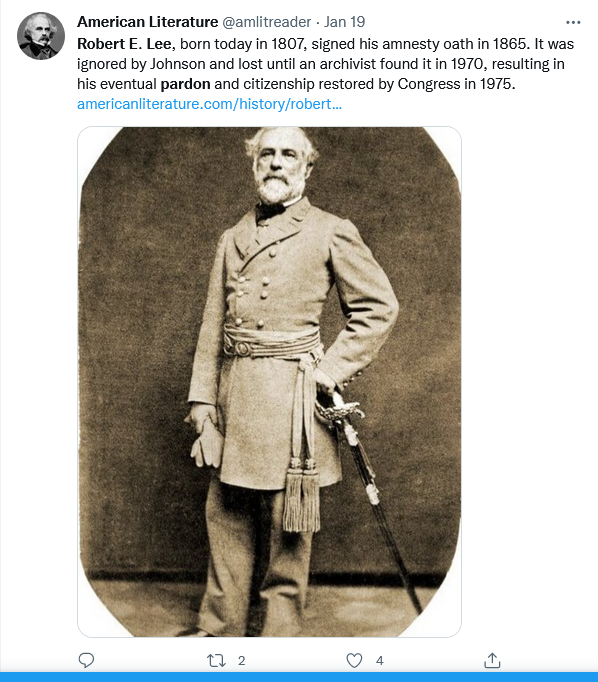
I once sent the government a check for some $35,000.00 to pay estate tax on behalf of a client. The check was lost for several months by the Feds. At the time I recalled this historical event:
Robert E. Lee was an advocate of reconciliation after the Civil War. This was demonstrated by his application for a Presidential Pardon on June 13, 1865, high confederate officers having been excluded from President Johnson’s general pardon and amnesty of May 29, 1865 and being required to appeal directly to the President. Lee wrote:
Being excluded from the provisions of amnesty & pardon contained in the proclamation of the 29th Ulto; I hereby apply for the benefits, & full restoration of all rights & privileges extended to those included in its terms. I graduated at the Mil. Academy at West Point in June 1829. Resigned from the U.S. Army April ’61. Was a General in the Confederate Army, & included in the surrender of the Army of N. Va. 9 April ’65.
Lee was not aware that an oath of loyalty was required and he took such an oath on October 2, 1865:
“I, Robert E. Lee, of Lexington, Virginia, do solemnly swear, in the presence of Almighty God, that I will henceforth faithfully support, protect and defend the Constitution of the United States, and the Union of the States thereunder, and that I will, in like manner, abide by and faithfully support all laws and proclamations which have been made during the existing rebellion with reference to the emancipation of slaves, so help me God.”
The oath went to Secretary of State Seward, and then it vanished from history for over a century until it was found by Elmer O. Parker, an archivist at the National Archives, in 1970 among State Department papers in a cardboard box clearly indexed V for Virginia and L for Lee. Lee had inquired frequently about his application over the five years he had to live from 1865-1870. Whether his application was lost deliberately or lost through ineptitude is unclear.
On August 5, 1975 President Ford restored the citizenship rights of Lee, making these remarks:
Lee’s dedication to his native State of Virginia charted his course for the bitter Civil War years, causing him to reluctantly resign from a distinguished career in the United States Army and to serve as General of the Army of Northern Virginia. He, thus, forfeited his rights to U.S. citizenship.
Once the war was over, he firmly felt the wounds of the North and South must be bound up. He sought to show by example that the citizens of the South must dedicate their efforts to rebuilding that region of the country as a strong and vital part of the American Union.
In 1865, Robert E. Lee wrote to a former Confederate soldier concerning his signing the Oath of Allegiance, and I quote: “This war, being at an end, the Southern States having laid down their arms, and the questions at issue between them and the Northern States having been decided, I believe it to be the duty of everyone to unite in the restoration of the country and the reestablishment of peace and harmony….
As a soldier, General Lee left his mark on military strategy. As a man, he stood as the symbol of valor and of duty. As an educator, he appealed to reason and learning to achieve understanding and to build a stronger nation. The course he chose after the war became a symbol to all those who had marched with him in the bitter years towards Appomattox.
General Lee’s character has been an example to succeeding generations, making the restoration of his citizenship an event in which every American can take pride.


One of the few points regarding the Civil War that is almost never mentioned is whether states can legally secede. Lee thought they could which is why he stated that he could never draw his sword against his native state of Virginia. That issue was settled by the war and Lee put his best efforts forth for reunification. One reason why much of the name changing of places and buildings, etc. is greatly misplaced when applied to former Confederates who did support the union after the war. Example: Gen. Wheeler supported and served in the Spanish-American War.
Lee thought they could
Actually Lee thought there was no right to secession under the Constitution and that it was revolution.
“I hope therefore that all Constitutional means will be exhausted, before there is a resort to force. Secession is nothing but revolution. The framers of our Constitution never exhausted so much labour, wisdom & forbearance in its formation & surrounded it with so many guards & securities, if it was intended to be broken by every member of the confederacy at will. It was intended for pepetual [sic] union, so expressed in the preamble,4 & for the establishment of a government, not a compact, which can only be dissolved by revolution or the consent of all the people in convention assembled. It is idle to talk of secession. Anarchy would have been established & not a government, by Washington, Hamilton, Jefferson, Madison & the other patriots of the Revolution. In 1808 when the New England States resisted Mr Jeffersons Imbargo law & the Hartford Convention assembled secession was termed treason by Virga statesmen. What can it be now? Still a union that can only be maintained by swords & bayonets, & in which strife & civil war are to take the place of brotherly love & kindness, has no charm for me. I shall mourn for my country, & for the welfare & progress of mankind. If the Union is dissolved & the government disrupted, I shall return to my native State & share the miseries of my people & save in her defence will draw my sword on none. Give much love to Charlotte to my dear little son & believe me always your devoted father.”
https://leefamilyarchive.org/reference/essays/rachal/index.html
just wish REL hadn’t sided with the slave owners even though they were his kinfolk… that war would have CERTAINLY.. ended very quickly..
that being such a grave decision.. a late 1975 restoration is acceptable.