
From The Institute For The Study of War:
Frederick W. Kagan, Kateryna Stepanenko, and Karolina Hird
April 23, 6:30 pm ET
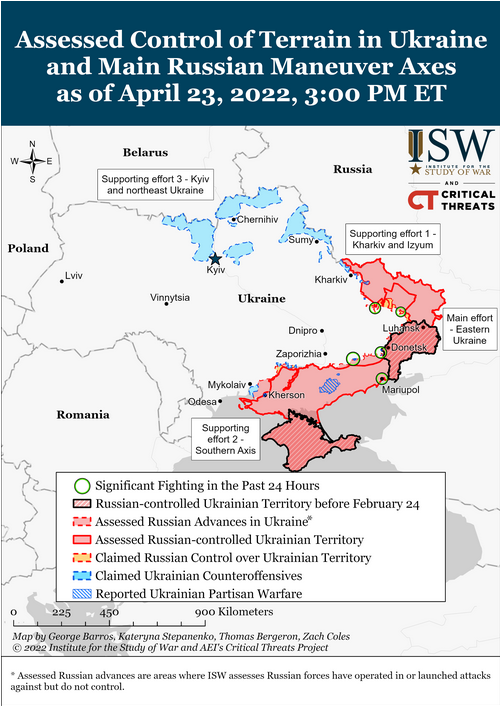
Russian forces continued offensive operations along multiple axes even as they completed moving reinforcements drawn from the retreat from Kyiv into the east and continued redeploying some forces from Mariupol to the north. The Russians have not taken time to refit troops moving from Kyiv or Mariupol before recommitting them to combat operations. They are not pausing offensive operations to wait until they have concentrated overwhelming combat power, and they do not appear to be massing forces on a few decisive axes of advance. They are continuing the pattern of operations they have followed throughout the war: committing small collections of units to widely dispersed attacks along multiple axes and refusing to accept necessary operational pauses to set conditions for decisive operations.
Russian forces have thus far only committed a handful of battalion tactical groups (BTGs) to offensive operations in their various sectors, however, and could still launch a massed offensive operation. We assess that such an operation is unlikely given observed patterns and the inherent limitations of available actual combat power in troops that have fought hard and suffered many casualties, as well as observed challenges with command-and-control at the regiment/brigade and division level. It is possible that the Russians are addressing or attempting to address some of those challenges and will soon launch an offensive in a new and better-coordinated form, but it remains unlikely.
The objectives of Russian offensives around the Izyum-Donetsk City salient are unclear. Russian forces may seek to reach the Izyum-Debaltseve road along two or more axes to encircle a large concentration of Ukrainian forces and built-up areas. Ukrainian officials suggested on April 23 that Russian forces near Rubizhne and Popasna may seek to encircle the Severodonetsk-Lysychansk area rather than pursue the deeper envelopment.[1] It is too soon to evaluate the likelihood of this Russian course of action or the probability of its success.
Key Takeaways
- Russian forces continued their pressure on the Azovstal facility in Mariupol.
- Russian troops drawn from the retreat from Kyiv are re-entering combat in eastern Ukraine.
- Russian forces from around Mariupol are redeploying to the vicinity of Donetsk City and are likely to enter combat again soon and without rest or refit.
- Russia continued conducting small-scale ground offensives at multiple points along the front from Izyum to Zaporizhia Oblast.
Go here to read the rest. If the Russian offensive continues so weak, I predict the Ukrainians will soon go on the offensive themselves.


“An unnamed NATO official” reported to Reuters today (4/24/22) that the Russians are trying to apply force at multiple points along the front stretching from south of Kharkhiv to Zaporizhzhia but are being consistently repelled by the Ukrainians, with the Russian forces evidently suffering further losses.
The Ukrainians also must feel very confident with the stream of powerful weaponry flowing into the conflict, weaponry clearly far more advanced than their Russian opponents’ armaments.
If this lack of coordinated attack continues by the Russians, they are going to be exhausted by the bloody losses they’re inevitably going to be suffering, and as a commentator notes above, with little chance for success. At some point they may suddenly become exhausted by losses and cascade into a rapid retreat and the whole line may then collapse. Even if they breakthrough in a column, the Ukrainians have savaged their narrow columns and salients (“A Bridge Too Far,” Operation Market Garden, Cornelius Ryan.).
Attacking the highly motivated Ukrainians in their clearly dug-in positions is going to be at a horrific cost. I’m beginning to think the Russians don’t have a chance.