
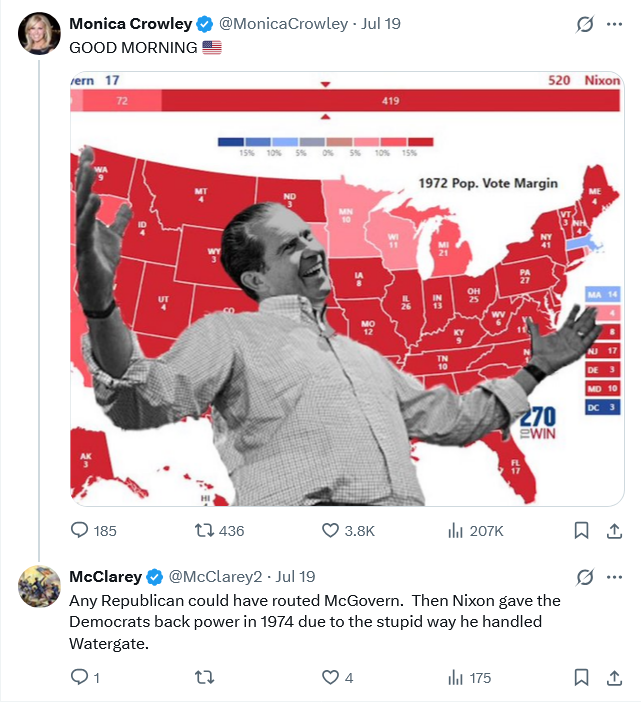
A lot of positive posts on Twitter the past few weeks about Nixon, attempting to give the impression that he is a favorite among young conservatives. Not buying it myself. It has the feel of an astro-turfed effort, and not a true grass roots phenomenon. Nixon was not a conservative. Domestically he was a liberal Republican, in favor of the expansion of government to “solve” problems, who used his anti-Communism to disguise that fact.
On foreign policy he saved Israel during the Yom Kippur War with a massive air lift of arms and munitions, something that I view as a positive, but that too many young conservatives would not. His extrication of us from Vietnam was not “peace with honor” as he claimed, but a necessary move since the country would not back the measures necessary to win that war, which included an invasion and occupation of parts of North Vietnam. His recognition of Red China was a typical too clever by half effort so beloved of Kissinger. It took a second rate Communist power, with a self-destructive economy, and gave it an opening to Western credits and technology to eventually become an economic rival to us.
His paranoia gave his enemies a sword called Watergate to destroy his presidency.
All this occurred while the true champion of conservatism, Ronald Reagan, was waiting in the wings. There are many lessons that can be drawn from the career of Nixon, most of them cautionary ones.


I agree, artificial.
==
I don’t think he was paranoid. He just had a thin hide, anxiety issues, and no experience with or skills in administration. A sterling example of Nixon as an administrator is manifest in John Dean’s account of Nixon groping about for nominees to the Supreme Court. John Mitchell comes up with five names. One was a federal appellate judge named Mildred Lille; Dean goes to interview her and decides ‘she’s damned bright and knows her mind’. Her name and others were submitted to a panel of the American Bar Association who vetoed her for a deficit of ‘experience’ and Nixon just caves. The other four candidates considered all had one thing in common: they had no time on the bench and three of the four had less time at the bar than judge Lille. The other four were a member of Congress from Roanoke (who withdrew his name from consideration – he was the one Nixon wanted), a trial lawyer from Little Rock (“he knows little constitutional law”), a corporate lawyer from Richmond, and another member of the Goldwater circle who had a patronage job in the Department of Justice. Nixon’s attorney-general was a lawyer who specialized in municipal bond issues. His White House council was a 32 year old quondam congressional aide (and part of the Goldwater circle) who had been fired from the one position in private practice he’d had and threatened by the senior partner in his firm with an ethics complaint. The man he installed as head of the Federal Reserve was a politically-connected economist who’d gotten the idea in his head that monetary policy could not be used to restabilize prices. His efforts to dismantle the New Deal era hash governing the energy sector were somewhere around zip. (The administration did manage to dismantle the ‘Office of Economic Opportunity’ which ran so many Great Society programs, so there’s that). Per Henry Kissinger, his meetings with subordinates were typically scripted and in dealing with foreign heads of state he used prepared scenarios and would not bargain. He tolerated blatant insubordination from the likes of Melvin Laird. And so on.
Granted that Nixon had his faults and problems. His present second look rises from the quality of politicians today, especially the crazies of the Democrat-Socialists and the failure of the Republicans to inspire confidence. The next two election cycles do not look promising.