
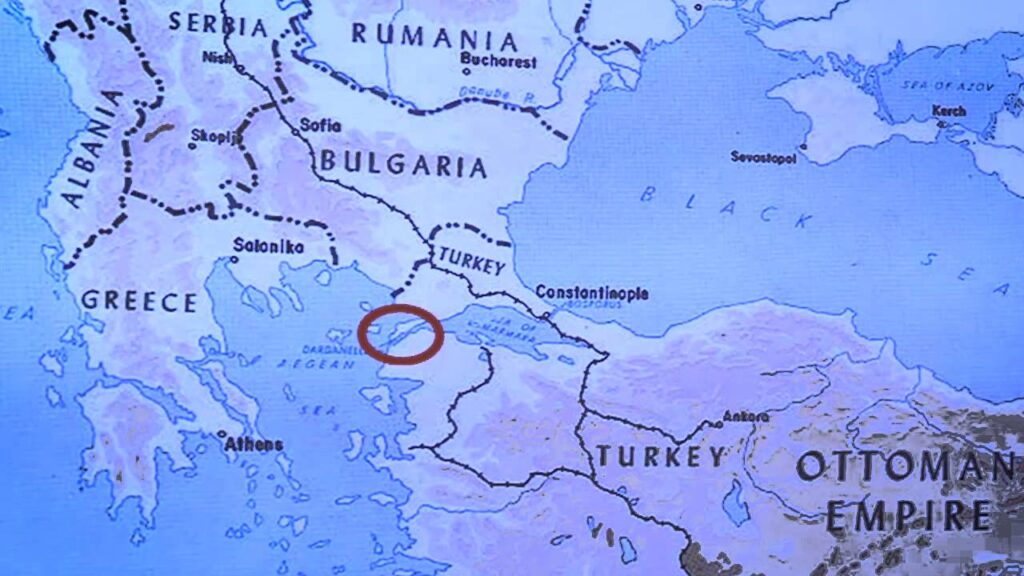
I was ruined for the time being in 1915 over the Dardanelles, and a supreme enterprise was cast away, through my trying to carry out a major and cardinal operation of war from a subordinate position. Men are ill- advised to try such ventures. This lesson had sunk into my nature.
Winston Churchill
Today is Anzac Day, in Australia and New Zealand. It commemorates the landing of the New Zealand and Australian troops at Gallipoli in World War I. Although the effort to take the Dardanelles was ultimately unsuccessful, the Anzac troops demonstrated great courage and tenacity, and the ordeal the troops underwent in this campaign has a vast meaning to the peoples of New Zealand and Australia.
This year I thought we would focus on taking a closer look at the Gallipoli Campaign. It was the project chiefly of Winston Churchill, then First Lord of the Admiralty. Churchill was an idea man. He constantly came up with ideas that ranged from insane to brilliant. The Gallipoli idea I think was on the surface brilliant. Seize the Dardanelles, the opening of the sea corridor between the Mediterranean and the Black Sea, take Constantinople, ferry Russian troops over the Black Sea by the Royal Navy to knock out Turkey from the War and then launch a war winning campaign up the Balkans to drive the Austro-Hungarian Empire out of the War and then defeat a surrounded Germany. It had the hallmark that would always remain Churchill’s goal in the realm of grand strategy: a short cut to victory. Rather than slug it out against Imperial Germany in bloody trench warfare where, in Churchill’s grim phrase, “if only the Generals had not been content to fight machine-gun bullets with the breasts of gallant men, and think that that was waging war.”, take an easier and quicker path to victory by defeating the weaker allies of Germany. Small wonder that Churchill convinced the British war cabinet to back this bold gamble.
This brilliant idea also had drawbacks that tend to suddenly appear when a high concept plan is attempted to be implemented in this Vale of Tears.
- Geography-The rough terrain of Gallipoli offered superb defensive ground for the Turks.
- Mines-In a narrow sea passage like the Dardanelles heavy use of mines could negate the sea power of the Royal Navy.
- Logistics-Keeping a large invasion force supplied would require a maximum effort, limiting the number of troops that could be landed and supported.
- New type of warfare-This type of amphibious operation seems commonplace now. It was not in 1915. There was much to learn in a short period, and many mistakes to make.
- Johnny Turk-The average illiterate peasant Turkish soldier was almost totally ignorant of the outside world and had little but hate for the Young Turk politicians of Constantinople. He had a great love for his religion and his country however, and he knew how to handle his weapons. If commanded to hold a position he would hold it or die trying. A superb soldier in defense.
Summing up the British implementation of the Gallipoli plan, the phrase too little and too late constantly recurs. Not enough forces were initially allotted, and operations seemed to proceed in slow motion, giving the Turks maximum opportunity to prepare and thwart the Allied efforts to overcome the battlefield stalemate.
So the troops deployed were left to endure a Golgotha of insufficient rations, appalling weather, millions of flies, some of the worst terrain on Earth over which to attempt to attack, all while fighting a valiant and tenacious foe. By January 1916 the British had enough and withdrew. The Butcher Bill was appalling:
British Empire:
198,340 (31,389 killed
9,708 missing and POWs
78,749 wounded
78,494 evacuated sick
France:
9,000 killed & missing
18,000 wounded
20,000 evacuated sick
Australia:
7,594 killed
18,500 wounded
New Zealand:
3,431 killed
4,140 wounded
The casualties for the sparsely populated countries of Australia and New Zealand sparked a moment in their new national histories that would never be forgotten, as they took pride in the courage and determination of their troops in a losing effort, which would ultimately end in victory in the War overall.


The battle of Gallipoli really defined both our nations identities – Australia and New Zealand. The ANZAC Ode, recited at ANZAC Day ceremonies and at Return Services Leagues every evening, everywhere, really sums up our gratitude for the sacrifice our soldiers made for our nations. It is always followed with The Last Post. I find myself clasping my hands in prayer whenever I hear both.
“They shall grow not old, as we that are left grow old;
Age shall not weary them, nor the years condemn.
At the going down of the sun and in the morning
We will remember them. Lest we forget”
https://m.youtube.com/watch?v=f7V07V1rjbM
Gallipoli was not without some positive consequences, according to my reading. The Turkish Central Command was badly mauled, with heavy losses that disillusioned men like Ataturk about both the war and the Empire. The Germans felt forced to kept many troops in reserve to send south at a critical time on the Western Front.
True. The British also learned lessons that served them in good stead in the campaigns of 1917 and 1918 that took down the Ottoman Empire.
My grandfather Don Piper & my great Uncle Eustace (Nick) Nicholson stormed ashore in the afternoon of 25th. April at Gaba Tepe a few miles east of the main landing. Uncle Nick was wounded & evacuated in November, & Pop Piper was there till the end, taken off with the final evacuation. They both returned to England, and from there to the trenches in France. Uncle Nick stayed till the end. Pop Piper was wounded at Paschendaele late 1917 and repatriated to NZ.
My dad’s oldest brother, George Beckett went to France in 1917 and was gassed in one of the German mustard gas attacks. He was evacuated and returned to NZ – he played rugby with one lung till 1926 and died when he was 94 – he smoked from the time he was young till the time he died.
Interestingly, Pop Piper’s younger brother Nigel was flying WW1 fighters when Pop was in the trenches. He was shot down a couple of times but always got back to the allied lines. He recounted one time when he was captured. The airmen were considered the gentlemen of the forces, and he was sent to a Luftwaffe prison – a commandeered chateau. He had his own room and was guarded only lightly – he often dined with the kommandant. He was a friendly man who knew some German, and got to know the guards very well. They would let hime stroll in the gardens which were extensive, and bordered the local roads. He gradually extended his walks to the roads without raising suspicion. After a few weeks, one day he went walking, and carried on to the allied lines. There is a BBC doco about him entitled “Wind in the Wires” where he recounts his experiences.
A small correction – Gaba Tepe is WEST of the main landing area. I have attached a link to Wind in the Wires where Uncle Nigel tells his stories. He was a good storyteller & didn’t hesitate to embellish, so I may have some of the facts in my story wrong. In the 1970’s & ’80’s he used to come to NZ for our summer to miss the English winter. He died about 1994 aged 101. It is rather strange to hear his Cornish accent again.
https://www.rnz.co.nz/national/programmes/spectrum/collections/spectrum-at-war
@ Don Beckett- a remarkable legacy your grandfather and his brothers left behind. Your mother must have had a resilient heart to see so many of her sons go off to war.