
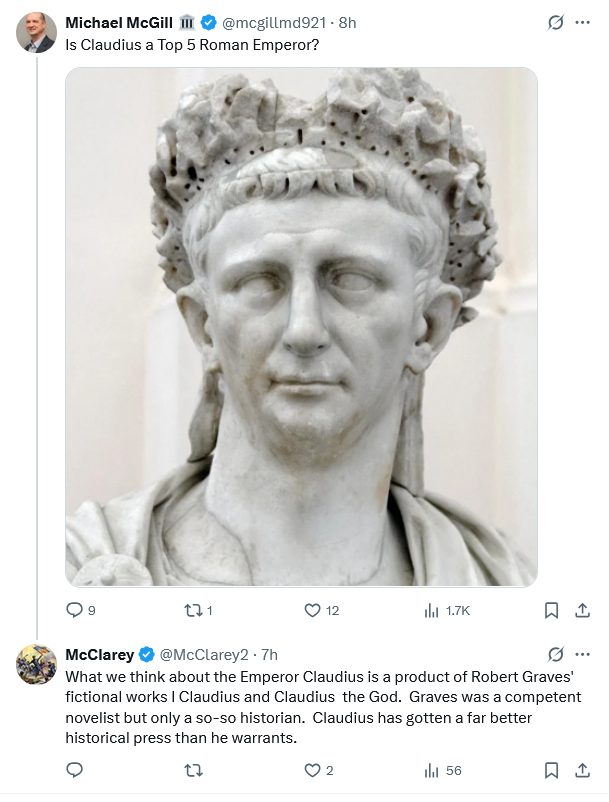
I have never been much for novels, but I have read a fair amount of historical fiction. The best of the genre add a lot of historical fact to the mixture, but even the best works tend to distort, rather than accurately report, the eras that they portray. Robert Graves understood that:
Livy: ‘Can’t I? Indeed I can,’ said Livy. ‘Do you mean to say that I mustn’t write a history with an epic theme because that’s a prerogative of poetry, or put worthy eve-of-battle speeches in the mouths of my generals because to compose such speeches is the prerogative of oratory?’
Pollio: ‘That is precisely what I do mean. History is a true record of what happened, how people lived and died, what they did and said; an epic theme merely distorts the record. As for your generals’ speeches they are admirable as oratory but damnably unhistorical: not only is there no particle of evidence for any one of them, but they are inappropriate. I have heard more eve-of-battle speeches than most men and though the generals that made them, Caesar and Antony especially, were remarkably fine platform orators, they were all too good soldiers to try any platform business on the troops. They spoke to them in a conversational way, they did not orate. What sort of speech did Caesar make before the Battle of Pharsalia? Did he beg us to remember our wives and children and the sacred temples of Rome and the glories of our past campaigns? By God, he didn’t! He climbed up on the stump of a pine-tree with one of those monster-radishes in one hand and a lump of hard soldiers’ bread in the other, and joked, between mouthfuls. Not dainty jokes but the real stuff told with the straightest face: about how chaste Pompey’s life was compared with his own reprobate one. The things he did with that radish would have made an ox laugh. I remember one broad anecdote about how Pompey won his surname The Great – oh, that radish! – and another still worse one about how he himself had lost his hair in the Bazaar at Alexandria. I’d tell you them both now but for this boy here, and but for your being certain to miss the point, not having been educated in Caesar’s camp. Not a word about the approaching battle except just at the close: “Poor old Pompey! Up against Julius Caesar and his men! What a chance he has”!’
Livy: ‘You didn’t put any of this in your history,’ said Livy.
Pollio: ‘Not in the public editions,’ said Pollio. ‘I’m not a fool. Still, if you like to borrow the private Supplement which I have just finished writing, you’ll find it there. But perhaps you’ll never bother. I’ll tell you the rest: Caesar was a wonderful mimic, you know, and he gave them Pompey’s dying speech, preparatory to falling on his sword (the radish again – with the end bitten off). He railed, in Pompey’s name, at the Immortal Gods for always allowing vice to triumph over virtue. How they laughed! Then he bellowed: “And isn’t it true, though Pompey says it? Deny it if you can, you damned fornicating dogs, you!” And he flung the half-radish at them. The roar that went up! Never were there soldiers like Caesar’s. Do you remember the song they sang at his French triumph?
“Home we bring the bald whoremonger,
Romans, lock your wives away.” ’
I, Claudius, Robert Graves


I loved reading Robert Graves’ books “I, Claudius” and “Claudius the God.” I loves watching the BBC series, too, in which Patrick Stewart played the part of Sejanus and Derek Jacobi the part of Claudius. I still have old recordings of the series. Yes, much fiction in the books and the series, but that was when entertainment had class.
This scene with the two historians Livy and Pollio is my favorite. Maybe my favorite from all literature I’ve read. I read “I, Claudius” in high school, and that book has had a long lasting effect on me.
History regularly gets distorted on PBS. The recent air of the mini-series about Cromwell and Henry III manage to whitewash, elevate and generally clean up the reputations of all the miscreants and simultaneously absolve them from their wrongdoings. Easy to see why there is wide support for cutting their government funding.
[…] & PropertyReport: Iran Pleads with Qatar, Oman to Get Trump to Stop War – BreitbartHistorical Fiction Should Never Be Confused With History – D McClarey at The American CatholicSee the Latest Western Civ Defender Posts – […]
After the death of Augustus, there came a series of incompetent emperors, including Claudius. Was not until Marcus Aurelius (a better writer than ruler), things got better organized in the empire. Still, as long as viewed as entertainment, films like I Claudius and Gladiator do provide some insight into the character of Rome at the time.
Tiberius wasn’t too bad, although he gets bad press from Tacitus, perhaps in part unfairly. Vespasian and Titus were able. Nerva started the line of the five good emperors: Trajan, Hadrian, Antonius Pius and Marcus Aurelius.