
Plato is a sterling example of how a good writer can make dubious ideas seem plausible. Not all of his ideas are dubious, the story of the cave has much insight into the human condition, but his political ideas would inevitably end in an authoritarian dystopia if taken seriously. Those last three words are the saving grace of Plato, because few rulers who have exercised power have taken Plato seriously. Plato I think understood this, after his experience with the politics of Syracuse, which is why his last dialogue The Laws took a much more down to earth look at governance. Alas, philosophers have been much more enamored of The Republic than The Laws, while rulers, the few who bother with philosophy, favor Machiavelli in private, while vigorously condemning him in public, Frederick the Great being an example of this type.
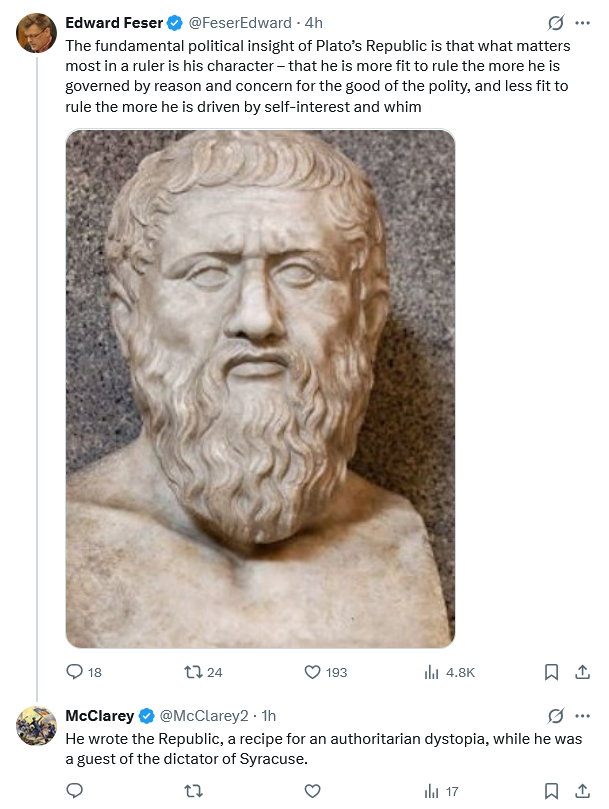


Authors tend not to mention what was assumed in their day. None of the Greek states in Plato’s time had walls or barbed wire keeping people who didn’t want to stay, and plenty went to colonies or other states where they lived for years and did business as resident aliens. Sparta’s helots were an exception. The Republic (and the Laws) detail proposals for people living voluntarily in a small city. That their plans would apply to a country the size of ours would have been thought laughable, and that free men would be constrained who didn’t want to stay outrageous.
None of the pagan authors understood or knew how to deal with Original Sin; that there is no civil or philosophic method of dealing with human weakness, that men will always tend to corruption and that successful political schemes must somehow manage and compromise with what they cannot hope to eliminate.
“A good writer can make dubious ideas seem plausible.”
And ironically, Don, Plato’s Socrates criticizes that exact tendency in the admirers of the “divine Homer” and other early poets. “The Republic” premiered bowdlerization of the traditional literature millennia ahead of the Victorians.
“while rulers, the few who bother with philosophy, favor Machiavelli in private, while vigorously condemning him in public”
Isn’t that the truth.
To some extent, the leaders who had good characters and value-based leadership they actually prescribed to – Lincoln, Churchill, De Gaulle the Thatcher, Reagan (these are modern examples) – governed with reason and concern for the people. They also governed out of love of country. Why is it that history is kind to them and they have become icons of their nations? There is some noble truth to Plato’s reason.
Ancient Greece had a mixture of democracy, oligarchy and authoritarianism. It was not a true democracy throughout the empire. The governance was dictated by who they were governing. Sparta was centred around military strength and they were governed according. Their society was disciplined.
Syracuse had an unstable society with a class driven mentality and unstable governance. They united by executing external military campaigns. You can’t exercise lasting peace in a society through continual military warfare and scaremongering against your neighbour and expect to be stable internally. That’s not governance using reason and good concern for the people. That’s governance for oneself.
When it comes to politics, whether ancient or modern, Dr. Feser misses the target more often than he hits it. Surprising for such a brilliant man. He can see nothing but the principles that he has selected to be right.
[…] Punditry, and News:The US Should Stay Out of Israel’s War With Iran – Edward C. Feser, Ph.D.Plato’s Love of Character Was Purely Platonic – Don. R. McClarey, J.D., at The American CatholicLet’s Try to Put out Fire with Gasoline, […]