Donald R. McClarey
Cradle Catholic. Active in the pro-life movement since 1973. Father of three, one in Heaven, and happily married for 43 years. Small town lawyer and amateur historian. Former president of the board of directors of the local crisis pregnancy center for a decade.
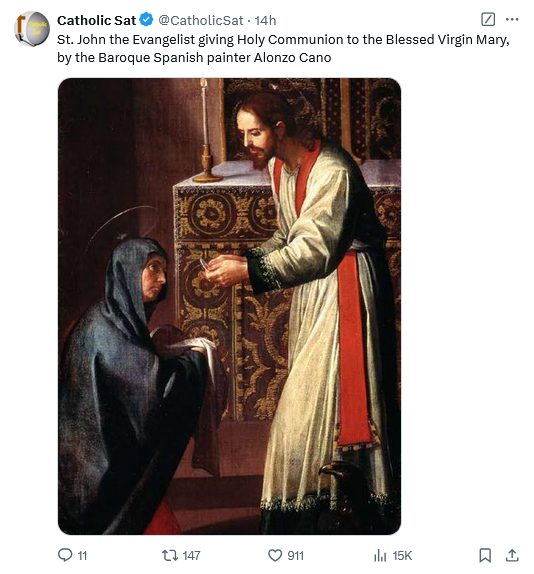






One of my favorite reflection assignments to give my students toward the end of the school year is after we have gone through Pentecost and the establishment of the Church in the NT, I ask them to think about how Our Lady would have pondered the Eucharist in its reception, given her special connection to the Lord and her status as a consecrated Ark.
Since Jesus had no biological father, all of Jesus’ DNA would have come from His Mother Mary with only one change having been miraculously made: the 23rd chromosome from XX to XY (since normally only the father’s DNA determines inheritance of an X or a Y). Thus, except for this one deviation, Jesus’ flesh and blood at the Eucharist would be genetically identical to His Mother’s. I am not sure what this means, theologically speaking.
So many mysteries LQC.
Here is St. Pope JPII take;
Mary lived her Eucharistic faith even before the institution of the Eucharist, by the very fact that she offered her virginal womb for the Incarnation of God’s Word,” the Holy Father wrote in Ecclesia de Eucharistia, 55 (original emphasis). For nine months, Mary had the Body and Blood of Jesus within her. At Mass, we receive the sacramental Body and Blood of Our Lord. John Paul II continues:
“At the Annunciation, Mary conceived the Son of God in the physical reality of his body and blood, thus anticipating within herself what to some degree happens sacramentally in every believer who receives, under the signs of bread and wine, the Lord’s body and blood” (55).
Second, St. John Paul II ponders how Mary would have felt when she first heard about the Eucharist. She was not present at the Last Supper and presumably would have learned about what happened there from the apostles:
“What must Mary have felt as she heard from the mouth of Peter, John, James and the other Apostles the words spoken at the Last Supper: ‘This is my body which is given for you’ (Luke 22:19)? The body given up for us and made present under sacramental signs was the same body which she had conceived in her womb!” (56).
John Paul then beautifully draws out the unique meaning Holy Communion would have had for the Blessed Virgin: “For Mary, receiving the Eucharist must have somehow meant welcoming once more into her womb that heart which had beat in unison with hers” (56).
What a profound insight! Imagine Mary preparing herself to be reunited with her Son in this way. Imagine the loving attention she gave to Jesus in every Holy Communion. What a joy it must have been for her to have her Son dwelling within her again.
That reflection was taken from an article in NCR;
https://www.ncregister.com/commentaries/what-mary-s-first-communion-teaches-us-about-reverencing-the-eucharist
LQC:
*
This my take on Incarnation:
*
Eve was made from a rib of Adam. She was of one flesh, one substance with Adam. In the same way during the Incarnation Christ’s flesh of His human body was taken from Mary. As the New Adam and the New Eve they were of one flesh and one substance. In both cases, Adam and Eve, and Christ and Mary, were physically consubstantial pointing to the Nicene Creed. The special creation of Eve from Adam and Christ from Mary is because they were the progenitors. Adam and Eve as the physical progenitors of the human race and Christ/New Adam and Mary/New Eve as the spiritual progenitors of the Mystical Body of Christ and the associated chaste spiritual marriage that takes place in heaven.