
From The Institute for the Study of War:
Russian Offensive Campaign Assessment, July 10, 2024
Riley Bailey, Nicole Wolkov, Kateryna Stepanenko, Karolina Hird and George Barros
July 10, 2024, 7:30pm ET
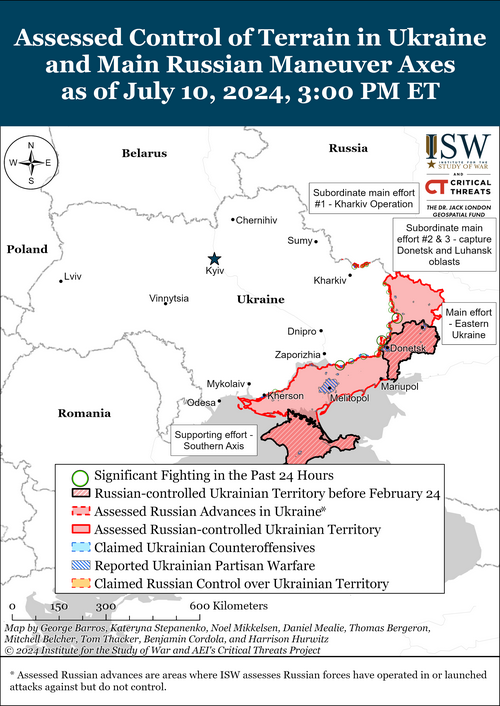
Click here to see ISW’s interactive map of the Russian invasion of Ukraine. This map is updated daily alongside the static maps present in this report.
Click here to see ISW’s 3D control of terrain topographic map of Ukraine. Use of a computer (not a mobile device) is strongly recommended for using this data-heavy tool.
Click here to access ISW’s archive of interactive time-lapse maps of the Russian invasion of Ukraine. These maps complement the static control-of-terrain map that ISW produces daily by showing a dynamic frontline. ISW will update this time-lapse map archive monthly.
Note: The data cut-off for this product was 1:30pm ET on July 10. ISW will cover subsequent reports in the July 11 Russian Offensive Campaign Assessment.
Ukrainian First Deputy Defense Minister Lieutenant General Ivan Havrylyuk stressed that robust Western security assistance will be crucial for Ukraine’s ability to contest and seize the battlefield initiative. Havrylyuk also challenged the notion that Russian forces will be able to indefinitely sustain the consistent gradual creeping advances that support Russian President Vladimir Putin’s theory of victory for winning a war of attrition in Ukraine. Havrylyuk published an article entitled “What Factors Will Allow Ukraine to Conduct a Counteroffensive” on July 9 wherein he states that Ukraine must contest the initiative and conduct counteroffensive operations in order to neutralize the Kremlin’s efforts to protract the war and to increase costs on Russia that will force it towards a just peace aligned with Ukraine’s terms.[1] Havrylyuk stated that Ukraine can contest the initiative if Ukraine strengthens combat brigades with personnel, ammunition, and equipment and specifically staffs and equips new brigades.[2] Havrylyuk also noted that it will be critical for Ukraine to create and consistently replenish reserves and sufficiently train new personnel.[3] Havrylyuk emphasized that Western security assistance will be critically important in determining at what scale Ukraine can achieve these tasks and called for more air defense systems, artillery shells, and long-range strike capabilities to strengthen Ukrainian combat effectiveness and operational capabilities.[4] Ukraine is addressing its manpower challenges and is already forming several new brigades, but Ukraine’s ability to equip these brigades will be the determining factor for how, when, and at what scale Ukraine can commit new brigades to support potential counteroffensive operations.[5] Current reporting suggests that Ukraine will not be able to fully equip all new planned brigades without the arrival of additional Western security assistance.[6] Western security assistance that provides Ukrainian forces with the necessary equipment and weapons at the scale, timing, and regularity required for operations that liberate significant swaths of occupied Ukraine remains the only likely path for reducing Putin’s current commitment to destroying Ukrainian statehood and identity.[7]
Ukrainian forces are already attempting to contest the battlefield initiative in limited and localized counterattacks at the tactical level — emphasizing that the current state of grinding positional warfare along the frontline is not an indefinitely stable one. The arrival of Western-provided aid to the frontlines has allowed Ukrainian forces to stabilize critical areas of the front, and Ukrainian forces have conducted tactically significant and successful localized counterattacks in northern Kharkiv Oblast and towards Kreminna (in the Donetsk-Luhansk Oblast border area) starting in mid-May 2024.[8] Ukrainian forces are not yet conducting counterattacks at the scale necessary to seize the battlefield initiative, but these tactical Ukrainian counterattacks are increasing the costs imposed on Russian forces for continuing to pursue their slow, grinding theory of advance. For example, Ukrainian counterattacks in northern Kharkiv Oblast have forced Russian troops to redeploy select Russian elements away from where their centralized command formation should hypothetically be — ISW observed that Russia moved elements of the 810th Naval Infantry Brigade (Black Sea Fleet) and a battalion tactical group of the 9th Motorized Rifle Brigade (1st Donetsk People’s Republic Army Corps) to northern Kharkiv Oblast in mid-June while other elements of the 810th Infantry and 9th Motorized Rifle brigades remained near Krynky, Kherson Oblast, and Toretsk, Donetsk Oblast respectively, where they had been fighting for some time.[9] ISW also recently assessed that the Russian military command was separating and deploying elements of Russian Airborne (VDV) formations across the frontline — elements of the 106th VDV Division’s 137th VDV Regiment are reportedly fighting in Kherson Oblast, while other elements of the regiment are fighting near Siversk, Donetsk Oblast.[10] The disparate deployment of elements of the same wider formation is a strong indicator that Russian forces are beginning to feel the pressure of Ukrainian counterattacks — emphasizing that the frontline is not as static as Putin assesses it to be. Ukraine’s ability to launch more powerful and organized counterattacks, however, continues to be contingent on sustained Western military support.
Havrylyuk assessed that Russia will face medium- to long-term economic and equipment challenges that will impede the Russian military’s ability to indefinitely retain the theater-wide initiative, sustain consistent offensive pressure that results in gradual creeping advances, and win a war of attrition. Havrylyuk stated that Russian forces still retain a significant artillery, armored vehicle, and manpower advantage over Ukrainian forces and that Ukraine lacks effective countermeasures to degrade the Russian aviation capabilities that are facilitating Russian tactical advances.[11] Havrylyuk stated that Russian forces are leveraging these advantages and the theater-wide initiative to intensify and sustain the tempo of their offensive operations in order to exhaust Ukrainian forces and prevent Ukraine from accumulating the manpower and materiel needed to contest the initiative.[12] Havrylyuk assessed that Russian forces will not make significant advances in the future but that the current positional warfare suits the Kremlin’s attempt to protract the war and convince the West that Ukraine’s victory is impossible.[13] Havrylyuk’s assessment is consistent with ISW’s assessment about Putin’s strategic calculus, his desire to protract the war, and his attempts to convince the West to abandon Ukraine.[14] Putin and the Russian military command likely view the retention of the initiative as a strategic priority and assess that Ukraine will be unable to conduct any operationally significant counteroffensive operations as long as Russia maintains consistent offensive pressure against Ukraine.[15]
Havrylyuk challenged Russia’s prospects for indefinitely maintaining that offensive pressure, however, suggesting that Russia has reached a limit for mobilizing its defense industrial base (DIB) in support of the war effort.[16] Russia will likely face human capital and supply chain constraints in the medium-term that will prevent the Kremlin from gradually mobilizing Russia’s DIB as it has done so far, presenting Putin with more politically fraught economic choices should he deem further economic mobilization necessary.[17] Havrylyuk stated that Russia is not producing enough to cover its current military equipment losses in Ukraine, increasingly relying on dwindling stockpiles of mainly Soviet-era equipment and becoming more dependent on foreign partners for military materiel.[18] Russia has extensively relied on the refurbishment of Soviet-era equipment to expand defense outputs, and growing constraints on available combat-ready equipment will pose challenges for sustaining Russian operations in Ukraine in the medium- to long-term.[19] Ukrainian forces that have accumulated the manpower and materiel needed for operationally significant counteroffensive operations can exploit disruptions that even temporary Russian equipment constraints cause to contest and seize the battlefield initiative.[20] Havrylyuk assessed that Russian forces will face fewer manpower challenges, although even Russia’s current ability to generate as many new personnel as battlefield losses leads to culminations – periods of temporary regrouping and reconstitution and lower offensive tempo — which will provide opportunities for sufficiently prepared Ukrainian forces to contest and seize the battlefield initiative.[21]
Putin’s articulated theory of a slow, grinding victory in Ukraine is notably premised on accepting continuously high casualty rates, as exemplified by reported Russian losses accrued during two recent offensive efforts. In his July 9 article, Havrylyuk claimed that Russian forces suffered 5,000 casualties for just one district of Chasiv Yar, likely referring to Kanal Microraion (the only neighborhood of easternmost Chasiv Yar that Russian forces currently control).[22] Kanal Microraion is around three blocks wide and three blocks long, and the loss of 5,000 personnel for such a small piece of territory is indicative of the highly attritional way in which Russian forces are conducting their offensive operations. Ukrainian Kharkiv Group of Forces Chief-of-Staff Viktor Solimchuk similarly reported on July 10 that Russian forces lost (killed, wounded, or captured) 91 percent of the personnel they committed to fighting (reportedly amounting to roughly a division‘s worth of personnel) in northern Kharkiv Oblast at the start of the Kharkiv Oblast offensive in early May 2024.[23] Solimchuk also noted that Russian offensive efforts in Vovchansk, Kharkiv Oblast, have severely weakened the 138th Motorized Rifle Brigade (6th Combined Arms Army, Leningrad Military District).[24] Ukrainian and Western sources recently reported that the 83rd Airborne (VDV) Brigade suffered such devastating losses in Kharkiv Oblast that it is no longer combat-effective.[25] ISW cannot independently verify either Ukrainian or Western estimates of Russian casualties, but the recent increase in reports of entire Russian units becoming combat ineffective due to losses highlights the tactics on which Russian forces are relying on to pursue Putin’s theory of a slow, gradual, grinding victory in Ukraine.
NATO allies reaffirmed their commitment to supporting Ukraine and announced new security assistance packages for the Ukrainian war effort at the NATO summit in Washington, DC on July 9 and 10. NATO Secretary General Jens Stoltenberg stated that he expects NATO allies to agree on a substantial package for Ukraine which includes establishing a NATO command center in Weisbaden, Germany to facilitate the training of Ukrainian personnel and the delivery of security assistance, establishing a new joint training center in Bydgoszcz, Poland, a long-term pledge of continued support for Ukraine, new announcements of provisions of air defense systems and F-16 fighter jets, and bilateral security agreements between NATO allies and Ukraine.[26] Stoltenberg noted that these pledges will constitute a “strong bridge” for possible, future Ukrainian NATO membership. US President Joe Biden, Dutch Prime Minister Dick Schoof, German Chancellor Olaf Scholz, Italian Prime Minister Giorgia Meloni, Romanian President Klaus Iohannis, and Ukrainian President Volodymyr Zelensky issued a joint statement on July 9 pledging to provide five additional Patriot air defense systems to Ukraine.[27] The joint statement notes that the US and its partners, including Canada, Norway, Spain, and the United Kingdom, intend to provide Ukraine with “dozens” of tactical air defense systems in the coming months. Biden, Schoof, and Danish Prime Minister Mette Fredriksen issued a joint statement on July 10 noting that the Netherlands and Denmark are in the process of transferring F-16 fighter jets to Ukraine and that Ukraine will start operating F-16s in the Summer of 2024.[28] Norwegian Prime Minister Jonas Gahr Store announced on July 10 that Norway will provide Ukraine with six F-16s starting at an unspecified date in 2024.[29] The Dutch Ministry of Defense (MoD) stated on July 10 that the Netherlands will allocate an additional 300 million euros (about $325 million) to purchase ammunition for F-16s.[30] The new United Kingdom (UK) Prime Minister, Keir Starmer, reaffirmed on July 9 that he would continue the UK’s policy of allowing Ukrainian forces to strike military targets in Russian territory with UK-provided Storm Shadow missiles.[31]
Russian Security Council Deputy Chairperson Dmitry Medvedev reaffirmed that Russia would not accept or uphold any negotiated peace settlements with Kyiv short of Ukrainian capitulation, the destruction of the entire Ukrainian state, and the full occupation of Ukraine. Medvedev stated on July 10 that even if Kyiv agrees to Russian President Vladimir Putin’s most recent conditions for peace — namely recognizing Russia’s territorial claims over eastern and southern Ukraine, including territory that Russia does not currently occupy, and pledging not to join NATO — and signs documents resulting in Ukrainian surrender, these actions will not constitute the “end of the Russian military operation” in Ukraine.[32] Medvedev stated that even if Ukraine surrenders, Russia will eventually still need to destroy the remaining Ukrainian “radicals” and return “remaining [Ukrainian] lands to the bosom of the Russian land.” Medvedev also implied that Russian-Ukrainian negotiations will likely take place only after there is a radical change within the Ukrainian government and that this can only occur after Ukrainian society stages a “third bloody Maidan” revolution in response to a ceasefire agreement and Ukraine’s willingness to abandon prospects for NATO accession. Medvedev insinuated that the Kremlin plans to continue its conquest of Ukraine following a negotiated peace agreement. Medvedev’s argumentation also indicates that the Kremlin believes that the full conquest of Ukraine will be easier if Kyiv accepts deeply unpopular ceasefire agreements and concessions at the current stage of the war, in anticipation that Ukrainian society would demand a government change that could benefit the Kremlin. The Kremlin has misread domestic Ukrainian sentiment before, however. Ukrainian officials have long warned that the Kremlin launched an elaborate “Maidan 3” information campaign, which aims to undermine the Ukrainian government likely in order to trigger a government change and establish a pro-Kremlin government in Ukraine.[33]
Servicemembers of a Russian motorized rifle regiment that was previously implicated in the execution of Ukrainian prisoners of war (POWs) in late May 2024 reportedly executed two Ukrainian POWs in the same area in western Zaporizhia Oblast in June 2024. Ukrainian social media sources amplified footage on July 10 showing Russian servicemembers shooting two Ukrainian POWs in the Zaporizhia direction and identified the perpetrators as servicemembers of the Russian 70th Motorized Rifle Regiment (42nd Motorized Rifle Division, 58th Combined Arms Army [CAA], Southern Military District [SMD]).[34] Ukrainian Prosecutor General Andriy Kostin stated on July 10 that the video clearly showed Ukrainian personnel laying down their arms and cooperating with Russian orders and noted that the investigation found that the incident took place near Robotyne in June 2024.[35] The execution of POWs is a violation of the Geneva Convention on POWs.[36] Ukraine’s Main Military Intelligence Directorate (GUR) previously identified four servicemembers of the Russian 70th Motorized Rifle Regiment who executed Ukrainian POWs near Robotyne in late May 2024.[37] ISW assessed on June 19 that the Russian military command endorses a culture of permissiveness towards war crimes perpetrated by subordinates throughout the theater in Ukraine, especially in Donetsk and Zaporizhia oblasts.[38] ISW also assessed that individual tactical-level commanders are likely enabling their subordinates to commit such atrocities given the pervasiveness and recurrence of these war crimes across different operational commands. The fact that the same military unit has continued to commit these crimes also suggests that the Russian high command is failing to properly discipline troops and maintain order.
Select US military bases in Europe have instituted increased alert levels in response to intensified Russian sabotage and hybrid operations against NATO allies over the past several months. CNN reported on July 9, citing multiple sources familiar with the matter, that the US recently implemented additional safety protocols and raised the state of alert at US military bases in Europe after receiving intelligence that Russian-backed actors may be planning sabotage attacks against US facilities and personnel.[39] CNN’s sources stated that several US military bases in Europe raised their alert level to “Force Protection Condition Charlie,” which applies “when an incident occurs, or intelligence is received indicating some form of terrorist action or targeting against personnel or facilities is likely.”[40] NATO Secretary General Jens Stoltenberg confirmed on July 10 that the US has increased its alert levels for some US bases in Europe and noted that Russian sabotage attempts and other malign acts against NATO allies are part of a campaign to intimidate NATO countries that support Ukraine.[41] Stoltenberg stated that NATO is increasing its awareness, intelligence sharing, and cyber defenses to combat increased Russian hybrid threats. The Washington Post reported on July 10, citing Kremlin documents obtained by an unspecified European intelligence service, that Russia is identifying individuals and recruiting sympathizers through social media to stage sabotage operations in Europe.[42] The Kremlin documents show that Kremlin political strategists in July 2023 analyzed the Facebook profiles of over 1,200 people who they believed were workers of the two large German plants and highlighted posts demonstrating an anti-government, anti-immigration, and anti-Ukraine position. Unspecified Western officials noted that Russia is increasingly working through proxies, including via internet recruits, which offers some deniability while maximizing the pool of potential recruits. Lithuanian Foreign Minister Gabrielius Landsbergis noted that individuals recruited online for Russian sabotage operations may not have a Russian handler in a NATO country.[43]
Key Takeaways:
- Ukrainian First Deputy Defense Minister Lieutenant General Ivan Havrylyuk stressed that robust Western security assistance will be crucial for Ukraine’s ability to contest and seize the battlefield initiative. Havrylyuk also challenged the notion that Russian forces will be able to indefinitely sustain the consistent gradual creeping advances that support Russian President Vladimir Putin’s theory of victory for winning a war of attrition in Ukraine.
- Ukrainian forces are already attempting to contest the battlefield initiative in limited and localized counterattacks at the tactical level — emphasizing that the current state of grinding positional warfare along the frontline is not an indefinitely stable one.
- Havrylyuk assessed that Russia will face medium- to long-term economic and equipment challenges that will impede the Russian military’s ability to indefinitely retain the theater-wide initiative, sustain consistent offensive pressure that results in gradual creeping advances, and win a war of attrition.
- Putin’s articulated theory of a slow, grinding victory in Ukraine is notably premised on accepting continuously high casualty rates, as exemplified by reported Russian losses accrued during two recent offensive efforts.
- NATO allies reaffirmed their commitment to supporting Ukraine and announced new security assistance packages for the Ukrainian war effort at the NATO summit in Washington, DC on July 9 and 10.
- Russian Security Council Deputy Chairperson Dmitry Medvedev reaffirmed that Russia would not accept or uphold any negotiated peace settlements with Kyiv short of Ukrainian capitulation, the destruction of the entire Ukrainian state, and the full occupation of Ukraine.
- Servicemembers of a Russian motorized rifle regiment that was previously implicated in the execution of Ukrainian prisoners of war (POWs) in late May 2024 reportedly executed two Ukrainian POWs in the same area in western Zaporizhia Oblast in June 2024.
- Select US military bases in Europe have instituted increased alert levels in response to intensified Russian sabotage and hybrid operations against NATO allies over the past several months.
- Russian forces recently advanced in Vovchansk, near Kreminna, and near Toretsk.
- The Russian Ministry of Defense (MoD) claimed on July 10 that the Russian military trained the first batch of Moscow Military District (MMD) counter-drone instructors at the Alabino training ground in Moscow Oblast.
Go here to read the rest. The idea that Ukraine can fight its war indefinitely on America’s credit card is likely to be a nonstarter in 2025. The simple truth is that the Ukrainian military lacks the power to drive the Russians out. Short of Putin dying, this war is a stalemate for the foreseeable future, and stalemates are always unpopular with Americans.

