
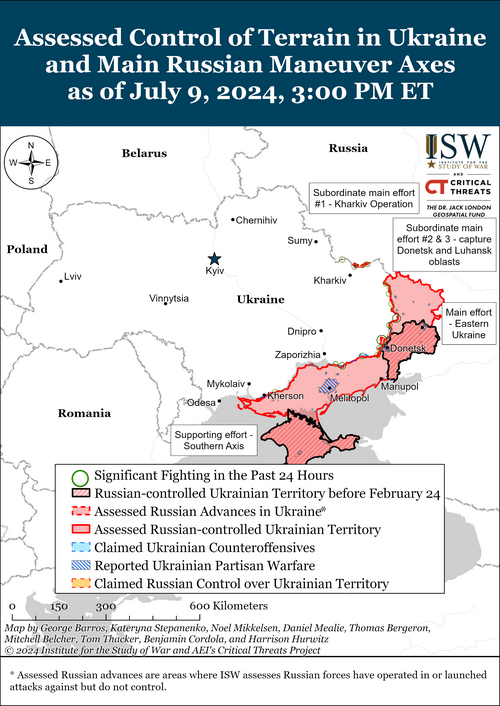
From The Institute for the Study of War:
Russian Offensive Campaign Assessment, July 9, 2024
Karolina Hird, Nicole Wolkov, Kateryna Stepanenko, Grace Mappes, and Fredrick W. Kagan
July 9, 2024, 8:45pm ET
Click here to see ISW’s interactive map of the Russian invasion of Ukraine. This map is updated daily alongside the static maps present in this report.
Click here to see ISW’s 3D control of terrain topographic map of Ukraine. Use of a computer (not a mobile device) is strongly recommended for using this data-heavy tool.
Click here to access ISW’s archive of interactive time-lapse maps of the Russian invasion of Ukraine. These maps complement the static control-of-terrain map that ISW produces daily by showing a dynamic frontline. ISW will update this time-lapse map archive monthly.
Note: The data cut-off for this product was 1pm ET on July 9. ISW will cover subsequent reports in the July 10 Russian Offensive Campaign Assessment.
Russian President Vladimir Putin and Indian Prime Minister Narendra Modi issued a joint statement on July 9 about strengthening mutually beneficial political, economic, energy, and military-technical cooperation between Russia and India. Modi met with Putin in Moscow on July 8 and 9 to discuss furthering Russo-Indian relations, which Putin referred to as a “particularly privileged strategic partnership.”[1] The joint statement specifically pledged to increase joint production of spare components and parts for servicing Russian-made military equipment and weapons in India, agreed to establish a working group on technological cooperation, and planned to reorient the existing Russo-Indian Intergovernmental Commission on Military and Military-Technical Cooperation on joint research, development, and production of advanced defense technologies and systems.[2] Russian Deputy Prime Minister Alexander Novak stated that India and Russia are considering entering a long-term agreement on oil supplies and that Russia is considering allowing Indian companies to participate in Russian gas projects.[3] Head of the Russian state nuclear energy operator Rosatom Alexei Likhachev stated during a tour that Putin and Modi took at a Rosatom exhibition that Russia is offering to assist India in constructing low-power tropical nuclear power plants.[4] Modi credited Russo-Indian energy, economic, and food security cooperation for helping to control Indian inflation and ensure economic stability.[5]
Putin has been intensifying efforts to strengthen Russian relations with non-Western countries through individualized appeals, although he is likely emphasizing Russo-Indian cooperation in the Shanghai Cooperation Organization (SCO) and BRICS as part of a wider Russian effort to create an alternative “Eurasian security architecture” leveraging existing Eurasian multilateral organizations.[6] Putin stated that Russia and India will continue to closely cooperate in multilateral organizations such as the United Nations (UN), SCO, and BRICS.[7] Putin and Russian Defense Minister Andrey Belousov have both explicitly identified the SCO and BRICS as the pillars of this “Eurasian security architecture.”[8] Putin also recently visited the People’s Republic of China (PRC), North Korea, and Vietnam to strengthen bilateral cooperation with these countries and attempt to build a coalition of support for Russia from non-Western countries.[9]
Modi tacitly supported the Kremlin’s false narrative that Russia is interested in a peaceful, negotiated resolution to the war in Ukraine, likely in exchange for deepening economic, energy, and technological cooperation with Russia. Putin thanked Modi for trying to find a “peaceful” way to resolve the war in Ukraine, and Modi stated that dialogue, not war, is necessary for a peaceful solution.[10] Modi also stated that India is ready to assist Russia in establishing peace as soon as possible. Modi notably did not frame India as a potential mediator between Russia and Ukraine, and Kremlin Spokesperson Dmitry Peskov stated to the press following Russian-Indian negotiations that Modi did not claim to be a mediator in the war.[11] Putin has previously expressed support for non-Western countries’ mediation efforts – most notably the People’s Republic of China (PRC) and a coalition of African states — as part of Russian information operations falsely portraying Russia as willing to negotiate with Ukraine.[12] Putin previously amplified the false narrative that Russian authorities are interested in good-faith negotiations but continues to state that his prerequisites for negotiation require Ukraine’s full capitulation through “demilitarization” and the surrender of significant territory that Russia does not currently occupy.[13] Putin has more recently rejected any efforts of third-party mediation.[14]
Putin may have pledged to return Indian volunteers fighting in Ukraine during a private dinner with Modi in Novo-Ogaryovo, Moscow Oblast on July 8. Indian Foreign Secretary Vinay Mohan Kwatra stated on July 9 that Modi “strongly” raised the need for Russia to facilitate the early discharge of Indian nationals “who have been misled” into fighting in Ukraine as part of the Russian military.[15] Kwatra stated that Russian officials promised the early discharge of Indian nationals and noted that around 35 to 50 Indian nationals have fought in Ukraine under misleading offers of high-paying “support roles” in the Russian military and that 10 of these Indian nationals already returned to India.[16] Unnamed sources told Indian news media company New Delhi Television (NDTV) that Putin personally agreed to discharge all Indian volunteers who had signed military service contracts with the Russian Ministry of Defense (MoD) and pledged to facilitate the return of Indian volunteers.[17] Unnamed sources told the Indian English-language newspaper The Hindu that India expects the release of Indian volunteers within the coming weeks after Modi’s ”direct intervention” in the matter.[18] Kremlin Spokesperson Dmitry Peskov stated that the Kremlin will not comment on these reports, although Russian state news agency TASS notably paraphrased Indian reports as stating that Indian citizens were allegedly fighting in Ukraine ”by mistake.”[19] The official Kremlin read-out of the July 8 meeting also omitted to mention the Putin-Modi discussion of Indian volunteers fighting in Ukraine.[20]
The recruitment of Indian volunteers into the Russian military is certainly not a “mistake” and is part of the Kremlin’s deceptive volunteer recruitment campaign aimed at reinforcing the frontlines in Ukraine without declaring unpopular mobilization in Russia. Indian officials announced their efforts in February 2024 to secure early discharge for 20 Indian nationals recruited into the Russian military.[21] The Indian Central Bureau of Investigation (CBI) announced in March 2022 that it uncovered “a major human trafficking network” that lured Indian citizens to work in Russia but forced them to join the Russian military.[22] A group of Indian men published a video appeal in March 2024 requesting help from the Indian government to return from Russia, stating that Russian officials coerced them into joining the Russian army upon arrival to Russia on tourist visas and threatened to imprison them for 10 years.[23] Indian nationals told Reuters in March 2024 that recruiters offered permanent residency in Russia after six months of combat service.[24] The recruitment of Indian nationals is part of an ongoing Kremlin force generation campaign which began in Spring 2022 as a way for Putin to avoid declaring deeply unpopular mobilization in Russia and has continued following Putin’s partial mobilization declaration in September 2022.[25] The Kremlin entrusted a wide range of recruiters including Russian government officials, businessmen, private military companies (PMCs), and foreign nationals with recruiting any available volunteers to fight in Ukraine, often using deceptive practices and incentives.[26] ISW observed Russia commit citizens of Nepal, Cuba, Serbia, and Central Asian and African countries to combat operations in Ukraine under deceptive premises such as offers of Russian citizenship or steep financial compensations.[27]
Some unnamed US government officials appear to believe that Ukraine does not need to liberate its occupied lands and people to win the war, despite Russian President Vladimir Putin’s recent clear statements that Russia will not accept a negotiated ceasefire on any terms other than Ukrainian capitulation and will not abandon its goals of the total destruction of the entire Ukrainian state–not just the lands it currently occupies. The New York Times (NYT) reported on July 9 that anonymous US officials think that “even without formally winning back its land, Ukraine could still emerge a victor in the war by moving closer to NATO and Europe.”[28] This US assessment is premised on several faulty assumptions—first and foremost on the assumption that Ukraine’s NATO or European Union (EU) membership is guaranteed. Ukraine’s NATO and EU membership should not be taken as a given in discussions of the future of Ukrainian security.[29] This assessment also rests on the assumption that losing the lands Russia currently occupies and its civilians under Russian occupation will not severely compromise Ukraine’s future economic viability and ability to defend itself against future Russian attacks, which, as ISW has frequently emphasized, is not the case.[30] The lands Russia currently occupies are both economically and strategically necessary for Ukraine, and their continued occupation will deprive Ukraine of economic resources and strategically critical land. Putin himself has stated that Russia will not be content with ending the war on the lines it currently holds and has explicitly called for the Ukrainian withdrawal from the non-occupied parts of Donetsk, Luhansk, Kherson, and Zaporizhia oblasts as a prerequisite for any sort of “peace” negotiations with Ukraine.[31] The areas Putin is currently demanding include the large cities of Kherson and Zaporizhzhia, among other things. Putin has, furthermore, continually framed the war as a struggle against NATO and repeated his insistence that Ukraine change its constitution to formally abandon any aspirations of joining the alliance.[32] There is no basis for assessing that Putin would agree to a ceasefire that leaves Ukraine closer to NATO. Finally, this suggestion is contingent on the faulty assumption that Russian aggression will “end” with the conclusion of the war on Russia’s terms. ISW, on the contrary, has assessed that a negotiated ceasefire on Russian terms will afford the Russian military time to rest and reconstitute, likely before conducting a future attack on Ukraine from a much more advanced and fortified frontline.[33] Putin has been firm and consistent in his ultimate goal of destroying the Ukrainian state and will not give up that goal until he feels that he has achieved it.[34]
Several independent investigations, including one conducted by the United Nations (UN) Human Rights Monitoring Mission in Ukraine (HRMMU), concluded that a Russian missile struck the Kyiv City Okhmatdyt Children’s Hospital on July 8 amid continued official Russian denials and deflections. The HRMMU assessed on July 9 that the Okhmatdyt strike “was likely caused by a direct hit from a Russian missile.”[35] Open-source investigations conducted by Molfar, Bellingcat, and a Ukrainian reserve officer for the Ukrainian outlet Euromaidan Press concluded that a Russian Kh-101 cruise missile struck the hospital.[36] The investigations cited visual characteristics of the Kh-101 model that are consistent with clear footage of the missile seconds before its impact. Ukraine called a meeting of the UN Security Council (UNSC) on July 9 to discuss the Okhmatdyt strike, and several international officials condemned Russia for so blatantly striking a civilian object.[37] Russian officials and commentators, however, continue to deny Russian responsibility for the strike or blame it on an errant Ukrainian air defense missile, despite the growing body of documentation to the contrary.[38] Russian Foreign Ministry Spokesperson Maria Zakharova claimed that a Ukrainian NASAMS air defense missile struck the Okhmatdyt hospital and accused Ukraine of using the strike for informational effect to “further escalate” the war.[39] Kremlin spokesperson Dmitry Peskov claimed that a Ukrainian missile hit Okhmatdyt and called it a “PR operation in blood.”[40] A former pro-Russian Ukrainian Rada deputy attempted to justify the strike by claiming that Ukrainian forces had an air defense headquarters in the area.[41] These Russian claims are baseless and refuted by the aforementioned visual evidence and open-source investigations, and as ISW stated on July 8, do not absolve Russian forces of legal or moral responsibility for the impacts of the strike on Okhmatdyt.[42]
Ukrainian forces conducted a series of drone strikes against Russian energy and military infrastructure in Belgorod, Kursk, Rostov, Astrakhan, and Volgograd oblasts overnight on July 8 to 9. Sources in Ukrainian intelligence told Ukrainian media that Ukraine’s Security Service (SBU) and Main Military Intelligence Directorate (GUR) conducted drone strikes against the Akhtubinsk military airfield in Astrakhan Oblast, an electrical substation in Rostov Oblast, and an oil depot in Kalach-on-Don in Volgograd Oblast overnight.[43] Geolocated footage published on July 9 shows fires at an electrical substation in Yudino, Rostov Oblast and the Kalach-on-Don oil depot.[44] Russian and Ukrainian sources reported that Ukrainian drones also struck electrical substations at an oil refinery, butter factory, and gas stations in Kursk Oblast, as well as the Energomash electrical equipment plant in Belgorod City.[45] Russian sources claimed that Ukrainian forces launched over 40 drones at areas in Russia overnight, including “several dozen” drones against Rostov Oblast, and that Russian air defenses intercepted most but not all of the drones.[46]
Russian President Vladimir Putin appointed new military prosecutors on July 8, likely in support of ongoing, long-term Russian military reforms. Putin appointed Russian Lieutenant General of Justice Sergey Kazakov as military prosecutor of the Russian Joint Group of Forces for a five-year term, replacing Lieutenant General of Justice Alexey Naida.[47] Putin appointed Naida as military prosecutor of the Leningrad Military District (LMD), Major General of Justice Konstantin Olkhovatenko as Central Military District (CMD) military prosecutor, Major General of Justice Igor Kupreev as Northern Fleet military prosecutor, and Major General of Justice Oleg Okorokov as Black Sea Fleet (BSF) military prosecutor.[48] Putin appointed Lieutenant General of Justice Andrey Popov on April 8 as military prosecutor of the Moscow Military District (MMD) after having served in the same position for the CMD.[49] Putin is likely shifting around and appointing new military prosecutors to support his effort to reform and encourage discipline within the Russian military in the long-term.
Newly-elected Iranian President Masoud Pezeshkian reiterated Iran’s continued willingness to enter a comprehensive strategic partnership with Russia, emphasizing the continuity in Iran’s support for Russia even under a new presidential administration. Pezeshkian spoke with Russian President Vladimir Putin on the phone on July 8 and reportedly voiced Iran’s willingness to sign a comprehensive strategic partnership agreement with Russia at the upcoming October 2024 BRICS summit.[50] Putin in turn highlighted his satisfaction with close Russo-Iranian relations and expressed his readiness for “joint work” in various areas.[51] Pezeshkian’s apparent willingness to pursue and develop a strategic partnership with Russia is consistent with the efforts of his predecessor, Ebrahim Raisi, to expand bilateral cooperation by having consistent meetings with Putin and other Russian officials.[52] ISW-CTP previously assessed that Pezeshkian’s presidency is unlikely to create meaningful changes in the Iranian regime, as Iranian Supreme Leader Ali Khamenei will continue to dictate Iran’s foreign policy objectives.[53]
The US Department of Justice (DoJ) released affidavits on July 9 for several hundred X (formerly Twitter) accounts and domain names used by Russian state media and security services to operate a bot farm aimed at spreading disinformation in the United States and abroad.[54] The DoJ announced that it seized two domain names and searched 986 X accounts linked to an artificial intelligence (AI)-enhanced bot farm developed by Russian state media network RT and operated by the Russian Federal Security Service (FSB). The DoJ reported that this bot farm used AI to create fictitious social media profiles of individuals falsely posing as US individuals to promote messages in support of Russian government objectives. The DoJ said that RT leadership has sought to develop alternative means to distribute Russian narratives beyond its international TV broadcasts since at least 2022 and began establishing this bot farm in April 2022. The DoJ added that the Kremlin approved and offered financial support in early 2023 to create and lead a private intelligence organization to spread Russian disinformation using this bot farm. US Attorney General Merrick Garland reported that DoJ searches and seizures have disrupted a Russian “AI-enabled propaganda campaign” intended to sow disinformation among US and international social media outlets. The DoJ report emphasized the prevalence of fictitious social media accounts, particularly on X, that were linked to both the bot farm and the seized domain names. The DoJ reported that X voluntarily suspended the remaining identified bot accounts. These X accounts propagated debunked narratives and Kremlin talking points about the war in Ukraine, such as Kremlin claims that parts of Poland, Ukraine, and Lithuania were “gifts” from Russia. The bot farm pushed other narratives in video format such as a video of Russian President Vladimir Putin claiming that the war in Ukraine is not a territorial conflict or a matter of geopolitical balance, but rather about the “principles on which the New World Order will be based.”
Key Takeaways:
- Russian President Vladimir Putin and Indian Prime Minister Narendra Modi issued a joint statement on July 9 about strengthening mutually beneficial political, economic, energy, and military-technical cooperation between Russia and India.
- Putin has been intensifying efforts to strengthen Russian relations with non-Western countries through individualized appeals, although he is likely emphasizing Russo-Indian cooperation in the Shanghai Cooperation Organization (SCO) and BRICS as part of a wider Russian effort to create an alternative “Eurasian security architecture” leveraging existing Eurasian multilateral organizations.
- Modi tacitly supported the Kremlin’s false narrative that Russia is interested in a peaceful, negotiated resolution to the war in Ukraine, likely in exchange for deepening economic, energy, and technological cooperation with Russia.
- Putin may have pledged to return Indian volunteers fighting in Ukraine during a private dinner with Modi in Novo-Ogaryovo, Moscow Oblast on July 8.
- Some unnamed US government officials appear to believe that Ukraine does not need to liberate its occupied lands and people to win the war, despite Russian President Vladimir Putin’s recent clear statements that Russia will not accept a negotiated ceasefire on any terms other than Ukrainian capitulation and will not abandon its goals of the total destruction of the entire Ukrainian state–not just the lands it currently occupies.
- Several independent investigations, including one conducted by the United Nations (UN) Human Rights Monitoring Mission in Ukraine (HRMMU), concluded that a Russian missile struck the Kyiv City Okhmatdyt Children’s Hospital on July 8 amid continued official Russian denials and deflections.
- Ukrainian forces conducted a series of drone strikes against Russian energy and military infrastructure in Belgorod, Kursk, Rostov, Astrakhan, and Volgograd oblasts overnight on July 8 to 9.
- Russian President Vladimir Putin appointed new military prosecutors on July 8, likely in support of ongoing, long-term Russian military reforms.
- Newly-elected Iranian President Masoud Pezeshkian reiterated Iran’s continued willingness to enter a comprehensive strategic partnership with Russia, emphasizing the continuity in Iran’s support for Russia even under a new presidential administration.
- The US Department of Justice (DoJ) released affidavits on July 9 for several hundred X (formerly Twitter) accounts and domain names used by Russian state media and security services to operate a bot farm aimed at spreading disinformation in the US and abroad.
- Russian forces recently made confirmed advances southeast of Chasiv Yar, near Avdiivka, and southwest of Donetsk City, and Ukrainian forces recently advanced north of Kharkiv City.
- Russian Prime Minister Mikhail Mishustin signed a decree ordering the reestablishment of the Saratov Higher Artillery Command School on July 8, likely as part of ongoing efforts to build out a cadre of Russian officers.
- Russian authorities continue to deploy Rosgvardia contingents to occupied Ukraine to serve law enforcement functions.
Go here to read the rest. This year in the Ukraine War reminds me of what Marshal Petain told French troops in 1917 after a series of mutinies in the French army: “We will wait on the tanks and the Americans.”, a comment which was received with thunderous applause. Now I think both sides, unable to conduct large scale offensives that have any hope of success, are waiting to see what Trump will do, in the likely event that he wins re-election. Trump will probably attempt to impose a peace, and if Putin proves resistant he will increase the aid to Ukraine. If Ukraine proves resistant he will likely threaten to cut off aid. An early challenge for Trump.

