

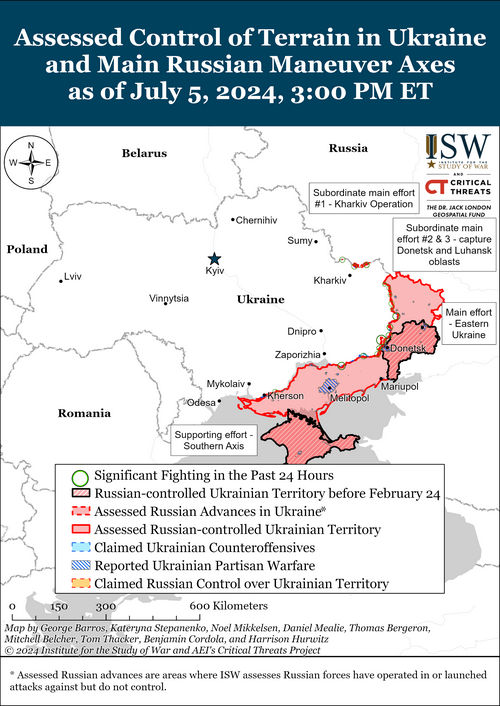
From The Institute for the Study of War:
Russian Offensive Campaign Assessment, July 5, 2024
Riley Bailey, Grace Mappes, Angelica Evans, Christina Harward, and Frederick W. Kagan
July 5, 2024, 7:20pm ET
Click here to see ISW’s interactive map of the Russian invasion of Ukraine. This map is updated daily alongside the static maps present in this report.
Click here to see ISW’s 3D control of terrain topographic map of Ukraine. Use of a computer (not a mobile device) is strongly recommended for using this data-heavy tool.
Click here to access ISW’s archive of interactive time-lapse maps of the Russian invasion of Ukraine. These maps complement the static control-of-terrain map that ISW produces daily by showing a dynamic frontline. ISW will update this time-lapse map archive monthly.
Note: The data cut-off for this product was 1:00pm ET on July 5. ISW will cover subsequent reports in the July 6 Russian Offensive Campaign Assessment.
Russian President Vladimir Putin used a meeting with Hungarian Prime Minister Viktor Orban on July 5 to oppose a negotiated ceasefire altogether and expressed his commitment to pursuing a “final” end to the war that would achieve his goal of destroying Ukrainian statehood. Putin met with Orban in Moscow and reportedly discussed Ukraine and the possibility of a negotiated ceasefire agreement.[1] Putin explicitly rejected Russian participation in any meaningful negotiations on a ceasefire agreement on July 4 in a departure from his usual feigned interest in negotiations, and Putin notably outright rejected any negotiated ceasefire in a press conference with Orban on July 5.[2] Putin stated that an agreement between Russia and Ukraine should not result in a temporary ceasefire since this would allow Ukraine to regroup and rearm and that Russia instead favors a “complete” and “final” end to the conflict.[3] Putin is currently unwilling to accept anything short of the destruction of Ukrainian statehood and identity, however, as his remarks and demands have consistently illustrated.[4]
Putin is demanding both the surrender of a significant portion of Ukraine’s territory and people to Russian occupation and Ukrainian military capitulation in advance of any negotiations on an end-state to the war. Putin called for the complete Ukrainian withdrawal from “Donbas and Novorossiya” as a prerequisite for ending the war during his press conference with Orban — a reference to Putin’s June 14 demand for Ukraine to recognize the Russian occupation of occupied Kherson, Zaporizhia, Donetsk, and Luhansk oblasts and for Ukraine to surrender all territory that Russia does not currently hold in the four oblasts.[5] The imagined borders of “Novorossiya” are disputed among Russian ultranationalists, however, and Putin and the Kremlin have routinely indicated that they hold aims of territorial conquest beyond the administrative boundaries of the four oblasts that Russia has illegally annexed.[6] Putin also invoked concerns on July 4 about Ukrainian military reconstitution and expansion during a potential ceasefire to call for Ukraine’s “irreversible” “demilitarization” as a prerequisite to negotiations.[7] Putin has long called for Ukraine’s “demilitarization” — a demand that Ukraine abandon its ability to resist Russian aggression so that Putin can freely impose his will upon Ukraine.[8] Putin would almost certainly use Ukraine’s capitulation to achieve his other goal of deposing Ukraine’s democratically elected government and replacing it with a pro-Russian government and a political system to his liking.
Ukrainian counteroffensive operations that liberate operationally significant territory remain the soundest course of action for degrading Putin’s confidence in and commitment to his desired end state for his war of aggression against Ukraine. Putin’s rejection of any ceasefire indicates that he is increasingly confident in his assessment that Russia can pursue victory by continuing creeping advances in Ukraine, outlasting Western support for Ukraine, and winning a war of attrition against Ukrainian forces.[9] Putin’s demands, achieved through either Ukraine’s capitulation or the protracted war he assesses Russian forces can successfully wage, are not consistent with the survival of an independent Ukrainian state or the Ukrainian people, nor are they compatible with NATO’s vital security interests. Putin’s confidence in Russia’s ability to encourage capitulation or win a protracted war of attrition is based on the assessment that Ukraine will not be able to conduct operationally significant counteroffensive operations.[10] The West must hasten to provide Ukraine the support it needs to conduct counteroffensive operations to invalidate Putin’s calculus and avoid protracting the war more than necessary to secure a peace acceptable to Ukraine and its partners.[11]
Putin’s rejection of any ceasefire agreement contradicts the Kremlin’s previous effort to place the onus for negotiations on the West and Ukraine. Putin blamed the West and Ukraine for the lack of negotiations while explicitly rejecting future Russian participation in any meaningful ceasefire negotiations during his July 4 press conference at the Shanghai Cooperation Organization (SCO), a stark contradiction in his rhetoric.[12] Putin also dismissed the possibility that any international body or head of state could mediate a ceasefire agreement between Russia and Ukraine, despite previously presenting China and various Western leaders as possible actors that Russia could negotiate with. Russian opposition outlet Meduza reported on July 5 that it obtained a Kremlin manual ordering pro-Kremlin and Russian state media to highlight Putin’s July 4 statements blaming the West and Ukraine for impeding peace negotiations with “ultimatums” and framing Russia as a willing, good-faith negotiator.[13] The manual recommends that Russian state media should present Putin’s demands for Ukrainian capitulation as logical and realistic and Ukraine and the West as untrustworthy and deceptive. Putin’s statements during his July 4 press conference and July 5 meetings will likely complicate the apparent ongoing Kremlin effort to convince select audiences that Russia remains interested in negotiations.[14]
Putin attempted to portray Orban as an EU representative who can speak on the EU’s behalf – a claim that EU officials explicitly denied. Putin stated before his talks with Orban that he understands that Orban visited Russia “not only as [Russia’s] long-standing partner, but also as the presiding officer of the EU Council.”[15] Putin stated that he hoped Orban would speak to the position of Orban’s “European partners” during their discussion. Orban stated that he would like to discuss Russia’s position on issues that are “important to Europe” and claimed that Hungary will likely soon become the only state in Europe that can speak to all parties of the war in Ukraine. The Ukrainian Ministry of Foreign Affairs (MFA) stated that Orban visited Russia without agreeing or coordinating with Ukraine and emphasized that there can be no agreements on Ukraine without Ukraine.[16] EU High Commissioner Josep Borrell and European Council President Charles Michel both explicitly stated that the EU Council presidency does not give Orban a mandate to visit Russia and that Orban is not acting on behalf of the EU.[17] Borrell stated that Orban’s visit to Russia is “exclusively” within the framework of Hungarian-Russian bilateral relations and noted that the EU excludes official contacts between the EU and Putin.[18] NATO Secretary General Jens Stoltenberg also stated that Orban is representing Hungary, not NATO.[19] Putin has repeatedly portrayed the West as his envisioned negotiating partner in a ceasefire agreement but notably dismissed all intermediary parties as possible mediators for an agreement between Ukraine and Russia on July 4.[20] Putin’s attempts to portray Orban as a legitimate representative of the EU who possesses the authority to speak about possible negotiations on July 5 directly contradicts Putin’s July 4 claims that intermediaries lack the competency and authority to mediate an end to the war.[21]
Recent Russian domestic polls suggest that Kremlin information operations are influencing domestic Russian support of the war in Ukraine. Independent Russian polling organization Levada Center published the results of a June 2024 poll on July 4 indicating that 58 percent of respondents believe that Russia should either definitely start peace negotiations with Ukraine in the near term or should start negotiations sooner rather than later, an all-time high since the start of the war but only a marginal increase since Levada’s most recent polling in May 2024.[22] Levada Center noted that Russian support for negotiations previously peaked at 57 percent each in October 2022 and November 2023 and that support for negotiations had hovered between 48 and 53 percent since January 2024. Senior Kremlin officials have largely perpetuated information operations aimed at portraying Russia as willing to negotiate with Ukraine but only on Russian terms that amount to Ukraine’s complete capitulation and destruction.[23] Levada noted that 41 percent of Russians believe that Russia is more interested in negotiations than Ukraine; that this number has been relatively consistent since 2023; and that these respondents largely believe that Russia is “going in the right direction,” approve of Russian President Vladimir Putin, and trust information about the war from television media (as opposed to information from the internet).
Prominent Kremlin information operations justifying the war in Ukraine have impacted domestic support for the war. Levada reported that two-thirds of respondents blame the US and NATO for the war in Ukraine and the resulting casualties, that this number has increased from around 53 percent since June 2023, and that half of these respondents believe that the war in Ukraine could escalate into a direct confrontation between Russia and NATO.[24] Levada noted that Russians remain concerned about the war; 95 percent of respondents expressed at least some concern about Ukrainian shelling of border areas and strikes against rear areas and about 86 percent of respondents are concerned about the “use of nuclear weapons” (actor unspecified) and the Western supply of weapons to Ukraine. Levada noted that 34 percent of Russians believe that the use of nuclear weapons in Ukraine “could be justified” but that over half of respondents remain directly opposed.
These Russian polls indicate that Russians who criticize the conduct of the war in Ukraine still support the war due to patriotism and disenfranchisement. Russian sociological organization Public Sociological Laboratory (PS Lab) told opposition outlet Verstka in an article published on July 5 that “non-opponents” to the war are increasingly criticizing the war in Ukraine but still believe that Russia should continue the war and will not say that the war is a mistake.[25] PS Lab defines “non-opponents” as those supporting, justifying, or distancing themselves from the war and that most justify the war but are not “convinced supporters.” PS Lab stated that most “non-opponents” share three attributes: they are apolitical and have a “detachment” from power, they possess serious and specific complaints about the government, and they cite patriotism for both their war justifications and their war criticisms. PS Lab noted that these “non-opponents” believe that they cannot influence the Russian government yet also feel more connected to the Russian government and identity than before the war, indicating that Kremlin propaganda is successfully establishing a degree of domestic unity that “non-opponents” value more than protesting against the Kremlin over their discontent about the war’s conduct. Levada reported that the percentage of Russians who are proud of Russia’s military actions in Ukraine rose to 48 percent, up from 45 percent in November 2023 and 38 percent from September 2023 – but still below the 51 percent peak following the onset of the war in February and March 2022.[26] Russian propaganda has created a layer of patriotism that likely acts as a buffer between complaints about the conduct of the war and the government that the Kremlin can endure and meaningful opposition that the Kremlin is unwilling or unable to tolerate.
PL Lab told Verstka that the percentage of actual “non-opponents” within Russia is difficult to estimate, but Verstka suggested several indicators that this percentage could range between 30 and 50 percent. Verstka noted that about 49 percent of respondents in a March 2024 Levada poll named human casualties as a possible reason for stopping the war in Ukraine and an increase in the number of respondents who avoid assessing the war.[27] Levada’s June 2024 poll reported that 31 percent of respondents follow the war but do not pay close attention whereas 19 percent closely follow the war.[28]
Many of Russia’s “non-opponents” of the war have criticisms that parallel those of Russian ultranationalist milbloggers, yet they lack the ultranationalists’ close attention to the war and desire for political change in support of Russian war aims. PS Labs told Verstka that surveyed “non-opponents” spoke about conversations with family members fighting in Ukraine who complained that Russian television lies about the real situation on the frontlines – echoing a longstanding Russian milblogger criticism that Russian state media frequently portrays the situation on the front as better than it is.[29] The “non-opponent” belief that they cannot influence the government and their inattention to the details of the war is a stark departure from the Russian ultranationalist voices, many of whom believe they can influence policy and have advocated for the better treatment of Russian military personnel, better conduct of the war in Ukraine, and even attempted political campaigns aimed at prompting change to these ends.[30]
Ukrainian forces conducted successful drone and missile strikes against targets in Tambov and Rostov oblasts and Krasnodar Krai on July 4 and 5. Ukrainian media reported that sources within Ukrainian intelligence stated that Ukraine’s Main Military Intelligence Directorate (GUR) conducted a successful drone strike against a gunpowder plant in Kotovsk, Tambov Oblast on July 4 and that the GUR is clarifying the consequences of the strike.[31] Russian opposition media outlet SOTA posted footage claiming to show the Ukrainian drone strike against the Tambov gunpowder plant.[32] GUR Spokesperson Andriy Yusov declined to comment on the reported strike on July 5 but stated that this gunpowder plant is a key Russian military enterprise and suggested that Russia will struggle to restart operations at the plant.[33]
Footage published on July 4 and 5 shows that a Ukrainian drone struck the Novoshakhtinsky oil refinery’s (NZNP) “Rostovskyi” oil depot in Rostov-on-Don and caused a subsequent explosion and fire at the depot on the night of July 4 to 5.[34] Rostov Oblast Governor Vasily Golubev stated that Russian air defenses destroyed 10 drones over Rostov Oblast and that debris from Ukrainian drones caused fires in Rostov Oblast.[35] NZNP is reportedly the largest supplier of petroleum products in southern Russia, and it is highly likely that the Russian Southern Military District (SMD) (which is based in Rostov-on-Don) uses products from the Rostovskyi oil depot.[36]
Sources within Krasnodar Krai emergency services told Russian opposition outlet Astra that several Ukrainian drones and at least two unspecified missiles struck Russia’s Primorsko-Akhtarsk air base in Krasnodar Krai on the night of July 4 to 5 and damaged a nearby substation, disrupting power to nearby residential areas.[37] Astra stated that the strike wounded a Russian servicemember and noted that the Russian 960th Guards Attack Aviation Regiment (1st Guards Mixed Aviation Division, 4th Guards Air Force and Air Defense Army) is stationed at the airbase and is typically armed with Su-25, Su-25UB, and Su-25SM3 attack aircraft. Ukrainian officials have not commented on the Krasnodar Krai strike as of this report, and the damage to the airfield is currently unclear. The Russian Investigative Committee has reportedly opened a criminal investigation into the Krasnodar Krai strike on charges of terrorism.[38]
Key Takeaways:
- Russian President Vladimir Putin used a meeting with Hungarian Prime Minister Viktor Orban on July 5 to oppose a negotiated ceasefire altogether and expressed his commitment to pursuing a “final” end to the war that would achieve his goal of destroying Ukrainian statehood.
- Putin is demanding both the surrender of a significant portion of Ukraine’s territory and people to Russian occupation and Ukrainian military capitulation in advance of any negotiations on an end-state to the war.
- Ukrainian counteroffensive operations that liberate operationally significant territory remain the soundest course of action for degrading Putin’s confidence in and commitment to his desired end state for his war of aggression against Ukraine.
- Putin’s rejection of any ceasefire agreement contradicts the Kremlin’s previous effort to place the onus for negotiations on the West and Ukraine.
- Putin attempted to portray Orban as an EU representative who can speak on the EU’s behalf – a claim that EU officials explicitly denied.
- Recent Russian domestic polls suggest that Kremlin information operations are influencing domestic Russian support of the war in Ukraine.
- These Russian polls indicate that Russians who criticize the conduct of the war in Ukraine still support the war due to patriotism and disenfranchisement.
- Many of Russia’s “non-opponents” to the war have criticisms that parallel those of Russian ultranationalist milbloggers, yet they lack the ultranationalists’ close attention to the war and desire for political change in support of Russian war aims.
- Ukrainian forces conducted successful drone and missile strikes against targets in Tambov and Rostov oblasts and Krasnodar Krai on July 4 and 5.
- Russian forces recently advanced near Vovchansk, Toretsk, and Donetsk City.
- Russian Ministry of Defense (MoD) officials continue to portray themselves as providing adequate medical care and other support for Russian soldiers who fought in Ukraine amid ongoing criticisms that the Russian military command sends injured soldiers to fight on the frontline.
Go here to read the rest. With both sides being reluctant to roll the iron dice of war this year, President Trump, assuming he replaces the animated corpse, will have the Ukraine War as an early test.





Xi is waiting to see if Putin is successful. If so, he will not stop at Taiwan.
Donald:
And Japan, South Korea, Taiwan and probably Vietnam are taking notes on the devastating power of drones to hold off numerically larger forces. I can only hope we are, too.