
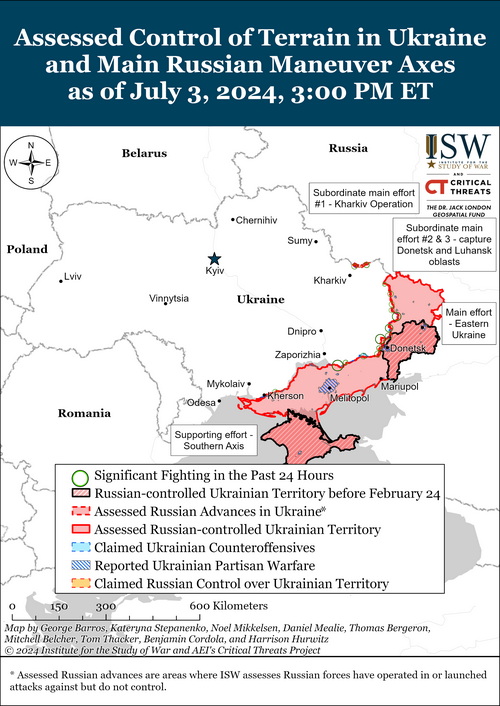
From The Institute for the Study of War:
Russian Offensive Campaign Assessment, July 3, 2024
Riley Bailey, Grace Mappes, Karolina Hird, Nicole Wolkov, and George Barros
July 3, 2024, 6:30pm ET
Click here to see ISW’s interactive map of the Russian invasion of Ukraine. This map is updated daily alongside the static maps present in this report.
Click here to see ISW’s 3D control of terrain topographic map of Ukraine. Use of a computer (not a mobile device) is strongly recommended for using this data-heavy tool.
Click here to access ISW’s archive of interactive time-lapse maps of the Russian invasion of Ukraine. These maps complement the static control-of-terrain map that ISW produces daily by showing a dynamic frontline. ISW will update this time-lapse map archive monthly.
Note: The data cut-off for this product was 1pm ET on July 3. ISW will cover subsequent reports in the July 4 Russian Offensive Campaign Assessment.
Ukraine is addressing its manpower challenges and is forming several new brigades, but delayed and insufficient Western weapons deliveries will likely prevent Ukraine from equipping all these new brigades. Timely and appropriate Western security assistance continues to be a crucial determinant of when and at what scale Ukrainian forces can contest the battlefield initiative and conduct operationally significant counteroffensive operations in the future. Ukrainian President Volodymyr Zelensky stated in an interview with Bloomberg published on July 3 that Ukrainian forces are better positioned in terms of manpower than they were a few months ago and that Ukraine’s ability to conduct a future counteroffensive operation depends on equipping brigades with heavy equipment, such as mechanized fighting vehicles, armored personnel carriers, tanks, and heavy artillery (likely referencing at least 10 planned new Ukrainian brigades.)[1] The commander of a Ukrainian brigade operating near Chasiv Yar provided a similar assessment at the tactical level on July 3, stating that Ukrainian forces in his area of operations are more in need of ammunition than manpower.[2] Zelensky stated that military equipment is taking too long to arrive at the front, however, echoing his comments from early June 2024 about how the slow arrival of US security assistance was complicating Ukrainian efforts to equip reserve brigades sufficiently to commit them to defensive operations.[3] Ukrainian media has routinely highlighted in recent months the lack of sufficient materiel for equipping all the new Ukrainian brigades currently being formed, and current reporting suggests that Ukraine will not be able to fully equip all their upcoming brigades without the arrival of additional Western security assistance.[4] The months-long delay of Western security assistance exacerbated challenges with Ukraine’s force mobilization efforts.[5]
Ukraine’s ability to conduct operationally significant counteroffensive operations at the time of its choosing is crucial to avoid protracting the war. Russian President Vladimir Putin’s theory of victory that Russia will be able to make creeping advances in Ukraine indefinitely is likely incentivizing Putin to protract the war and hardening his commitment to destroying Ukrainian statehood, and Putin is unlikely to change his calculus without Ukraine inflicting further significant defeats on Russian forces.[6] Ukraine does not have the time and flexibility to wait for Western security assistance to equip new units. Russian forces are likely currently attempting to leverage the theater-wide initiative to try to force Ukraine to commit manpower and materiel to current defensive operations and to prevent Ukraine from accumulating the decisive personnel and resources it needs to contest the initiative.[7] The longer Ukraine must wait to equip and deploy new brigades the more opportunities Russian forces will have to disrupt Ukrainian efforts to concentrate new uncommitted combat power for future counteroffensive operations. Western security assistance that allows Ukrainian forces to equip new units will ease these pressures, and more certainty in what forces will be available will permit Ukraine to start concretely planning future counteroffensive operations. Western security assistance that provides Ukrainian forces with the necessary equipment and weapons at the scale, timing, and regularity required for operations that liberate significant swaths of occupied Ukraine remains the only likely path for reducing Putin’s current commitment to destroying Ukrainian statehood and identity.[8]
Russian President Vladimir Putin is leveraging existing Eurasian-focused and Russian-led international organizations as the cornerstone for his new proposed alternative “Eurasian security architecture.” Russian Defense Minister Andrey Belousov stated during the Commonwealth of Independent States (CIS) Defense Ministers’ meeting on July 3 that Putin’s recently-announced “Eurasian security structure” will cover “all spheres of activity” and is “open to all Eurasian countries without exception.”[9] Belousov emphasized the importance of the Russian-Belarusian Union State, Collective Security Treaty Organization (CSTO), Eurasian Economic Union (EAEU), CIS, and Shanghai Cooperation Organization (SCO) in the creation of this new Eurasian security architecture.[10] Putin previously emphasized on June 21 that Russia wants to discuss Eurasian security issues with these international organizations and BRICS.[11]
Putin held bilateral meetings with the heads of various SCO member states, observers, and dialogue partners on the sidelines of the SCO summit on July 3, including Turkish President Recep Tayyip Erdogan, People’s Republic of China (PRC) President Xi Jinping, Azerbaijani President Ilham Aliyev, Pakistani Prime Minister Shehbaz Sharif, Mongolian President Ukhnaagiin Khürelsükh, and Kazakh President Kassym-Jomart Tokayev.[12] The Kremlin readouts for each meeting were largely boilerplate and emphasized a long history of friendly relations, strong trade, and growing energy cooperation — all portraying Russia as part of a network of friendly economic partners within Eurasia despite Western sanctions. Putin has been attempting to create a coalition of states friendly to act as an alternative to the West and undermine NATO and has recently pursued the PRC, North Korea, Vietnam, and Venezuela in support of this coalition, and is especially seeking to persuade and portray the PRC as invested in this Eurasian security architecture.[13] Senior Russian officials including Kremlin Spokesperson Dmitry Peskov and Foreign Minister Sergey Lavrov celebrated the July 3 Putin-Xi meeting as having gone “excellently” and with “complete mutual understanding,” while Xi reiterated ongoing Kremlin information operations aimed at undermining the Ukrainian peace formula.[14] Putin and Khürelsükh discussed further developing rail infrastructure between Russia and Mongolia, and the Kremlin’s readout of the meeting emphasized that these rail lines would increase logistics between Russia and the PRC through Mongolia and enable trilateral trade, while the official Mongolian readout did not include this emphasis.[15]
Ukraine conducted a naval drone strike against Russian naval infrastructure in Novorossiysk, Krasnodar Krai on the night of July 3 and reportedly damaged energy infrastructure during an aerial drone strike on Belgorod Oblast on the night of July 1. The Russian Ministry of Defense (MoD) claimed that Russian Black Sea Fleet (BSF) forces destroyed three Ukrainian naval drones en route to Novorossiysk, and the Russian MoD and Russian milbloggers later amplified footage reportedly showing BSF elements repelling naval drones that were reportedly targeting the Russian naval base in Novorossiysk.[16] Novorossiysk Mayor Andrey Kravchenko confirmed the attack and announced the closure of beaches.[17] Ukrainian Naval Spokesperson Captain Third Rank Dmytro Pletenchuk noted on July 3 that the Ukrainian Navy is not yet ready to confirm details of the attack, however. ISW has not yet observed visual evidence of the attack damaging Russian naval targets.[18]
Ukrainian outlet Suspilne, citing sources within the Ukrainian special forces, reported on June 3 that a June 1 Ukrainian drone strike “seriously damaged” the Oskol Electrometallurgical Plant (OEMK) in Belgorod Oblast.[19] Suspilne stated that Ukrainian loitering munitions targeted two OEMK electrical substations—the Stary Oskol Substation near Neznamovo and the Metalurgiyna Substation near Volokonovka— causing the entire OMEK to lose power.[20] Suspilne noted that the OMEK is the only full-cycle metallurgical enterprise in Russia, so an outage could severely impact metallurgical outputs.[21] Russian sources noted electricity outages near Stary Oskol on July 1, apparently as a result of the Ukrainian strike.[22]
Unspecified People’s Republic of China (PRC) and Russian companies are reportedly working together to develop a drone similar to the Iranian-designed Shahed loitering munition for Russia to use in Ukraine. Two unspecified European officials told Bloomberg in a July 2 article that unspecified Russian and PRC companies held talks in 2023 about collaborating to “replicate” Shahed drones and started developing and testing a prototype in 2024.[23] The officials stated the companies are preparing to ship the drones to Russia but that Russian forces have yet to use the drones against Ukraine. Bloomberg reported that, according to another official familiar with the matter, the United States assesses that the PRC is not currently providing lethal aid to Russia but is sending kits to Russia that Russia can convert into attack drones, while continuing to consider whether to send fully built drones to Russia. ISW cannot independently verify any of these reported officials’ statements. Ukrainian President Volodymyr Zelensky stated in an interview with Bloomberg published on July 3 that Ukraine does not have evidence that the PRC is providing Russia with weapons but noted that Russia has acquired dual-use goods from the PRC. US Secretary of State Antony Blinken stated on May 1 that the PRC’s export of dual-use goods to Russia have helped Russia significantly increase its defense production and that Russia is acquiring 70 percent of its machine tools and 90 percent of its microelectronics from the PRC.[24] The provision of jointly PRC- and Russian-made loitering munitions to Russia to use in Ukraine would be a significant inflection in PRC-Russian relations and would suggest that Russian President Vladimir Putin had secured a notable concession from PRC President Xi Jinping given that ISW continues to assess that the PRC is attempting to portray itself as a neutral mediator and retains the upper hand in PRC-Russian relations.[25]
Key Takeaways:
- Ukraine is addressing its manpower challenges and is forming several new brigades, but delayed and insufficient Western weapons deliveries will likely prevent Ukraine from equipping all these new brigades. Timely and appropriate Western security assistance continues to be crucial determinant of when and at what scale Ukrainian forces can contest the battlefield initiative and conduct operationally significant counteroffensive operations in the future.
- Russian President Vladimir Putin is leveraging existing Eurasian-focused and Russian-led international organizations as the cornerstone for his new proposed alternative “Eurasian security architecture.”
- Ukraine conducted a naval drone strike against Russian naval infrastructure in Novorossiysk, Krasnodar Krai on the night of July 3 and reportedly damaged energy infrastructure during an aerial drone strike on Belgorod Oblast on the night of July 1.
- Unspecified People’s Republic of China (PRC) and Russian companies are reportedly working together to develop a drone similar to the Iranian-designed Shahed loitering munition for Russia to use in Ukraine.
- Russian forces recently advanced within easternmost Chasiv Yar, in the Toretsk direction, and near Avdiivka, and Ukrainian forces recently advanced within Vovchansk, near Kreminna, and southeast of Chasiv Yar.
- The Kremlin continues efforts to position Russian veterans who have fought in Ukraine in official roles in Russian domestic politics.
Go here to read the rest. Supplying of Western aid has little to do with how Ukraine organizes its manpower. Ukraine is fighting for survival and they should conscript all the manpower they need. Considering the vast bulk of their troops are on the defense, Ukraine should have the resources to arm them. A problem that the US has had from Vietnam to Afghanistan is building up carbon copy militaries, trained to fight the type of rich man’s war the US fights. That policy has proven to be disastrous, and if we are following a similar course in Ukraine, I doubt we will have a better result, at least short term.

