
From The Institute for the Study of War:
Russian Offensive Campaign Assessment, March 4, 2024
Christina Harward, Grace Mappes, Nicole Wolkov, Karolina Hird, and George Barros
March 4, 2024, 6:15pm ET
Click here to see ISW’s interactive map of the Russian invasion of Ukraine. This map is updated daily alongside the static maps present in this report.
Click here to see ISW’s 3D control of terrain topographic map of Ukraine. Use of a computer (not a mobile device) is strongly recommended for using this data-heavy tool.
Click here to access ISW’s archive of interactive time-lapse maps of the Russian invasion of Ukraine. These maps complement the static control-of-terrain map that ISW produces daily by showing a dynamic frontline. ISW will update this time-lapse map archive monthly.
Note: The data cut-off for this product was 12:30pm ET on March 4. ISW will cover subsequent reports in the March 5 Russian Offensive Campaign Assessment.
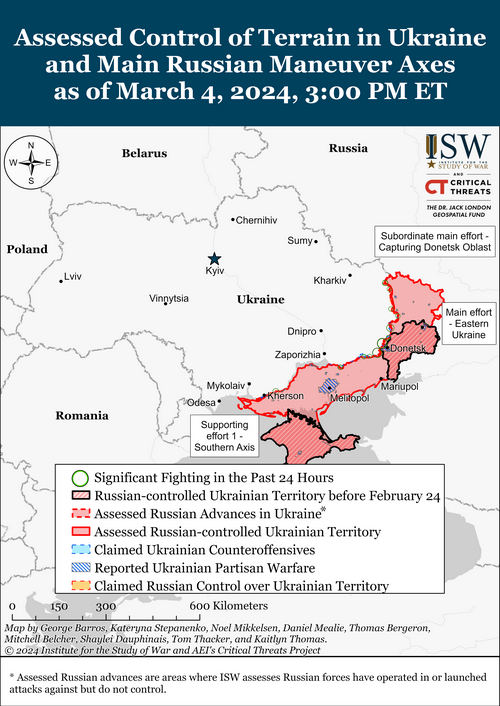
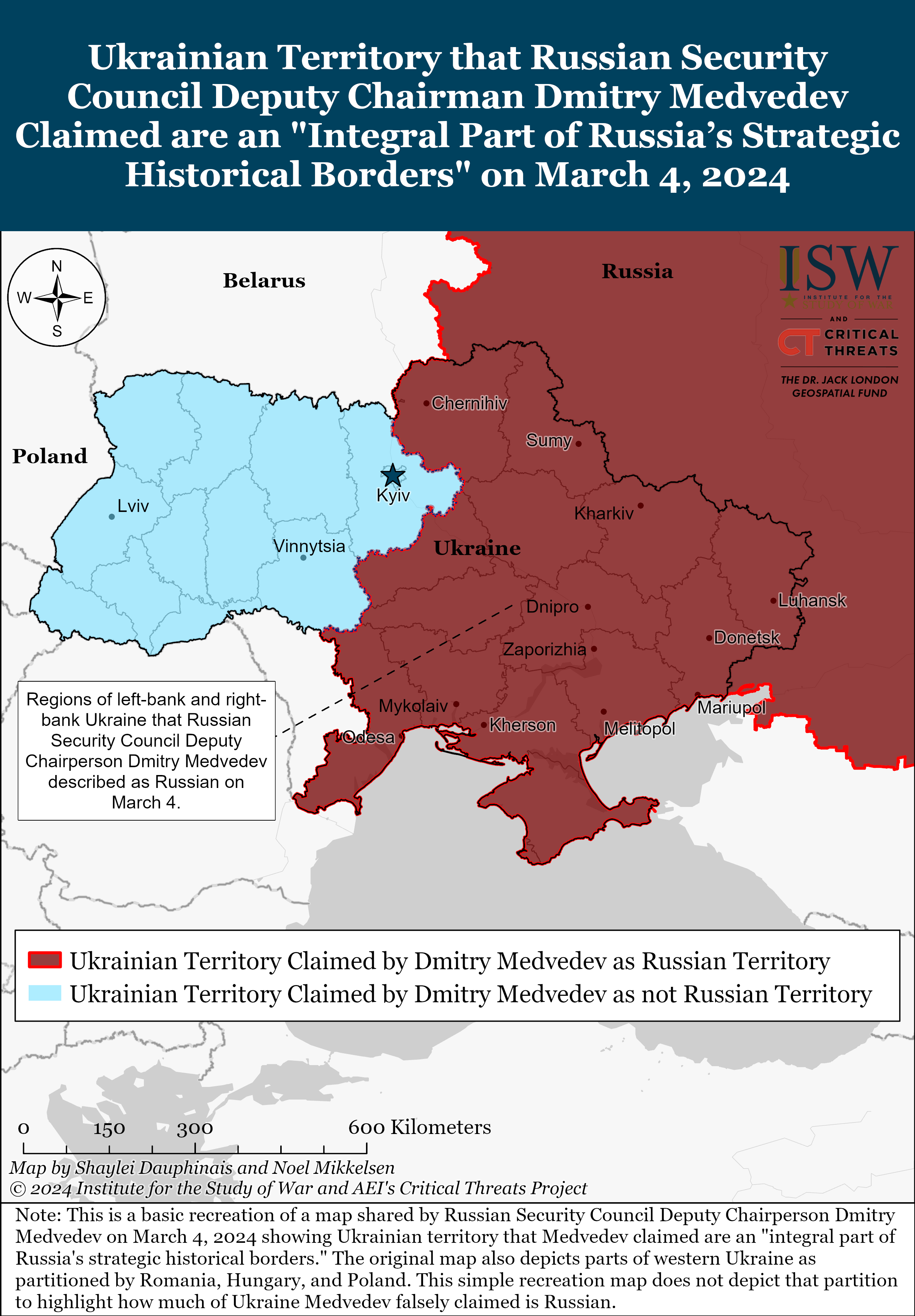
Russian Security Council Deputy Chairperson Dmitry Medvedev promoted Russia’s extensive territorial objectives that expand deep into Ukraine’s territory. Medvedev gave a lecture on March 4 called “Geographical and Strategic Borders” at the Russian World Youth Festival, a Kremlin-organized event that includes attendees from more than 100 foreign countries, during which he claimed that “Ukraine is, of course, Russia.”[1] Russian forces currently occupy the east (left) bank of Kherson Oblast, but Medvedev defined all the territories on the left bank of the Dnipro River and many territories on the right bank of the Dnipro River as “integral” to Russia’s “strategic historical borders.”[2] Russian forces currently do not occupy any territory in right-bank Ukraine. Medvedev spoke against the backdrop of a hypothetical English-language map of Eastern Europe that he originally posted on his Telegram channel in July 2022.[3] The map depicts parts of western Ukraine under Hungarian, Polish, and Romanian control — furthering the recently reignited Kremlin narrative that eastern European states have “territorial disputes” in western Ukraine that is aimed at spoiling Ukraine‘s relationships with its western neighbors.[4] The map shows Ukraine existing as a rump state only within the borders of Kyiv Oblast and the rest of modern-day Ukraine as part of Russia — well beyond the areas that Russian forces currently occupy, and the four oblasts Russia has illegally annexed.[5] The fact that Medvedev reused a map from 2022 underscores that the Kremlin’s maximalist territorial objectives have remained unchanged since the beginning months of the war.
Medvedev argued that the influence of sovereign great powers, like Russia, extends beyond their geographic borders, catering to a wider maximalist ideological interpretation of the “Russian World” (Russkiy Mir). Medvedev repeated Russian President Vladimir Putin’s previous statement that “Russia’s borders do not end anywhere.”[6] Medvedev alleged that a state’s strategic borders, which he differentiated from a state’s geographical borders, directly depend on “how strong and sovereign” the state and its authorities are.[7] Medvedev claimed that the more “powerful” a state is, the “further its strategic frontiers extend beyond its state borders” and the larger the state’s sphere of “economic, political, and socio-cultural influence.”[8] Putin made similar remarks recently that suggested that he views weaker states that are unable to unilaterally impose their will upon others, such as Ukraine, as having a truncated sovereignty.[9] Medvedev claimed on February 22 that Russia “probably” must seize and occupy Kyiv City, which he labelled an historically “Russian” city, at some point in the future.[10] Medvedev’s February 22 and March 4 statements suggest that the existence of a Ukrainian rump state in Kyiv Oblast — even after a hypothetical Russian-led negotiated settlement to the war in Ukraine — may be temporary and subject to future Russian attacks.[11] Medvedev also did not specify to where Russia’s “strategic” borders would extend should Russia’s “geographic” borders expand as shown in the hypothetical map he presented. The map is notably a conservative depiction of possible Russian territorial claims, given Putin’s recent geographic definition of Russkiy Mir encompassing the former Russian Empire, which includes parts of Poland, Romania, Finland, and Moldova.[12]
Medvedev indicated that Russia is more interested in subjugating Ukraine’s people than taking its territory. Medvedev claimed that Russia’s “enemies constantly insist that Russia’s main goal is to seize Ukrainian lands” but, as the “riches” of Ukraine’s lands, such as wheat, steel, gas, and coal are “almost absent,” the main value that Russia seeks from its occupation of Ukraine is through controlling its people.[13] Medvedev also claimed that the concept of a sovereign Ukrainian state and the concept of a Ukrainian national identity that is not Russian must “disappear forever.”[14] ISW continues to document how Russian authorities are repeatedly engaging in large-scale and deliberate ethnic cleansing campaigns and systematically working to eliminate Ukrainian language, culture, history, and ethnicity in areas of Ukraine that Russia occupies.[15]
The Ukrainian Main Military Intelligence Directorate (GUR) reported that unknown actors detonated explosives and severely damaged a Russian railway bridge over the Chapaevka River near Chapaevsk, Samara Oblast on March 4. The GUR reported that Russia uses the railway to transport military cargo, particularly ammunition produced at a joint-stock company in Chapaevsk.[16] Kremlin newswire TASS reported that the explosion delayed five trains and that Russian authorities suspended traffic across the bridge, but later opened one railway track.[17] The Russian Federal Security Service (FSB) stated that it opened a criminal investigation into the explosion but did not speculate on the actor responsible for the explosion.[18] Some Russian milbloggers blamed Ukrainian forces for the explosion on the railway bridge.[19]
Russian President Vladimir Putin reportedly awarded a Russian Airborne Forces (VDV) and Spetsnaz–affiliated Russian milblogger, likely as part of the Kremlin’s longstanding efforts to co-opt milbloggers and make them loyal to the Kremlin. Russian milblogger channel Rusich Army (also known as Archangel Spetsnaza) claimed on March 4 that Putin awarded the channel’s anonymous head the Russian Order of Merit of the Fatherland Second Class for his efforts in supporting the Russian full-scale invasion of Ukraine.[20] Rusich is the second Russian milblogger that has received a federal award for his activities as such (Putin awarded Rybar founder Mikhail Zvinchuk with the same award on November 16, 2023, likely after co-opting him).[21] The Rusich Telegram channel has over one million followers as of March 4 and is well connected among other prominent Russian ultranationalist voices, including the Rybar Telegram channel and Russian state TV propagandist Vladimir Solovyov.[22] ISW previously assessed that Rybar’s public award was designed to incentivize other Russian milbloggers to offer their loyalty to the Kremlin in exchange for awards and accolades.[23] Rusich’s award demonstrates to other milbloggers that the Kremlin is actively willing to publicly praise milbloggers who embrace Kremlin messaging — and suppress negative reporting about Russia’s military performance in Ukraine — as the Kremlin continues to encourage self-censorship efforts in the Russian information space.
Kremlin-awarded milbloggers remain a minority in the Russian information space, however, and some milbloggers actively clash with state propagandists despite the Kremlin’s consolidation of the information space. Pro–Wagner Group Russian milbloggers strongly criticized Russian state propagandist and Solovyov-affiliate Boris Yakemenko on March 4 for disparaging deceased Wagner Group financier Yevgeny Prigozhin and for accusing Russian milbloggers of failing to contribute to the Kremlin’s war effort in late February 2024.[24] Other Russian milbloggers, including deceased milblogger Andrei “Murz” Morozov, who lost faith in the Russian command due to its censorship efforts, regularly clashed with Solovyov and other information-space voices whom these milbloggers deemed as liars or otherwise unreliable.[25] The Kremlin will likely continue to tighten control over some milbloggers by coercing some critical milbloggers into self-censorship and awarding those who are loyal to the Kremlin as it seeks to consolidate control over the Russian information space.
The Russian government reportedly hid data on recipients of social support services in 2022, likely to obfuscate casualties suffered in the first year of the war in Ukraine or to cover up the government’s inability to pay promised social support to vulnerable populations. Russian opposition outlet Verstka investigated the Russian Unified State Information System for Social Security (EGISSO) and reported on March 4 that EGISSO has hidden the data on recipients of social benefits in 2022.[26] Verstka noted that that some of the hidden data contain information that could reveal the scale of losses in Ukraine, such as indicators about “widows of military personnel who died during military service” and “citizens who were wounded, concussed, injured, and mutilated while performing military duties.” The EGISSO may have hidden this information to prevent social discontent arising around reports of Russian casualties in Ukraine and decided only to share this information in 2023 and 2024 when the Kremlin line on Russian losses has consolidated somewhat to eliminate social shocks. The Kremlin may have also hidden 2022 social services data to cover its issues in providing promised social support measures to various individuals, particularly those impacted by the first year of the war.
The Kremlin is continuing efforts to ensure high voter turnout in the upcoming presidential election to present the guise of legitimacy and widespread popular support among Russian President Vladimir Putin’s domestic electorate. Russian opposition outlet Meduza reported on March 4 that the Russian presidential administration is concerned about meeting its intended 70 to 80 percent voter turnout mark in March 2024 because there is a widespread sentiment in Russia that the election has already been decided and that Russians have generally accepted that Putin has already won again.[27] Meduza stated that the Kremlin hopes to obtain this voter turnout by mobilizing the domestic electorate affiliated with the Russian government, particularly employees of the public sector, state corporations, and companies loyal to the Russian government, as well as their families. United Russia employees, for example, are required to bring at least 10 people (family members, friends, and acquaintances) to polling stations. Meduza noted that the requirements of these employees decrease proportionately to their proximity to the Kremlin; for example, employees of large corporations only have to bring two people to polling stations. Meduza reported that there is no enforcement mechanism for the requirements but that the Kremlin is trying to encourage voting using electronic voting methods and QR codes to make voting more convenient. ISW has long assessed that the Kremlin’s election preparations are intended to cast the election as completely legitimate and widely popular with strong voter turnout.
Russian authorities continue to exploit the leaked recording of German military officers discussing the theoretical provision of Taurus missiles to Ukraine to deter Western military aid provisions to Ukraine. The Russian Ministry of Foreign Affairs (MFA) summoned the German Ambassador to Moscow on March 4 in response to the leaked recording.[28] German Defense Minister Boris Pistorius stated on March 3 that the leaked recording is part of the “information war” that that Russian President Vladimir Putin is waging against the West in order to undermine Western unity and resolve in supporting Ukraine.[29]
Key Takeaways:
- Russian Security Council Deputy Chairperson Dmitry Medvedev promoted Russia’s extensive territorial objectives that expand deep into Ukraine’s territory.
- The Ukrainian Main Military Intelligence Directorate (GUR) reported that unknown actors detonated explosives and severely damaged a Russian railway bridge over the Chapaevka River near Chapaevsk, Samara Oblast on March 4.
- Russian President Vladimir Putin reportedly awarded a Russian Airborne Forces (VDV) and Spetsnaz–affiliated Russian milblogger, likely as part of the Kremlin’s longstanding efforts to co-opt milbloggers and make them loyal to the Kremlin.
- The Russian government reportedly hid data on recipients of social support services in 2022, likely to obfuscate casualties suffered in the first year of the war in Ukraine or to cover up the government’s inability to pay promised social support to vulnerable populations.
- The Kremlin is continuing efforts to ensure high voter turnout in the upcoming presidential election to present the guise of legitimacy and widespread popular support among Russian President Vladimir Putin’s domestic electorate.
- Russian authorities continue to exploit the leaked recording of German military officers discussing the theoretical provision of Taurus missiles to Ukraine to deter Western military aid provisions to Ukraine.
- Russian forces recently made confirmed advances near Bakhmut, Avdiivka, and Donetsk City amid continued positional engagements along the entire frontline.
- A Russian news aggregator claimed on March 4 that Russian forces replaced Storm-Z convict units with Storm-V units, a mechanism for distributing convicts into the regular Russian military as opposed to keeping them siloed within convict-only units, as was the case with Storm-Z formations.
Go here to read the rest. When you are looking to prisons to fill the ranks of its combat arms, a nation has a big problem.

