
From The Institute for the Study of War:
Russian Offensive Campaign Assessment, February 17, 2024
Grace Mappes, Riley Bailey, Karolina Hird, Angelica Evans, and Frederick W. Kagan
February 17, 2024, 7:10pm ET
Click here to see ISW’s interactive map of the Russian invasion of Ukraine. This map is updated daily alongside the static maps present in this report.
Click here to see ISW’s 3D control of terrain topographic map of Ukraine. Use of a computer (not a mobile device) is strongly recommended for using this data-heavy tool.
Click here to access ISW’s archive of interactive time-lapse maps of the Russian invasion of Ukraine. These maps complement the static control-of-terrain map that ISW produces daily by showing a dynamic frontline. ISW will update this time-lapse map archive monthly.
Note: The data cut-off for this product was 3:40pm ET on February 17. ISW will cover subsequent reports in the February 18 Russian Offensive Campaign Assessment.
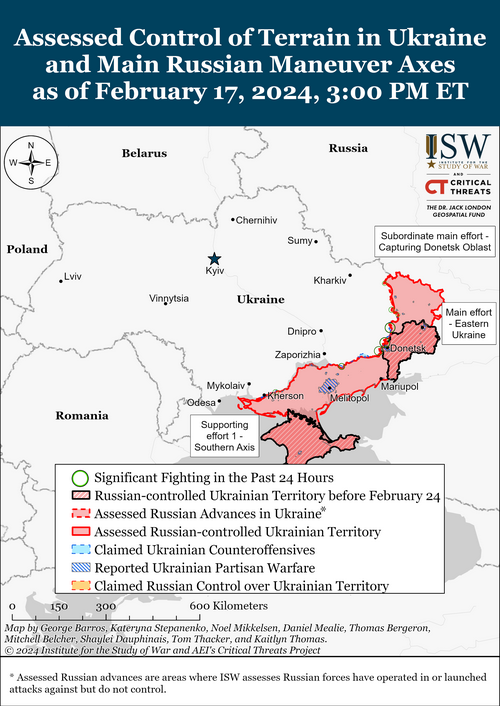
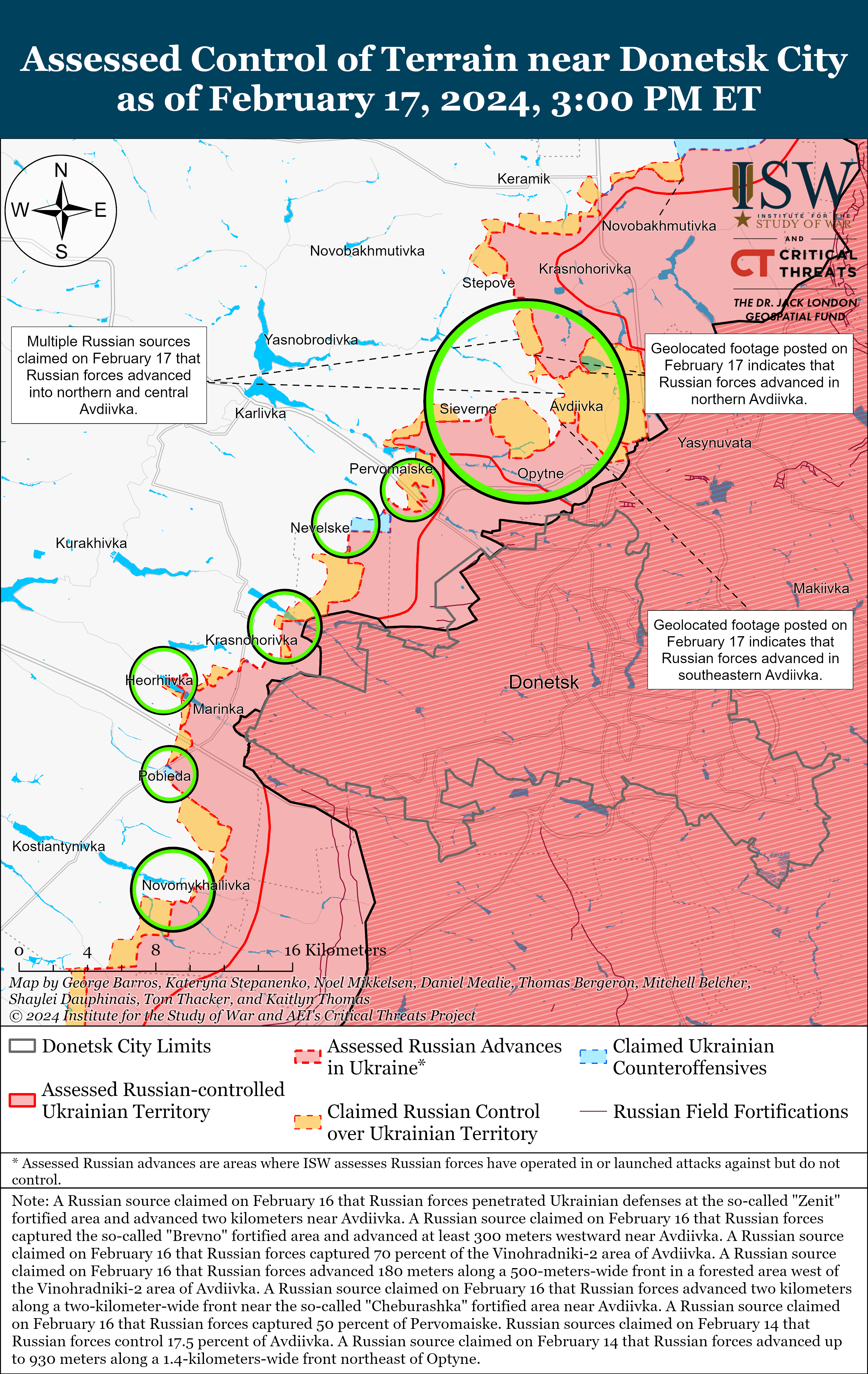
Russian Defense Minister Sergei Shoigu claimed that Russian forces have established “full control” over Avdiivka, Donetsk Oblast as Russian forces continued to advance in the settlement on February 17, and Ukrainian forces have likely withdrawn from Avdiivka. Shoigu reported to Russian President Vladimir Putin on the evening of February 17 that elements of the Russian Central Grouping of Forces are completing the capture of Avdiivka and clearing areas where Shoigu claimed Russian forces had trapped Ukrainian forces.[1] Putin credited the 30th Motorized Rifle Brigade (2nd Combined Arms Army [CAA], Central Military District [CMD]); 35th, 55th, and 74th Motorized Rifle Brigades (all of the 41st CAA, CMD); 1st, 9th, and 114th Motorized Rifle Brigades and 1454th Motorized Rifle Regiment and 10th Tank Regiment (all of the 1st Donetsk People’s Republic [DNR] Army Corps [AC]); and the 6th, 80th, and 239th Tank Regiments (all of the 90th Tank Division, 41st CAA, CMD) for capturing Avdiivka under the leadership of Russian Center Group of Forces commander Colonel General Andrei Mordvichev.[2]
Geolocated footage published on February 17 shows that Russian forces advanced into northern Avdiivka along the railway line, in the eastern part of the Avdiivka Coke Plant, and in the industrial area near the Avdiivka quarry in northeastern Avdiivka.[3] Additional geolocated footage shows that Russian forces advanced into central Avdiivka from the south and captured the City Administration and Palace of Culture buildings.[4] Russian milbloggers largely claimed that Russian forces captured most of Avdiivka except for some of the western outskirts and advanced up to Lastochkyne (west of Avdiivka), though some prominent milbloggers claimed that pockets of Ukrainian forces remain in the western part of the Avdiivka Coke Plant, in the Khimik Microraion in southwestern Avdiivka, and in the residential area in southeastern Avdiivka.[5]
Ukrainian officials indicated that Ukrainian forces inflicted heavy losses on Russian forces during the defense of and withdrawal from Avdiivka — the Ukrainian Tavriisk Group of Forces Press Service reported that Ukrainian forces inflicted losses of 20,018 personnel, 199 tanks, and 481 armored combat vehicles in the Tavriisk direction (from Avdiivka through western Zaporizhia Oblast) between January 1 and February 15, with the majority of those losses inflicted near Avdiivka.[6] A Ukrainian soldier reportedly operating near Avdiivka stated that Russian forces lost hundreds of personnel just on February 17 and suffered massive losses on February 16.[7] Ukrainian Tavriisk Group of Forces Commander Brigadier General Oleksandr Tarnavskyi stated that some Ukrainian forces were captured during the withdrawal from Avdiivka but that the withdrawal largely occurred according to plan and that Russian forces did not complete their intended encirclement of Ukrainian forces.[8]
Russian sources largely characterized the Ukrainian withdrawal as disorganized and costly and claimed that Russian forces managed to encircle large Ukrainian groups in Avdiivka, but ISW has observed no evidence supporting these Russian claims. Russian ultranationalist milbloggers largely amplified the same few videos of a handful of Ukrainian prisoners of war (POWs) captured near Avdiivka to claim that Russian forces managed to surround large groups of Ukrainian forces in the settlement.[9] Russian milbloggers also claimed that Ukrainian forces suffered exorbitant losses in Avdiivka due to a disorderly withdrawal, and Shoigu similarly claimed that Ukrainian forces lost over 1,500 personnel in the past 24 hours.[10] Russian milbloggers usually publish and heavily amplify footage of the capture of Ukrainian POWs and footage of war dead during battles of high informational importance, and the footage that Russian milbloggers have amplified thus far is not consistent with Russian claims about Ukrainian casualties and the capture of Ukrainian POWs.[11] The Russian milbloggers also amplified limited footage of a handful of Ukrainian personnel withdrawing under fire to support claims that the withdrawal was disorganized, but this footage alone does not indicate that there were large chaotic Ukrainian withdrawals.[12] Some milbloggers also amplified footage showing Ukrainian forces walking freely in the open while withdrawing.[13]
The lack of footage supporting Russian claims that the withdrawal was not orderly or that Russian forces took many Ukrainian POWs does not by itself disprove the Russian claims, but this lack of such footage is very unusual for the information environment when Russian forces capture a settlement. The Donetsk People’s Republic (DNR) publishes extensive drone footage of areas in which the 1st DNR Army Corps operates, including the Avdiivka area, and Russian forces tend to publicize extensive Ukrainian losses to demonstrate the scale of their success.[14] Though the current Russian information space does not glorify battlefield horrors as much as Wagner Group affiliated sources did during the captures of Soledar and Bakhmut in winter and spring 2023, Avdiivka is such a prominent area of the front that the lack of filming or amplifying footage of such events is unusual if those events occurred as claimed.[15]
Russian forces appear to have temporarily established limited and localized air superiority and were able to provide ground troops with close air support during the final days of their offensive operation to capture Avdiivka, likely the first time that Russian forces have done so in Ukraine. The spokesperson for a Ukrainian brigade operating near Avdiivka stated on February 17 that Russian forces launched 60 KAB glide bombs at Ukrainian positions in Avdiivka over the past day, and a Ukrainian soldier operating in the area stated that Russian forces launched up to 500 glide bombs at Avdiivka in recent days.[16] Ukrainian Tavriisk Group of Forces Commander Brigadier General Oleksandr Tarnavskyi stated that Russian forces conducted 73 airstrikes in the Tavriisk direction (Avdiivka through western Zaporizhia Oblast) on February 14, a record number, as Russian forces intensified their tactical turning movement in Avdiivka.[17] A Kremlin-affiliated milblogger claimed on February 17 that Russian forces launched 250 FAB glide bombs at one specific area in Avdiivka alone in the past 48 hours.[18] Russian sources widely credited the Russian use of glide bombs with allowing Russian forces to overcome Ukrainian defenses in Avdiivka, and some Russian milbloggers asserted that Russian forces have air superiority in the area.[19]
Russian forces have gradually increased their use of glide bombs throughout the theater since early 2023, but the recent mass use of glide bombs in Avdiivka is the first time that Russian aviation has used these bombs at scale to provide close air support to advancing infantry troops.[20] A Russian Storm-Z instructor claimed that Russian forces have previously struggled to conduct mass airstrikes in close air support operations and expressed hope that Russian aviation operations in Avdiivka will herald a change in Russian operations elsewhere along the frontline.[21] The Russian ability to conduct these mass strikes for several days in the most active part of the frontline suggests that Ukrainian forces were not able to deny them access to the airspace around Avdiivka, and Russian forces likely leveraged this temporary localized air superiority to facilitate the capture of much of the settlement.
Delays in Western security assistance may lead to further significant constraints on Ukrainian air defenses that could allow Russian forces to replicate the close air support that facilitated Russian advances in Avdiivka at scale in Ukraine. Ukrainian Defense Minister Rustem Umerov stated on February 17 that one of the main lessons learned from the defense of Avdiivka is that Ukrainian forces need modern air defense systems to prevent Russian forces from using glide bombs.[22] Ukrainian Air Force Spokesperson Colonel Yuriy Ihnat stated that Ukrainian air defenses need to shoot down the Russian Su-34 and Su-35 attack aircraft that launch the glide bombs in order to stop the strikes.[23] Glide bombs have a range up to 70 kilometers, and Russian forces widely began using the glide bombs in an effort to allow tactical aircraft to conduct strikes from further behind the frontline in order to minimize Russian fixed and rotary wing losses in Ukraine.[24] Ukrainian forces need large numbers of air defense systems that can effectively target Russian aircraft at these ranges. Ukrainian officials have stressed that Ukraine is facing a “critical shortage” of air defense missiles, and the New York Times reported on February 9 that American officials assess that Ukrainian air defense missile stocks will run out in March 2024 without further replenishment by Western security assistance.[25]
Limited effective air defense systems, dwindling air defense missiles stocks, and continued Russian missile and drone strikes against rear population centers are likely forcing Ukraine to make difficult choices about what areas of the frontline receive air defense coverage.[26] Recurring temporary localized and limited Russian air superiority would likely allow Russian forces to more aggressively pursue operational advances along the frontline. Widespread interrupted air superiority would allow Russian forces to conduct routine large-scale aviation operations and bomb Ukrainian cities beyond the frontline to devastating effect.
Ukrainian forces reportedly shot down three Russian fighter aircraft—two Su-34s and one Su-35—over Donetsk Oblast on February 17, likely having committed scarce air defense assets to help cover the withdrawal of Ukrainian forces from Avdiivka. Ukrainian Commander-in-Chief Colonel General Oleksandr Syrskyi stated that Ukrainian forces shot all three of the aircraft down while they were sortied to conduct glide bomb strikes.[27] Russian sources largely disputed the shootdowns, but claims diverged between various Russian milbloggers. Some Russian sources claimed that Ukrainian sources are lying about the shootdowns, others claimed that the Su-34s returned to their base, but the fate of the Su-35 is unclear, and some others claimed that Russian forces accidentally shot down the Su-35 in a friendly fire incident.[28] Ukrainian Air Force Commander Lieutenant General Mykola Oleshchuk posted Cospas-Sarat satellite data, however, that apparently shows the locations of the downed planes.[29] Ukrainian forces possess the capabilities to shoot down such high-value aviation assets when modern air defense systems and missiles are available and may have used those systems during the critical period of the withdrawal of Ukrainian ground forces from Avdiivka.[30]
Russian authorities arrested several hundred demonstrators on February 17 amid slightly larger demonstrations responding to imprisoned opposition politician Alexei Navalny’s death. Russian opposition news outlets reported that Russian law enforcement has detained at least 350 people in over 30 Russian cities as crowds gathered to lay flowers in honor of Navalny over the last two days, including an estimated 230 people on February 17 alone.[31] Russian opposition sources also published footage of unspecified Russian actors picking up flowers laid at the Solovetsky Stone in Moscow City and other temporary memorials to Navalny throughout Russia on the night of February 16 to 17, attempting to erase any evidence of previous demonstrations.[32] Russian authorities seemed to tolerate smaller public gatherings immediately following the announcement of Navalny’s death but appeared less tolerant of and engaged in more concerted efforts to suppress the second day of larger demonstrations.
The US Department of Justice (DoJ) announced on February 17 that the US sent $500,000 of forfeited Russian funds to Estonia to repair Ukraine’s energy infrastructure.[33] The DoJ reported that the US acquired the funds after breaking up an illegal procurement network attempting to import US-made high-precision machine tools to Russia.[34] US Deputy Attorney General Lisa Monavo stated that this announcement demonstrates the resolve of the US and Estonia in cutting off Russia’s access to critical Western technology.[35]
Key Takeaways:
- Russian Defense Minister Sergei Shoigu claimed that Russian forces have established “full control” over Avdiivka, Donetsk Oblast as Russian forces continued to advance in the settlement on February 17, and Ukrainian forces have likely withdrawn from Avdiivka.
- Russian sources largely characterized the Ukrainian withdrawal as disorganized and costly and claimed that Russian forces managed to encircle large Ukrainian groups in Avdiivka, but ISW has observed no evidence supporting these Russian claims.
- Russian forces appear to have temporarily established limited and localized air superiority and were able to provide ground troops with close air support during the final days of their offensive operation to capture Avdiivka, likely the first time that Russian forces have done so in Ukraine.
- Delays in Western security assistance may lead to further significant constraints on Ukrainian air defenses that could allow Russian forces to replicate the close air support that facilitated Russian advances in Avdiivka at scale in Ukraine.
- Ukrainian forces reportedly shot down three Russian fighter aircraft—two Su-34s and one Su-35—over Donetsk Oblast on February 17, likely having committed scarce air defense assets to help cover the withdrawal of Ukrainian forces from Avdiivka.
- Russian authorities arrested several hundred demonstrators on February 17 amid slightly larger demonstrations responding to imprisoned opposition politician Alexei Navalny’s death.
- The US Department of Justice (DoJ) announced on February 17 that the US sent $500,000 of forfeited Russian funds to Estonia to repair Ukraine’s energy infrastructure
- Russian forces made confirmed advances near Bakhmut and Avdiivka and in western Zaporizhia Oblast
- Russian occupation authorities continue efforts to propagandize and militarize Ukrainian youth in occupied areas.
Go here to read the rest. Putin is riding high in preparation for the March election. Let’s see how long it lasts.

