
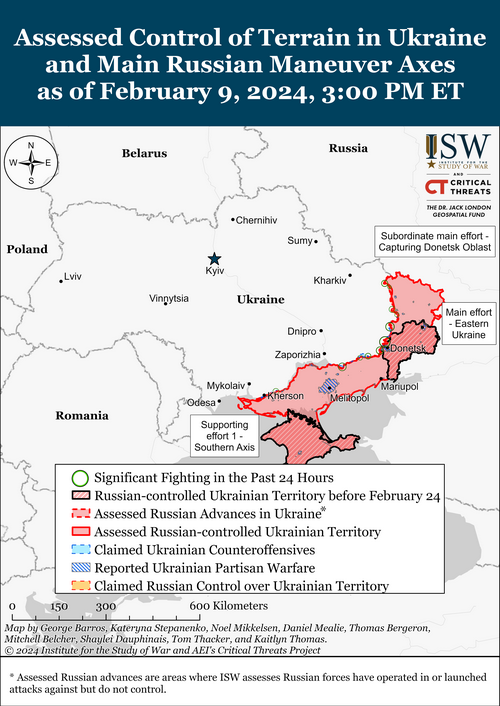
From The Institute for the Study of War:
Russian Offensive Campaign Assessment, February 9, 2024
Angelica Evans, Riley Bailey, Karolina Hird, Kateryna Stepanenko, George Barros, and Fredrick W. Kagan
February 9, 2024, 6:40pm ET
Click here to see ISW’s interactive map of the Russian invasion of Ukraine. This map is updated daily alongside the static maps present in this report.
Click here to see ISW’s 3D control of terrain topographic map of Ukraine. Use of a computer (not a mobile device) is strongly recommended for using this data-heavy tool.
Click here to access ISW’s archive of interactive time-lapse maps of the Russian invasion of Ukraine. These maps complement the static control-of-terrain map that ISW produces daily by showing a dynamic frontline. ISW will update this time-lapse map archive monthly.
Note: The data cut-off for this product was 2pm ET on February 9. ISW will cover subsequent reports in the February 10 Russian Offensive Campaign Assessment.
The Russian online community noted that Russian President Vladimir Putin did not offer any new information in his interview with American media personality Tucker Carlson and simply repeated longstanding Kremlin talking points about Russia’s full-scale invasion of Ukraine for American audiences. Prominent Russian milbloggers claimed that Putin did not say anything new and framed the interview as a Russian attempt to infiltrate Western mainstream media rather than to make any fundamentally new arguments or to address Russian audiences.[1] One milblogger claimed that Putin’s interview aimed to promote Russian foreign policy to Americans who are actively engaged on social media and explained Putin’s repetition of tired Kremlin talking points as a summary of Russia’s justifications for its invasion of Ukraine for American voters.[2] Sources close to the Russian Presidential Administration similarly told Russian opposition outlet Meduza that Putin’s interview was not designed for a Russian audience and that the Kremlin intended to generate informational effects and hysteria in the West.[3] One of Meduza’s interlocutors added that the interview’s secondary objective was to show Russian domestic audiences that Putin can still shape global discourse based on the popularity of the interview but did not offer an assessment of Putin’s success in this regard.
Kremlin sources focused on presenting the interview as a massively successful and popular Russian effort to shape the information environment in the West and claimed that the interview demonstrated that Putin is an influential world leader. Kremlin Spokesperson Dmitry Peskov claimed that American interest in Putin’s interview was “undeniable” and that the Kremlin is interested in the reaction to the interview abroad as it continues to prioritize observing the domestic response to the interview.[4] Russian occupation officials celebrated a claim that the interview surpassed 60 million views and claimed that the world is increasingly interested in Putin’s opinion and his ”truths.”[5]
Russian Security Council Deputy Chairperson Dmitry Medvedev noted that Putin told the Western world in the most thorough and detailed way why Ukraine did not exist, does not exist, and will not exist.[6] Medvedev’s description of Putin’s interview further demonstrates that Russia has not abandoned its maximalist goals of eradicating Ukrainian statehood and that Putin does not intend to negotiate with Ukraine on any terms short of these goals.
Delays in Western aid appear to be exacerbating Ukraine’s current artillery shortages and could impact Ukraine’s long-term war effort. The Financial Times (FT) reported on February 9 that Ukraine is struggling with artillery shortages amid delayed US aid and Europe’s anticipated failure to meet its March 2024 deadline of providing one million artillery shells to Ukraine.[7] An unnamed senior US military official told FT that delayed US aid risks creating an “air bubble” or a “gap in the hose” of Western aid to Ukraine and leaving Ukraine without Western aid for an unspecified period of time.[8] The official stated that the Pentagon is particularly concerned about Ukraine’s ability to maintain its air defense systems and ammunition supplies, and a senior European diplomat warned that it will be difficult for Ukraine to even maintain its current positions without Western materiel.[9] ISW continues to assess that the collapse of Western aid to Ukraine would likely lead to the eventual collapse of Ukraine’s ability to defend itself and hold off the Russian military and could allow Russian forces to push all the way to western Ukraine closer to the borders of NATO member states.[10] Another European official expressed concern over Europe’s ability to substitute the volume of assistance that the US previously provided to Ukraine.[11] Ukrainian Ambassador to the US Oksana Markarova told Bloomberg on February 8 that Ukraine is facing a ”critical shortage” in military equipment, particularly missiles and interceptors.[12] Ukrainian military officials recently warned that Ukraine is rationing air defense equipment and ammunition while attempting to adapt and respond to large-scale Russian drone and missile strikes.[13]
Newly appointed Ukrainian Commander-in-Chief Colonel General Oleksandr Syrskyi identified several of his goals as commander of the Ukrainian Armed Forces. Syrskyi stated that his primary agenda is to set clear and detailed plans for the Ukrainian command as well as to facilitate the quick distribution and delivery of necessary materiel to combat units deployed throughout the theater.[14] Syrskyi stated that he intends to balance between having Ukrainian forces conduct combat missions and building Ukraine’s combat power by restoring and training Ukrainian units.[15] Syrskyi added that the introduction of new technical solutions and the implementation of lessons learned from successful modern combat experience, specifically with drones and electronic warfare (EW) systems, is a path towards Ukrainian victory, echoing themes from former Ukrainian Commander-in-Chief General Valerii Zaluzhnyi’s recent focus on using technological innovation and adaptation to offset Russian forces‘ numerical advantages.[16] Syrskyi further discussed these goals at a meeting with Ukrainian Defense Minister Rustem Umerov on February 9 in which the two discussed plans for improving logistics and the quality of training for Ukrainian forces in 2024.[17]
Ukrainian actors reportedly conducted a successful drone strike against two oil refineries in Krasnodar Krai on February 9. Ukrainian outlet Suspilne, citing its internal sources in the Ukrainian security service (SBU), reported that SBU drones struck the Ilsky and Afipsky oil refineries in Krasnodar Krai on February 9.[18] The Russian Ministry of Defense (MoD) claimed that Ukraine launched two drones at Krasnodar Krai, but claimed that Russian air defense intercepted the drones, despite footage showing a fire at the Ilsky oil refinery following apparent drone impacts.[19] SBU sources additionally reported that the SBU conducted a drone strike against the Lukoil refinery in Volgograd Oblast on February 3.[20] Russian outlet Kommersant reported on February 6 that Russian refineries had to marginally reduce their output due to damage caused by Ukrainian drone strikes, and the Kommersant investigation found that Russian refinery output reduced by 4 percent in January 2024 compared to January 2023 and by 1.4 percent in January 2024 compared to December 2023.[21] While the reduction in refinery percentage is not large, it is noteworthy that Ukraine is able to achieve such asymmetrical effects against infrastructure that supports the Russian war effort using a few drones per strike on such high-value targets.
Ukrainian military officials reported that Russian forces are increasing their use of illegal chemical weapons in Ukraine, in an apparent violation of the Chemical Weapons Convention (CWC), to which Russia is a signatory.[22] The Ukrainian General Staff reported that the Ukrainian military has recorded 815 Russian attacks with ammunition equipped with toxic chemicals since the beginning of the full-scale invasion, 229 of which occurred in January 2024 alone.[23] Ukrainian Tavriisk Group Commander Brigadier General Oleksandr Tarnavskyi noted that Russian forces are increasingly conducting chemical attacks in the Tavriisk operational direction (from Avdiivka through western Zaporizhia Oblast).[24] Ukrainian military officials stated that Russian forces most often use K-51 grenades, RGR 60mm irritant hand grenades, and RGO Soviet-era defensive fragmentation hand grenades, likely filled with either chlorobenzylidenemalononitrile (CS) gas or chloropicrin (PS).[25] Both CS gas and PS are considered riot control agents (RCAs), or irritant chemical compounds that are not necessarily lethal but have extremely irritating and harmful effects, especially when inhaled.[26] The CWC – which Russia ratified in 1997 – bans the use of RCAs in warfare.[27] The Russian 810th Naval Infantry Brigade recently acknowledged in a now-deleted post that elements of the brigade deliberately used K-51 grenades with CS gas on Ukrainian positions near Krynky in east (left) bank Kherson Oblast.[28]
Bloomberg reported on February 9 that Ukraine is considering economic reforms in order to secure funding from the International Monetary Fund (IMF) in the event that the US Congress continues to block crucial aid.[29] Bloomberg reported that Ukrainian officials will propose a plan to IMF officials in Kyiv next week to expand Ukraine’s domestic bond sales, raise taxes, and cut federal spending. Ukrainian officials hope to assure the IMF that Ukraine can pay back its $15.6 billion IMF loan without additional Western aid.
Key Takeaways:
- The Russian online community noted that Russian President Vladimir Putin did not offer any new information in his interview with American media personality Tucker Carlson and simply repeated longstanding Kremlin talking points about Russia’s full-scale invasion of Ukraine for American audiences.
- Russian Security Council Deputy Chairperson Dmitry Medvedev noted that Putin told the Western world in the most thorough and detailed way why Ukraine did not exist, does not exist, and will not exist.
- Delays in Western aid appear to be exacerbating Ukraine’s current artillery shortages and could impact Ukraine’s long-term war effort.
- Newly appointed Ukrainian Commander-in-Chief Colonel General Oleksandr Syrskyi identified several of his goals as commander of the Ukrainian Armed Forces.
- Ukrainian actors reportedly conducted a successful drone strike against two oil refineries in Krasnodar Krai on February 9.
- Ukrainian military officials reported that Russian forces are increasing their use of illegal chemical weapons in Ukraine, in an apparent violation of the Chemical Weapons Convention (CWC), to which Russia is a signatory.
- Bloomberg reported on February 9 that Ukraine is considering economic reforms in order to secure funding from the International Monetary Fund (IMF) in the event that the US Congress continues to block crucial aid.
- Russian forces advanced near Kreminna, Bakhmut, and Avdiivka amid continued positional engagements along the frontline.
- Russian paramilitary organization Novorossiya Aid Coordination Center (KCPN) is training drone operators in east (left) bank Kherson Oblast near Krynky.
- Russian occupation authorities continue to prepare for the upcoming Russian presidential elections by creating the appearance of popular support for Russian Vladimir Putin in occupied areas of Ukraine.
Go here to read the rest. Putin went on a lengthy lecture to the gullible Carlson to convince him that Ukraine is part of Russia. Ukrainian nationalism has been a growing force since the 19th Century and Putin has ensured that the Ukrainians will never exist peacefully under the yoke of Moscow. Putin would do better to recall that Russian autocracy has been frequently mitigated by assassination.

