
“I have but to show him my design, and I know that if it can be done it will be done. Straight as the needle to the pole he advances to the execution of my purpose.”
Robert E. Lee on Stonewall Jackson
Of Thomas Jonathan Jackson, nicknamed Stonewall by General Barnard Bee at the battle of Bull Run, it was said he lived by the New Testament and fought by the Old. Certainly throughout his life he was a convinced Christian. As a young man he would attend services of various Christian denominations. In Mexico, during his service in the Mexican War, he attended mass, although he did not convert to Catholicism. Instead he eventually became a Presbyterian. His Bible was his constant companion, and he would often speak of God and theological matters in private conversation.
Jackson in his professional life was a soldier. Just before the Civil War he was a professor of natural and experimental philosophy (science) and artillery instruction at the Virginia Military Institute. As a teacher he made a good soldier. His lectures were rather dry. If his students seemed to fail to grasp a lecture, he would repeat it the next day, word for word.
His home life was a mixture of sorrow and joy. His first wife died in childbirth along with their still-born son, a tragedy that would have crushed many a man less iron-willed than Jackson. His second marriage, like his first, was happy, but heartache also haunted it. A daughter died shortly after birth in 1858. A second daughter was born in 1862, Julia, shortly before Jackson’s own death in 1863. His wife would spend a widowhood of 52 years, dedicated to raising their daughter, cherishing the memory of her husband, and helping destitute Confederate veterans. For her good works she became known as the Widow of the Confederacy. Their daughter Julia would marry and have children before her early death of typhoid fever at age 26. Her two children had several children and there are many living descendants of Jackson.
He and his second wife established and taught a Sunday school for black slaves. At the time it was against the law in Virginia to teach slaves to read, but apparently that is precisely what Jackson and his wife did. One of the last letters he ever posted was his regular contribution he mailed off throughout the war for the financial support of the Sunday school for slaves he and his wife had founded.
During the war he rose to fame as Stonewall Jackson. His Valley Campaign in 1862 in the Shenandoah Valley where he outmarched and outfought numerous Union armies, each larger than the force he led, is still studied in military academies around the world as a classic example of how a weaker force, using mobility and surprise, can defeat vastly superior forces.
His service under Lee established a military partnership that reached its culmination at Chancellorsville where Jackson led his corps around the Union right and into the rear of the Union army, leading to a stunning Confederate victory over an Army of the Potomac that outnumbered the Army of Northern Virginia more than two to one.
Jackson summed up his military philosophy succinctly: Always mystify, mislead, and surprise the enemy, if possible; and when you strike and overcome him, never let up in the pursuit so long as your men have strength to follow; for an army routed, if hotly pursued, becomes panic-stricken, and can then be destroyed by half their number. The other rule is, never fight against heavy odds, if by any possible maneuvering you can hurl your own force on only a part, and that the weakest part, of your enemy and crush it. Such tactics will win every time, and a small army may thus destroy a large one in detail, and repeated victory will make it invincible.
Most of us can act very differently under different circumstances, but Jackson was almost a different person depending upon how a person encountered him. As a general he could be a martinet who would refuse a subordinate during the Valley Campaign time to go to the bedside of his dying children, explaining that the needs of the service must always come first. However, he could then surrender his bed to a subordinate officer he did not like when he learned that the man was unwell. He shot men out of hand for desertion following swift military trials, and he could weep like a child upon learning of the death of a child he had known from Scarlet Fever. Suggesting at the beginning of the War that the Confederacy should raise the Black Flag and take no prisoners of invaders from the North, during the War he allowed Union surgeons to continue treating captured Union wounded and then freed them to return to their own lines. Ostensibly a man fighting to help the South preserve slavery, he founded a Sunday school for blacks in the teeth of resistance in his home town and taught blacks to read in violation of Virginia state law. A grim religious warrior who would have been at home in the ranks of Cromwell’s Ironsides during the English Civil War, he became a good friend of General Jeb Stuart, the embodiment of the Cavalier legend of the South. Complex has always been a word that pops into my mind when I think of Thomas Jonathan Jackson.
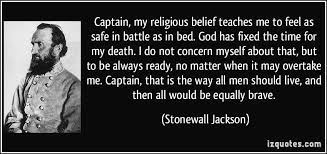
Completely fearless on the battlefield, Jackson assumed that God would determine his span of life and fear was useless as a result: Captain, my religious belief teaches me to feel as safe in battle as in bed. God has fixed the time for my death. I do not concern myself about that, but to be always ready, no matter when it may overtake me.
At Chancellorsville, Jackson was shot accidentally by his own men. As a result of his wounding Jackson’s left arm was amputated. Lee learning of it, said that Jackson had lost his left arm, but that he had lost his right.
For a time it looked as if Jackson would recover, but infection, that great killer after any nineteenth century surgery, prevented that happy outcome. He met the news of his inevitable death with Christian stoicism, bidding farewell to his tearful wife and infant daughter. In his delirium towards the end he returned in his mind to the battlefields, shouting out commands. At the very end, his voice grew calm and his face relaxed. He then gave the last command he would ever utter in this life: “Let us cross over the river, and rest under the shade of the trees.”
“And Thou knowest O Lord, when Thou didst decide that the Confederacy should not succeed, Thou hadst first to remove thy servant, Stonewall Jackson.”
Father D. Hubert, Chaplain, Hay’s Louisiana Brigade, upon the dedication of the statue of Stonewall Jackson on May 10, 1881 in New Orleans


Most military historians concede that the Union victory at Gettysburg would have been highly questionable, if not impossible, had Jackson lived to fight on that battlefield.
“Ostensibly, fighting to help the South preserve slavery “ is questionable proposition. While slavery was a motivating factor for many, most of the average Confederate soldiers would have gone home if they believed this was what they were fighting for. They would have sneered at you if you suggested the same to them. Most (North and South) supreme loyalty was to their State and their neighbors. Secession was always a debated right and quite popular in New England during the War of 1812. The outcome of the war settled the question of secession. Twenty Five percent of the white male population of Dixie lost their lives in that war, including two of my great grandfather (both non slave owners). All people of good will will hopefully remember that the winners write the history books. It amazes me that a society that has sanctioned the legal murder of approximately 60 million children can be so quick to condemn people who lived in a different time (more than 150 years ago). Overall, a good article. I hope and pray that we can save this nation without some form of repetition of that horrible was. Deo Vindice (God will Judge)