
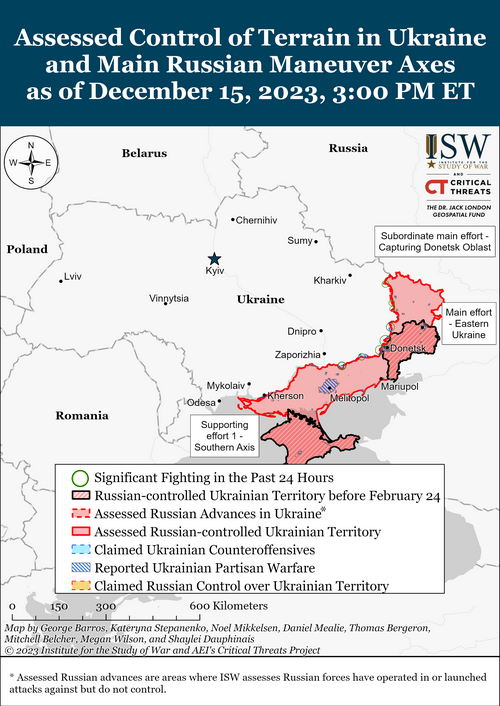
From The Institute For The Study of War:
Russian Offensive Campaign Assessment, December 15, 2023
Christina Harward, Angelica Evans, Riley Bailey, and Frederick W. Kagan
December 15, 2023, 6:45pm ET
Click here to see ISW’s interactive map of the Russian invasion of Ukraine. This map is updated daily alongside the static maps present in this report.
Click here to see ISW’s 3D control of terrain topographic map of Ukraine. Use of a computer (not a mobile device) is strongly recommended for using this data-heavy tool.
Click here to access ISW’s archive of interactive time-lapse maps of the Russian invasion of Ukraine. These maps complement the static control-of-terrain map that ISW produces daily by showing a dynamic frontline. ISW will update this time-lapse map archive monthly.
Note: The data cut-off for this product was 2:00 pm ET on December 15. ISW will cover subsequent reports in the December 16 Russian Offensive Campaign Assessment.
German outlet BILD stated on December 14 that unspecified intelligence findings and sources indicate that Russia plans to occupy Ukrainian territory beyond the four (illegally) annexed Ukrainian oblasts throughout 2024-2026. BILD stated that Russia plans to capture the entirety of Donetsk and Luhansk oblasts and up to the Oskil River in Kharkiv Oblast by the end of 2024.[1] These reported goals are in line with ongoing localized Russian offensive operations in Donetsk, Luhansk, and Kharkiv oblasts. Russia also reportedly plans to take large parts of Zaporizhia, Dnipropetrovsk, and Kharkiv oblasts, including Kharkiv City if possible, in 2025 and 2026. BILD reported that an insider source stated that Russia plans to occupy large parts of eastern Ukraine located east of the Dnipro River within the next 36 months. Russia is reportedly planning to hold the current front line in Kherson Oblast along the Dnipro River and is only concerned about preventing Ukrainian forces in southern Ukraine from advancing towards occupied Crimea. BILD stated that Russia’s plans are based on mobilizing Russia’s defense industrial base (DIB), suffering annual casualties of around 100,000 military personnel in attritional offensive operations, and benefiting from the possible election of a US president in 2024 who dramatically reduces or stops military support to Ukraine. BILD reported that a source familiar with the intelligence findings stated that the Kremlin plans to rely on “sham negotiations” while continuing to conduct offensive operations similar to the way in which Russia negotiated the Second Minsk agreement in 2015 while the Russian military continued to occupy additional Ukrainian settlements. BILD previously published largely accurate intelligence findings about Russia’s plans for its full-scale invasion of Ukraine in December 2021 which assessed that Russia would attack Ukraine from the south from Crimea, from Russian-controlled territory in eastern Ukraine, and from the north in late January or early February 2022, although the Russian invasion as executed did not perfectly align with BILD’s reporting.[2]
ISW cannot independently authenticate BILD’s reporting, but Russia’s reported plans for the war in Ukraine through 2026 are in line with continued Russian preparations for a prolonged war effort. The Russian military command is pursuing long-term restructuring and expansion efforts to form strategic reserves, and Russia has been gradually mobilizing its DIB to sustain a long war.[3] Russia’s reported medium to long-term plans to occupy territory beyond the four (illegally) annexed territories are also plausible considering that Russian officials, including Russian President Vladimir Putin, have reverted to expansionist rhetoric recently, and Russian forces continue offensive operations to expand their positions in Kharkiv Oblast. Russian officials have issued statements about Russia’s intention to occupy and annex additional Ukrainian territory beyond the current front lines and the four (illegally) annexed territories.“[4] ISW recently assessed that the sudden collapse of Western aid would likely lead sooner or later to the collapse of Ukraine’s ability to hold off the Russian military, and Russian forces could ultimately push all the way to the western Ukrainian border in such a scenario.[5]
Ukrainian Main Military Intelligence Directorate (GUR) Lieutenant General Kyrylo Budanov stated in an interview published on December 14 that Russia currently has no intention of changing its plans for the war in Ukraine in 2025, however.[6] Budanov stated that Russia may develop a new plan if nothing changes on the front line by the end of 2024.
Russian Foreign Minister Sergei Lavrov threateningly urged Ukraine to negotiate with Russia sooner rather than later in framing consistent with the ISW assessment that Russia intends to achieve its maximalist objectives in Ukraine through military means. Lavrov said at a December 15 meeting of the collegiums of the Russian and Belarusian Foreign Ministries that the longer the war in Ukraine continues, the more difficult negotiating conditions will be for Ukraine.[7] Lavrov’s statement suggests that the Kremlin believes that the longer the war continues, the more territory Russia will be able to occupy and the course of the war will increasingly put Ukraine in a weaker negotiating position. Russian President Vladimir Putin reiterated on December 14 that Russia’s maximalist objectives in Ukraine – which are tantamount to full Ukrainian and Western surrender – are unchanged.[8] ISW continues to assess that Russia does not intend to engage in serious negotiations with Ukraine in good faith.[9] The Kremlin has repeatedly pushed information operations feigning interest in negotiations with Ukraine, and Lavrov’s statement is likely also an attempt to set conditions for Russia to move away from this information operation.[10]
Ukrainian Foreign Minister Dmytro Kuleba published an op-ed entitled “There is a Path to Victory in Ukraine” on December 15, wherein he argues that Ukrainian military objectives remain feasible despite increasingly pessimistic discussions in the West. Kuleba stated in the op-ed published in Foreign Affairs that Ukrainian objectives are still attainable as long as three factors remain in place: an adequate level of Western military aid; the rapid development of industrial capacity in the US, Europe, and Ukraine; and a principled and realistic approach to the prospects of negotiations with Russia.[11] Kuleba acknowledged that the Ukrainian 2023 counteroffensive did not achieve the ”lightning fast” liberation of Ukrainian territory but said that observers would be mistaken to make judgments about the entire course of the war based on one stage of fighting.[12] Kuleba pointed to Russian gains in eastern Ukraine in summer 2022 and the following successful Ukrainian counteroffensives in Kharkiv and Kherson oblasts as an example of how one stage of fighting does not indicate how subsequent stages of fighting may develop.[13] Kuleba added that a negotiated ceasefire would allow Russia to reinforce positions, making it difficult for Ukrainian forces to liberate territory in the future while also giving Russia respite to launch a more intense offensive campaign in the following years.[14] ISW has routinely assessed that the Kremlin would leverage any pause or ceasefire to prepare for renewed aggression against Ukraine.[15]
Russian forces conducted a series of missile and drone strikes against Ukraine on the night of December 14 to 15. Ukrainian sources reported that Ukrainian air defenses downed 14 Shahed-131/136 drones, an S-300 missile, and a Kh-59 missile.[16] The Ukrainian Air Force reported that Russian forces launched three Kinzhal missiles in the direction of Kyiv City, Kyiv Oblast and Starokostyantyniv, Khmelnytskyi Oblast on December 14 and that Ukrainian forces destroyed one Kinzhal over Kyiv Oblast.[17] Russian sources claimed that Russian forces struck targets in Mykolaiv, Dnipropetrovsk, Khmelnytskyi, Kharkiv, Poltava, Kyiv, and Odesa oblasts on the night of December 14 to 15.[18]
Finnish authorities closed Finland’s border checkpoints with Russia again on December 15 amid continued Russian hybrid warfare efforts to orchestrate an artificial migrant crisis. The Finnish Ministry of the Interior announced on December 12 that Finland would reopen two border checkpoints with Russia on December 14 and warned that Finland would close the border again if Russia continued its “hybrid operation.”[19] The Finnish Ministry of the Interior announced on December 14 that Finland would close the two checkpoints on December 15 after a reported 36 asylum seekers arrived on the Finnish-Russian border several hours after the checkpoints re-opened.[20] Reuters reported that Finland typically received less than one asylum seeker per day prior to Russian efforts to artificially inflate the number of migrants seeking asylum in Finland.[21] Finnish Minister of the Interior Mari Rantanen stated that this is a sign that Russian authorities are continuing their hybrid operation against Finland.[22] Finland’s border checkpoints with Russia will remain closed until January 14, 2024.[23]
Germany announced new military and humanitarian aid packages to Ukraine on December 14. The German military aid package includes a Patriot air defense system and missiles, 40mm and 155mm ammunition, mine clearing systems, and drone detection systems.[24] The German government also announced an aid package valued at 6.1 million euros of winter humanitarian assistance for Ukraine, including generators, heaters, and tents.[25]
Key Takeaways:
- German outlet BILD stated on December 14 that unspecified intelligence findings and sources indicate that Russia plans to occupy Ukrainian territory beyond the four (illegally) annexed Ukrainian oblasts throughout 2024-2026.
- Russian Foreign Minister Sergei Lavrov threateningly urged Ukraine to negotiate with Russia sooner rather than later in framing consistent with the ISW assessment that Russia intends to achieve its maximalist objectives in Ukraine through military means.
- Ukrainian Foreign Minister Dmytro Kuleba published an op-ed entitled “There is a Path to Victory in Ukraine” on December 15, wherein he argues that Ukrainian military objectives remain feasible despite increasingly pessimistic discussions in the West.
- Russian forces conducted a series of missile and drone strikes against Ukraine on the night of December 14 to 15.
- Finnish authorities closed Finland’s border checkpoints with Russia again on December 15 amid continued Russian hybrid warfare efforts to orchestrate an artificial migrant crisis.
- Germany announced new military and humanitarian aid packages to Ukraine on December 14.
- Russian forces continued offensive operations near Kupyansk, northeast and near Bakhmut, near Avdiivka, west and southwest of Donetsk City, in the Donetsk-Zaporizhia Oblast border area, and in western Zaporizhia Oblast and made confirmed advances in several areas.
- Kremlin newswire TASS reported on December 14 that “Grom” special units (elite anti-drug special units of the Russian Ministry of Internal Affairs [MVD]) will fully transition to being subordinated to Rosgvardia in early 2024.
- Russian President Vladimir Putin highlighted Russia’s intention to build high-speed railways in occupied Ukraine, likely hours after Ukrainian partisans damaged a key railway line in occupied Zaporizhia Oblast.
Go here to read the rest. Stalemated wars fluctuate between hope and despair. Both are usually mistaken based upon the military situation on the ground.

