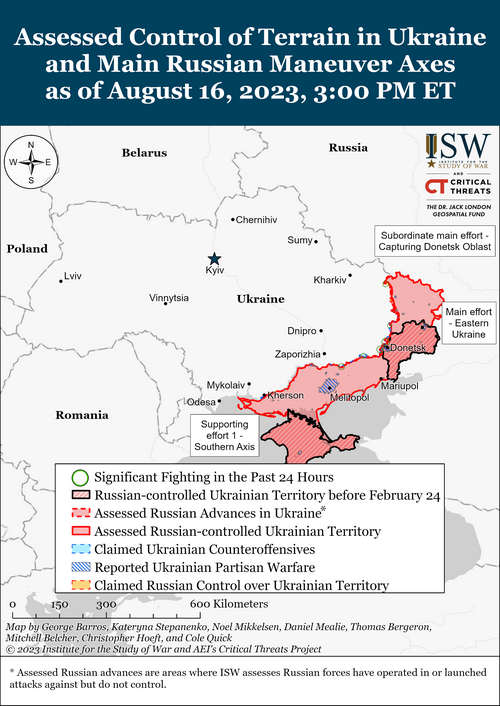
From The Institute For The Study of War:
Russian Offensive Campaign Assessment, August 16, 2023
Angelica Evans, Nicole Wolkov, Riley Bailey, Kateryna Stepanenko, and Mason Clark
August 16, 2023, 6:45pm ET
Click here to see ISW’s interactive map of the Russian invasion of Ukraine. This map is updated daily alongside the static maps present in this report.
Click here to access ISW’s archive of interactive time-lapse maps of the Russian invasion of Ukraine. These maps complement the static control-of-terrain map that ISW produces daily by showing a dynamic frontline. ISW will update this time-lapse map archive monthly.
Note: The data cut-off for this product was 12:30pm ET on August 16. ISW will cover subsequent reports in the August 17 Russian Offensive Campaign Assessment.
Ukrainian forces continued counteroffensive operations on at least three sectors of the front on August 16 and advanced in western Zaporizhia Oblast and on the Donetsk-Zaporizhia Oblast border, including liberating the village of Urozhaine. The Ukrainian General Staff reported that Ukrainian forces continued offensive operations in the Bakhmut, Berdyansk (Zaporizhia-Donetsk Oblast border area), and Melitopol (western Zaporizhia Oblast) directions.[1] Geolocated footage published on August 16 indicates that Ukrainian forces advanced northeast of Robotyne (10km south of Orikhiv) in western Zaporizhia Oblast and have likely made wider gains in the surrounding areas given weeks of consistent Ukrainian activity in the forested areas northeast of the settlement.[2] Ukrainian officials reported that Ukrainian forces liberated Urozhaine (9km south of Velyka Novosilka) in the Zaporizhia-Donetsk Oblast border area, and the Ukrainian 35th Marine Brigade published footage of their personnel raising the Ukrainian flag in the center of the settlement.[3] Ukrainian reporting on the liberation of Urozhaine is in line with previous statements by Ukrainian officials about the liberation of other settlements in the area and recent reports by Russian forces that Russian units in the area were withdrawing.[4] Russian claims about Ukrainian assaults further south and east of the limits of the settlement further indicate that Ukrainian forces likely control the majority of the settlement.[5]
Russian sources claimed that Ukrainian forces have committed their “main reserves” to counteroffensive operations in western Zaporizhia Oblast, although continued Russian claims of small Ukrainian infantry assaults in the area do not correspond with the alleged commitment of major elements of Ukraine’s mechanized reserves.[6] Russian sources appear to be incorrectly portraying Ukrainian reserves as one large unitary contingent that Ukraine would commit to fighting as a whole and prematurely claiming that Ukraine has committed all of its reserves based on scattered observations of western-equipped Ukrainian units.[7]
Russian forces conducted a series of drone strikes against Ukraine on the night of August 15 to 16, primarily targeting grain and port infrastructure in Odesa Oblast. The Ukrainian General Staff reported that Russian forces targeted port infrastructure in Odesa Oblast with an unspecified number of Shahed-131/136 drones and reported that Ukrainian forces shot down 13 of the drones over Odesa and Mykolaiv oblasts.[8] Ukrainian and Russian sources stated that an unspecified number of Russian drones struck Ukrainian port infrastructure and residential buildings and destroyed a grain silo and elevator in Reni, Izmail Raion, Odesa Oblast.[9]
The first civilian vessel travelled through a Ukrainian-created temporary corridor for civilian vessels in the Black Sea on August 16 as part of Ukrainian efforts to circumvent Russian attempts to further curtail maritime traffic. Ukrainian Deputy Prime Minister for Restoration and Minister for Communities, Territories, and Infrastructure Development Oleksandr Kubrakov reported on August 16 that the container ship Joseph Schulte left the Odesa port through one of the temporary corridors.[10] Ukrainian Monitoring Group on Sanctions and Freedom of Navigation of the Institute of Black Sea Strategic Studies Head Andriy Klymenko stated on August 16 that Ukraine is implementing strategies to create a “grain corridor” without Russia and had submitted a map of possible routes for the “grain corridor” to the International Maritime Organization in mid-July.[11] The Ukrainian Navy announced the creation of temporary traffic routes for civilian ships going to and from Ukrainian Black Sea ports beginning on August 8.[12] Russian Ambassador to Turkey Alexei Yerkhov announced on August 16 that Russia is working with unnamed partners on alternatives to the Black Sea Grain Deal so that Russia can deliver food to countries in need.[13] The Kremlin likely seeks to curtail maritime traffic to Ukrainian ports without fully enforcing a blockade through escalatory posturing in the Black Sea, including the recent forcible stop and inspection of a civilian cargo ship on August 13.[14] Russia’s naval posturing in the Black Sea may not yet be having this desired effect, and Russia is likely trying to promote its own initiatives to export Russian and stolen Ukrainian grain to further undermine the potential success of a Ukrainian-established “grain corridor.”
Russian ultranationalists are increasingly criticizing Russian military command for failing to recruit and train effective middle-level military officers to lead Russian forces on the frontlines in Ukraine. Some Russian milbloggers recently expressed their frustrations with middle-level military officers and accused them of introducing unnecessary bureaucratic measures, mistreating wounded and deceased Russian military personnel, issuing commands that lead to military losses, and misinforming the Russian higher military command.[15] One Russian milblogger claimed that a middle-level military officer ordered his unit to introduce additional bureaucratic measures following a visit from the head of the Russian Air and Missile Defense Troops — likely Lieutenant General Andrey Demin — who originally advised against such bureaucratic practices.[16] Some milbloggers claimed that anger in the Russian information space directed at mid-level military officers should instead target the senior officials who appointed poor commanders.[17] Some milbloggers noted that the senior military leadership is supporting a system that fails to recruit and train a new generation of middle-level officers, instead appointing old and ineffective commanders to the frontlines.[18] One milblogger noted that the Russian military command and Russian leadership, in general, prefer officers that are loyal rather than competent and are incapable of training new officers, while another milblogger claimed that Russia will not eliminate this detrimental culture within its military without making significant changes to the Russian military leadership.[19]
Russian senators proposed an amendment to ban the distribution of photos and videos containing information about Russian military activities and locations on August 16, amplifying a recent trend of cracking down on public imagery of the war. Russian Federation Council Committee on Constitutional Legislation and State Construction Head Senator Andrey Klishas stated on August 16 that a group of Russian senators has proposed an amendment to the laws “On Mass Media” and “On Information, Information Technology and Information Protection” prohibiting the distribution of photos or videos of Russian troop deployments and redeployments, military infrastructure, the location of critical facilities, and videos or photos that could be used to confirm the defeat of an element of the Russian military.[20] The amendment also reportedly bans the distribution of photos or videos that: show the location of shelling and strikes on Russian territory; explain how Russian forces use specific weapons, air defense systems, drones, and other weapons; or reveal information that could help identify a Russian weapon’s type, location, launch patterns, or flight path.[21] Klishas noted that official Russian Ministry of Defense (MoD) content will be exempt from punishment.[22] Russian authorities will reportedly fine violators up to 500,000 rubles ($5,290) or imprison them for up to three years.[23]
Crimean occupation authorities announced their intention to propose a similar amendment on August 14 following Ukrainian strikes targeting the Kerch Strait bridge.[24] These efforts are consistent with ISW’s prior assessments that the Kremlin and Russian MoD intend to gain greater control over the Russian information space and the narratives surrounding the war in Ukraine, particularly through attempts to court or control Russian milbloggers.[25] Russian milbloggers notably did not comment on the Ukrainian strikes on the Chonhar bridge on August 7, suggesting that Russian officials may have directed Russian correspondents to not offer commentary on Ukrainian strikes on Russian logistic nodes.[26] It remains unclear exactly how this amendment or prior guidance issued by Russian authorities to Russian milbloggers shapes their coverage of the war in Ukraine. Any significant censorship or self-censorship among milbloggers will affect ISW’s ability to cover Russian operations, and ISW will continue to track changes in the Russian information space that could affect open-source reporting on the war in Ukraine.
The Russian MoD may be using the Army-2023 Forum in Moscow to coerce countries into refusing to cooperate with the Wagner Group and to advertise Russian MoD-controlled private military companies (PMCs). Wagner-affiliated sources amplified claims on August 16 that the Russian MoD is using the Army-2023 Forum to request that countries refuse all cooperation with Wagner and is offering the services of Russian MoD-controlled PMCs instead.[27] The Russian MoD is also reportedly threatening to end military-technical support and support at the United Nations if countries continue to leverage existing ties with Wagner.[28] Wagner-affiliated sources claimed that the Russian MoD already issued Burkina Faso an ultimatum by threatening to end Russian support if Burkina Faso continues to use Wagner forces.[29] These claims are unconfirmed and primarily come from Wagner-affiliated sources, but track with ISW’s previous assessments that the Kremlin seeks to destroy or restructure Wagner in favor of Russian MoD-controlled PMCs.[30]
Russian sources claimed that the Russian military command placed nominal Russian deputy theater commander in Ukraine and notable Wagner-affiliated Army General Sergei Surovikin under house arrest as of early August. Russian State Duma Deputy Viktor Sobolev claimed on August 9 that the Russian military leadership suspended Surovikin from his involvement in the war in Ukraine but did not comment on the reason for the suspension.[31] Sobolev added that Surovikin may return to the Russian military command if he does not “have any serious violations,” but his reinstalment depends on a decision from Russian President Vladimir Putin. Politico Europe reported that a Russian insider source claimed on August 13 that Surovikin is under some kind of house arrest but has been able to meet with subordinates.[32] The insider source claimed that there is no official investigation into Surovikin but suggested that Putin has instructed the military leadership to silence and isolate Surovikin.[33] Surovikin’s position in the Russian military and legal status remains unclear. ISW previously assessed that the Russian veteran community may be attempting to rehabilitate Surovikin following intense scrutiny over his affiliations with the Wagner Group in the wake of Wagner’s June 24 rebellion.[34] Putin’s reported decision to isolate Surovikin may indicate that he has not decided on Surovikin’s fate at this time, consistent with Putin’s observed policy of allowing disgraced or ineffective commanders to return to his favor rather than removing them completely.[35]
Former Eastern Military District Commander Army General Gennady Zhidko died on August 16, reportedly from cancer.[36] Zhidko reportedly served as overall theater commander in Ukraine during the Russian offensive operation to capture Lysychansk and Severodonetsk, Luhansk Oblast, in the summer of 2022, before being dismissed from both positions following Ukraine’s rapid liberation of territory during the Kharkiv counteroffensive.[37]
Key Takeaways:
- Ukrainian forces continued counteroffensive operations on at least three sectors of the front on August 16 and advanced in western Zaporizhia Oblast and on the Donetsk-Zaporizhia Oblast border.
- Ukrainian reports and video released by Ukrainian troops confirm that Ukrainian forces liberated Urozhaine, on the Donetsk-Zaporizhia Oblast border, on August 16.
- Russian sources are prematurely asserting that Ukrainian forces have committed their entire “main reserves” to counteroffensive operations in western Zaporizhia Oblast based on scattered observations of western-equipped Ukrainian units.
- Russian forces conducted a series of drone strikes against Ukraine on the night of August 15 to 16, primarily targeting grain and port infrastructure in Odesa Oblast.
- The first civilian vessel traveled through a Ukrainian-created temporary corridor for civilian vessels in the Black Sea on August 16 as part of Ukrainian efforts to circumvent Russian attempts to further curtail maritime traffic.
- Russian ultranationalists are increasingly criticizing Russian military command for failing to recruit and train effective middle-level military officers to lead Russian forces on the frontlines in Ukraine.
- Russian senators proposed an amendment to ban the distribution of photos and videos containing information about Russian military activities and locations on August 16, amplifying a recent trend of cracking down on public imagery of the war.
- The Russian MoD may be using the Army-2023 Forum in Moscow to coerce countries into refusing to cooperate with the Wagner Group and to advertise Russian MoD-controlled private military companies (PMCs).
- Russian sources claimed that the Russian military command placed nominal Russian deputy theater commander in Ukraine and notable Wagner-affiliated Army General Sergei Surovikin under house arrest as of early August.
- Russian forces conducted offensive operations along the Kupyansk-Svatove line, near Bakhmut, along the Avdiivka-Donetsk City line, in the Donetsk-Zaporizhia Oblast border area, and in western Zaporizhia Oblast and did not make any confirmed advances.
Go here to read the rest. The arrest of General Surovikin indicates that the turmoil in the Russian upper ranks over Wagner contiues.