
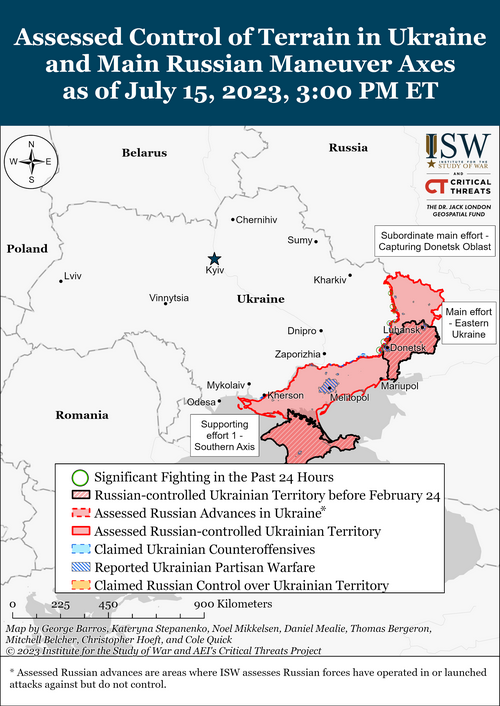
From The Institute For The Study of War:
Russian Offensive Campaign Assessment, July 15, 2023
Riley Bailey, Kateryna Stepanenko, Nicole Wolkov, Angelica Evans, and Frederick W. Kagan
July 15, 2023, 8pm ET
Click here to see ISW’s interactive map of the Russian invasion of Ukraine. This map is updated daily alongside the static maps present in this report.
Click here to access ISW’s archive of interactive time-lapse maps of the Russian invasion of Ukraine. These maps complement the static control-of-terrain map that ISW produces daily by showing a dynamic frontline. ISW will update this time-lapse map archive monthly.
Note: The data cutoff for this product was 1:00pm ET on July 15. ISW will cover subsequent reports in the July 16 Russian Offensive Campaign Assessment.
Russian sources reported on July 15 that the Russian military command dismissed 106th Guards Airborne (VDV) Division Commander Major General Vladimir Seliverstov.[1] Russian sources stated that the reason for Seliverstov’s dismissal is currently unknown but speculated that it could be associated with Seliverstov’s reputation for speaking up on behalf of his soldiers.[2] Russian sources claimed that the 106th VDV Division has been operating in the Bakhmut area since January, and ISW has recently observed the 106th VDV Division’s 137th Guards VDV Regiment defending against Ukrainian counteroffensive operations on Bakhmut’s northern flank.[3] A Russian milblogger has claimed that elements of the 106th VDV Division are also supporting Russian defensive operations south of Bakhmut.[4] Relatives of mobilized personnel serving in the 137th VDV Regiment notably appealed to Russian President Vladimir Putin, Tula Oblast Governor Alexei Dyumin, and Russian Defense Minister Sergei Shoigu in April about poor conditions and lack of supplies in the unit.[5] Vocal discontent about conditions in areas where Russian forces are defending against Ukrainian counteroffensive operations may have prompted Seliverstov to appeal to the Russian military command, which may have contributed to his dismissal. ISW has not observed confirmation of Seliverstov’s dismissal, but Russian reporting about the dismissal follows a pattern similar to that of previous claims of command changes that have proven true.[6]
Seliverstov’s dismissal may be a part of an ongoing purge of insubordinate commanders by the Russian military command and may suggest that the corrosion of the Russian chain of command in Ukraine is accelerating. The Russian military command recently dismissed 58th Combined Arms Army (Southern Military District) Commander Major General Ivan Popov after he reportedly attempted to bypass Chief of the Russian General Staff and overall theater commander Army General Valery Gerasimov and bring his complaints about the situation in western Zaporizhia Oblast directly to Putin.[7] Popov’s complaints reportedly centered on a lack of rotations for his troops, and in a leaked audio message Popov also complained about heavy losses and a lack of effective counterbattery capabilities.[8] These issues are likely impacting Russian forces throughout the theater in Ukraine, and reports of Seliverstov’s dismissal only four days after reports of Popov’s dismissal suggest that the Russian command may have fired Seliverstov for similar reasons.[9] ISW assessed that Popov’s insubordination is indicative of a pattern of behavior that has developed within the Russian command in Ukraine, in which commanders have challenged the authority of senior commanders and sought to use their responsibility for key sectors of the front to cajole the Kremlin to support them.[10]
Endemic problems within the Russian war effort in Ukraine, exacerbated by poor decisions made by senior political and military leaders, are likely prompting strong-willed commanders to challenge their senior commanders in efforts to preserve their forces and lead combat effective units.[11] The 58th Combined Arms Army‘s (CAA) and the 106th VDV Division’s relatively effective defense against Ukrainian counteroffensive operations in their respective areas of the front thus far suggests that they are some of the most combat effective formations committed to the frontline, and Popov and Seliverstov likely contributed to their relative effectiveness by being willing to challenge superiors and the system. Popov’s reported actions clearly crossed the line to insubordination. Seliverstov may have followed Popov’s example or the Russian military leadership may have dismissed Seliverstov out of the fear that he would do so.
Seliverstov’s dismissal suggests that there is a deep concern within the Russian military leadership about the chain of command in Ukraine. Popov’s, Russian VDV Commander Colonel General Mikhail Teplinsky’s, and Wagner Group financier Yevgeny Prigozhin’s challenges to Gerasimov’s and Shoigu’s authority have established a precedent for insubordination that can hollow out support for the Russian military command among senior officers.[12] ”Vostok“ Battalion Commander Alexander Khodakovsky, who leads forces defending against Ukrainian counteroffensives in western Donetsk Oblast, amplified Popov’s complaints about the lack of Russian counterbattery capabilities on July 15, suggesting that the controversy with Popov’s dismissal may be influencing other commanders to more publicly voice their frustrations.[13] The apparently intensifying pattern of insubordination may prompt the Russian military leadership to replace commanders whom they perceive to be potentially insubordinate with loyal figures, preferring yes-men to competent and strong-willed officers able to maintain the combat capabilities of Russian formations defending in key sectors of the front in Ukraine.
The Russian military leadership is likely attempting to dissuade commanders from emulating recent cases of insubordination by punishing those involved in leaking Popov’s message of complaints. Shoigu is also likely attempting to mitigate the aftermath of Popov’s leaked audio recording within the Russian government and punish Russian State Duma Deputy and former Deputy Commander of the Southern Military District (SMD) Lieutenant General Andrei Gurulev for the leak. Russian sources speculated that Shoigu is demanding that the Russian State Duma Defense Committee expel Gurulev for leaking Popov’s audio message.[14] A Russian source close to Russian security officials claimed that the United Russia party is preparing a set of punishments that will include censoring Gurulev from discussing Russia’s invasion of Ukraine.[15] One source claimed that Gurulev’s fate in the State Duma depends on an upcoming meeting between Secretary of the General Council of United Russia Party Andrey Turchak and Shoigu.[16] Turchak previously publicly accused Gurulev of leaking the audio recording to stage a ”political show.”[17] Another source claimed that Gurlev was summoned to meet with Chairman of the Russian State Duma Vyacheslav Volodin on July 17.[18]
Growing insubordination will likely exacerbate existing factional divides within the Russian military and the wider Russian security sphere. A Russian source claimed that Dyumin unsuccessfully attempted to intercede to prevent Seliverstov’s dismissal in a trip to Moscow on July 14.[19] Dyumin may have been advocating for Seliverstov in opposition to Shoigu and Gerasimov or simply because the 106th VDV Division is headquartered in Tula Oblast. In either case Dyumin‘s intervention likely inflamed perceptions within the Russian military that the dismissal was associated with factionalism. Gerasimov and Shoigu may view Dyumin as an anti-MoD establishment figure due to his reported affiliations with Prigozhin, his reported involvement in negotiations that brought Wagner’s rebellion to an end, and widespread rumors following the rebellion that Dyumin would replace Shoigu as defense minister.[20] Shoigu and Gerasimov may also view insubordination within the VDV as the result of factionalism since Teplinsky is now the highest profile anti-Gerasimov officer following Prigozhin’s apparent denouement.[21] Russian sources notably claimed that the 106th VDV Division closely operated alongside Wagner forces in January 2023 as their offensive on Bakhmut intensified, and Gerasimov and his affiliates may view Seliverstov as an officer in a hostile camp due to his relationships with both Wagner and Teplinsky.[22] Russian forces also claimed that Seliverstov routinely opposed the command of former VDV commander and close Gerasimov affiliate Colonel General Andrey Serdyukov during the Russian offensive on Kyiv in the early stages of the full-scale invasion and may have established himself as a noted anti-Gerasimov commander at that time, since Serdyukov was in Gerasimov’s patronage.[23] Teplinsky’s and Prigozhin’s challenges to Gerasimov and Shoigu likely engendered a view within the MoD establishment that acts of insubordination are likely also factional power plays aimed at weakening their support with the Kremlin.[24] Gerasimov and Shoigu may increasingly view opposition to their decisions as evidence of factionalism and may use perceived factional affiliations as grounds for punishing or firing those they view as presenting a threat of insubordination.
Factions within the Russian security forces and the Kremlin appear to be fighting for control over the Russian insider information space. Russian insider Telegram channels routinely speculate on internal Kremlin and Russian Ministry of Defense (MoD) politics and dynamics between Russian political factions. Russian authorities arrested on July 14 former Russian Federal Security Service (FSB) officer Colonel Mikhail Polyakov, who reportedly ran several popular insider Telegram channels.[25] A Russian source claimed that Polyakov previously served as the head of the Moscow FSB service for the protection of the constitutional order.[26] Russian insider sources claimed that Polyakov was in frequent contact with the Russian MoD’s Department of Military Representatives and used his affiliation with the FSB to advance his personal unspecified objectives – possibly using secret information to defame Russian officials.[27] One source claimed that Polyakov was involved in distributing Popov’s leaked audio recording.[28] An insider source also claimed that the recent arrest of Russian Deputy Minister for Digital Development Maxim Parshin for bribery was also related to inter-Kremlin fight for control over the online information space and noted that Presidential Administration officials such as First Deputy Chief of Staff of the Russian Presidential Administration Sergey Kiriyenko also controls a number of Telegram channels.[29] One source sarcastically observed that the FSB has moved from controlling Russia to fighting for control over Telegram, while another noted that Polyakov’s arrest may be the start of a fight for control over insider sources on the Russian internet.[30]
Polyakov’s arrest suggests that different factions within the Kremlin and Russian security entities are exploiting the Russian information space and secret information to advance their political and financial objectives against the backdrop of Russia’s war in Ukraine. If Polyakov’s affiliation with numerous insider Telegram channels is true, then it is evident that Russian officials see the Russian information space as an important source of authority that allows them to promote their interests and discredit their opponents in the eyes of their constituencies. One Russian source, for example, rhetorically asked who would want to discredit the FSB via Polyakov’s arrest, while another milblogger observed that such infighting was not as evident prior to 2022.[31] Wagner Group financier Yevgeny Prigozhin’s mutiny may also have impelled Russian officials to seek to discredit or eliminate opponents who control some of the insider Telegram sources to maintain their standings or positions.
Ukrainian forces conducted counteroffensive operations on at least three sectors of the front on June 15 and reportedly made limited gains. Russian sources claimed that Ukrainian forces made limited gains south of Bakhmut near Andriivka (10km south of Bakhmut) and crossed the Siverskyi Donetsk Canal in the area.[32] Russian sources also claimed that Ukrainian forces made limited advances in the western Donetsk-eastern Zaporizhia Oblast border area southwest of Velyka Novosilka and in western Zaporizhia Oblast northeast of Robotyne (12km south of Orikhiv).[33] A Russian milblogger claimed that Russian forces are ”constantly” moving reinforcements to the Bakhmut area and recently transferred an unspecified BARS (Russian Combat Reserve) unit from the Kreminna area to near Klishchiivka (7km southwest of Bakhmut), indicating that Ukrainian counteroffensive operations continue to trigger transfers of Russian forces to the Bakhmut area.[34] Ukrainian Tavriisk Group of Forces Commander Brigadier General Oleksandr Tarnavskyi stated in an interview with CNN published on July 14 that the counteroffensive is successful but acknowledged that the tempo of Ukrainian advances is slower than expected.[35] Tarnavskyi stated that Ukrainian forces are effectively defeating Russian forces at longer distances, likely referencing Ukraine’s continued interdiction campaigns in eastern and southern Ukraine.[36] Tarnavskyi also reported that Ukrainian forces received cluster munitions that can ”radically change [the battlefield]” and have yet to use them.[37]
The New York Times (NYT) reported that the Ukrainian military has adjusted its strategy to minimize Ukrainian casualties while continuing to attrit Russian forces, supporting ISW’s previous assessments. NYT reported that unnamed US and European officials estimated that Russian forces destroyed up to 20 percent of Ukraine’s Western-provided weaponry in the first two weeks of the counteroffensive.[38] The NYT reported that officials stated that the rate of losses has dropped to 10 percent in the subsequent weeks due to a change in Ukrainian strategy.[39] The NYT reported that the Ukrainian military has changed tactics to focus on wearing down Russian forces with artillery and long-range missiles instead of large-scale assaults, which is consistent with Ukrainian Commander-in-Chief General Valerii Zaluzhnyi’s statement on July 14 that increased Ukrainian indirect fire can both pin down Russian forces and minimize Ukrainian casualties.[40] ISW previously assessed on July 4 that Ukrainian forces appear to be focusing on creating an asymmetrical attrition gradient that conserves Ukrainian manpower at the cost of a slower rate of territorial gains, while gradually wearing down Russian manpower and equipment.[41] Ukraine‘s military has likely been refining its counteroffensive strategy for weeks, and the larger effects of those adjustments are only just becoming clear to some observers. Ukraine will likely continue to adjust its strategy and execution throughout the counteroffensive to facilitate continued progress.
The Belarusian Ministry of Defense (MoD) announced that it developed a plan for Wagner Group personnel to train Belarusian forces as Ukrainian, Russian, and Belarusian sources continue to report that Wagner forces are moving to Belarus. The Belarusian MoD announced on July 14 that it developed a roadmap with ”Wagner leadership” for Wagner forces to train Belarusian forces and pledged to provide additional information about the plan.[42] Independent Belarusian monitoring group The Hajun Project reported that an anonymous source observed Belarusian traffic police escorting a convoy consisting of at least 60 vehicles with Donetsk and Luhansk People’s Republics’ license plates in Belarus on the morning of July 15.[43] The Hajun Project stated that the convoy was likely transferring Wagner personnel from Russia to Belarus and may be en route to a tent camp in Tsel (15km northwest of Aspovichy), Mogilev Oblast.[44] The Ukrainian Resistance Center reported that Belarusian partisans confirmed that 240 Wagner personnel, 40 trucks, and a large number of weapons arrived in Aspovichy and that Wagner forces are staying in Tsel, Mogilev Oblast.[45] Several milbloggers also posted footage and photos claiming to show a convoy of Wagner vehicles en route to Belarus.[46] It is unclear if a single Wagner convoy traveled from Russia to Belarus or if multiple conveys are en route to Belarus at this time.
Russian authorities likely continue to forcibly integrate Ukrainian Orthodox Church (UOC) dioceses into the Kremlin-controlled Russian Orthodox Church (ROC) as part of a wider religious persecution campaign in occupied Ukraine. Luhansk People’s Republic (LNR) Head Leonid Pasechnik announced on July 15 the incorporation of the Luhansk, Alchevsk, Severodonetsk, Starobilsk, and Rovenky UOC dioceses into the ROC.[47] The ROC has already seized the Berdyansk and Prymorsk dioceses in occupied Zaporizhia Oblast, and a Russian news aggregator claimed that the Russian Ministry of Justice recently registered the Donetsk City and Horlivka dioceses as part of the ROC.[48] The new round of forced integration of the UOC dioceses in occupied Luhansk Oblast followed a Ukrainian court ruling that the Head of the Kyiv-Pechersk Lavra Metropolitan Pavel will go to a detention center instead of remaining under house arrest.[49] Russian sources attempted to portray the integration of UOC dioceses into the ROC as a response to claimed Ukrainian religious suppression of a Kremlin-run ROC. The ROC has explicit links to the Kremlin and has provided material and spiritual support to Russia during the war.[50] This explanation makes little sense, however, as the ROC clearly faces no threats from the Ukrainian government in Russian-occupied territory. The Ukrainian government is not engaging in religious suppression, moreover, but rather acting against religious elements it asserts are linked to the Kremlin’s war effort.[51] Russian authorities have conducted systematic religious persecution in occupied Ukraine since the start of the war, however.[52]
Key Takeaways:
- Russian sources reported on July 15 that the Russian military command dismissed 106th Guards Airborne (VDV) Division Commander Major General Vladimir Seliverstov.
- Seliverstov’s dismissal may be a part of an ongoing purge of insubordinate commanders by the Russian military command and may suggest that the corrosion of the Russian chain of command in Ukraine is accelerating.
- The Russian military leadership is likely attempting to dissuade commanders from emulating recent cases of insubordination by punishing those involved in leaking Popov’s message of complaints.
- Growing insubordination will likely exacerbate existing factional divides within the Russian military and the wider Russian security sphere.
- Factions within the Russian security forces and the Kremlin appear to be fighting for control over the Russian insider information space.
- Polyakov’s arrest suggests that different factions within the Kremlin and Russian security entities are exploiting the Russian information space and secret information to advance their political and financial objectives against the backdrop of Russia’s war in Ukraine.
- Ukrainian forces conducted counteroffensive operations on at least three sectors of the front on June 15 and reportedly made limited gains.
- The New York Times (NYT) reported that the Ukrainian military has adjusted its strategy to minimize Ukrainian casualties while continuing to attrit Russian forces, supporting ISW’s previous assessments.
- The Belarusian Ministry of Defense (MoD) announced that it developed a plan for Wagner Group personnel to train Belarusian forces as Ukrainian, Russian, and Belarusian sources continue to report that Wagner forces are moving to Belarus.
- Russian authorities likely continue to forcibly integrate Ukrainian Orthodox Church (UOC) dioceses into the Kremlin-controlled Russian Orthodox Church (ROC) as part of a wider religious persecution campaign in occupied Ukraine.
- Russian forces conducted offensive operations and made limited territorial gains near Svatove.
- Ukrainian forces reportedly made limited territorial gains on Bakhmut’s southern flank, while Russian sources claimed that Russian forces made limited advances on Bakhmut’s northern and southern flanks.
- Russian forces continued limited offensive operations on the Donetsk City-Avdiivka line but did not make any territorial gains.
- Ukrainian forces continued counteroffensive operations along the western Donetsk-eastern Zaporizhia Oblast border and reportedly made limited gains.
- Ukrainian forces continued counteroffensive operations and reportedly made limited advances in western Zaporizhia Oblast.
- The Russian Ministry of Defense (MoD) announced the completion of Russia’s spring 2023 conscription cycle on July 15.
- The Ukrainian Resistance Center reported that the Kremlin launched a program to recruit young adults in Russia for service in occupation administrations in Ukraine.
Go here to read the rest. The Russians are shifting forces to find new forces to commit for the fight over Bakhmut. Such shiftings open up opportunities for the Ukainians.

