
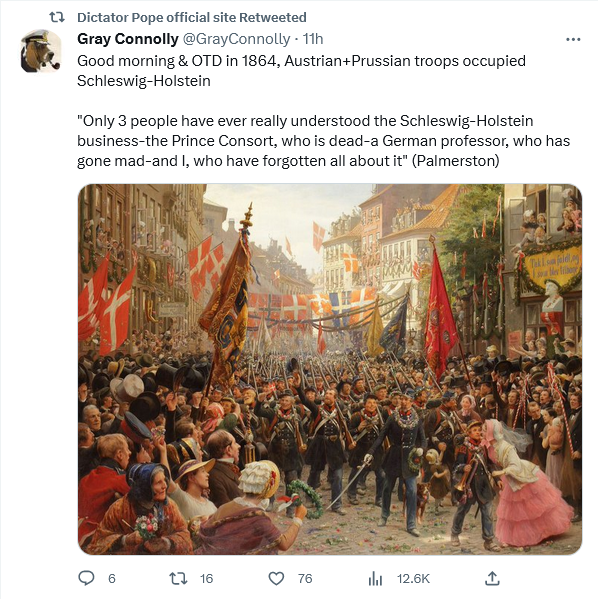
The Second Schleswig War which began on February 1, 1864 was the first of a series of three wars, the remaining two being the Austro-Prussian War of 1866 and the Franco-Prussian War of 1870-71, devised by the Prussian Chancellor Otto von Bismarck, which led to the creation of the German Empire and German supremacy in Mittel Europa. Although buried in deep obscurity today, the conflict over these territories of Denmark led directly to the conditions which led to the modern world. What seems small at the time can often have huge consequences in the fullness of time.


The history of Europe is the history of war. Enough.
The history of the world is the history of war.
The history of Europe is the history of war.
It isn’t.
We suffer from a modern map bias. We subconsciously think that any lines that were drawn before the current ones were “wrong”. That seems particularly unhelpful with Central Europe.
You can say that again Pinky! I admire a map of Germany circa 1617 with every principality outlined. It looks like an Impressionist painting rather than a map. Middle Europe has always been a confused welter of polities and peoples, divided by religion, language, histories. Both World Wars were largely a function of attempting to rationalize this reality with mega states attempting to enforce uniformity where there was precious little.
Both of my grandparents families, paternal and fraternal, left Germany shortly after the Franco-Prussian War. They were not pacifists or democrats. They simply saw that the provisions of the Congress of Vienna, which supposedly settled the boundaries in Europe, would never be honored. That underlying condition persists in one form or another to this day.
If the Second Schleswig War was the first of a series of three wars, what was the First Schleswig War? Asking for a friend.
That underlying condition persists in one form or another to this day.
Somehow, I don’t think the Congress of Vienna figures much in Europe’s current problems.
Art Deco: There are a number of leftovers that still fester. Separatist movements in Spain and the Balkan countries, language/cultural stresses in Belgium, France and the Bretons, Russia-Ukraine-Moldova war and occupation. In addition, there are parts of various countries that have never fully accepted the borders that were drawn following the Napoleonic wars. Europe is not quite as united as the EU thinks it is or as some would like it to be.
There are a number of leftovers that still fester. Separatist movements in Spain and the Balkan countries, language/cultural stresses in Belgium, France and the Bretons, Russia-Ukraine-Moldova war and occupation.
None of this has anything to do with the Congress of Vienna.
1848-1851-Danish victory.
Don, I guess that’s the corollary, that it’s bad thinking to believe that the current map is right.
I think I mentioned this before on here, but a woman once showed me an 11th c. map of Eastern Europe as justification for Russia’s claim to Ukrainian territory … I remained unconvinced.
The current map is Pinky just as the then current map was in 1617. If you want to have a war just start trying to redraw boundary lines in Europe. Doesn’t make the current maps right, whatever that means in the European context, but it does mean that trying to redraw them will probably be a bloody process as was the case in the breakup of Yugoslavia. May be worth it to the people involved, but such European broils do tend to get major powers involved.
but it does mean that trying to redraw them will probably be a bloody process as was the case in the breakup of Yugoslavia.
Bosnia, Herzegovina, Krajina, and Kosovo saw a great deal of bloodshed. In the case of Kosovo, western armed intervention was useful in putting a limit on further bloodshed. Note, the alternative to redrawing the borders is (1) mass expulsion, as happened to the Germans in Bohemia and Moravia in 1945 or (2) jerry-rigged political institutions to accommodate distinct subsets (whose operations have costs of their own, see Belgium, Quebec, and Ulster).
I have to laugh at the thought of an 11th century map of Eirope justifying Russia’s claim to Ukraine. Russia did not exist as a country at that time. Poland..did!
The land of the Baltic nations, Belarus, some of Ukraine and a part of Russia were the Grand Duchy of Lithuania.
[…] The Second Schleswig War Begins – Donald R. McClarey, J.D., at The American […]