
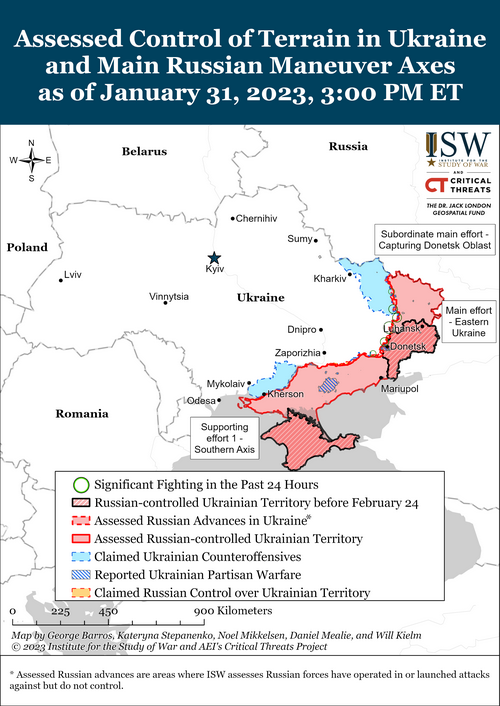
From The Institute For The Study of War:
Kateryna Stepanenko, Karolina Hird, Riley Bailey, Grace Mappes, Angela Howard, Nicole Wolkov, and Frederick W. Kagan
January 31, 8:15 pm ET
Click here to see ISW’s interactive map of the Russian invasion of Ukraine. This map is updated daily alongside the static maps present in this report.
The introduction of Russian conventional forces to the Bakhmut frontline has offset the culmination of the Wagner Group’s offensive and retained the initiative for Russian operations around the city. The ISW December 27 forecast that the Russian offensive against Bakhmut was culminating was inaccurate.[1] The Wagner Group offensive culminated, as ISW assessed on January 28, but the Russian command has committed sufficient conventional Russian forces to the effort to reinvigorate it, thus forestalling the overall culmination of the offensive on Bakhmut, which continues.[2] The commander of a Ukrainian unit operating in Bakhmut, Denys Yarolavskyi, confirmed that “super qualified” Russian conventional military troops are now reinforcing Wagner Group private military company (PMC) assault units in an ongoing effort to encircle Bakhmut.[3] Another Ukrainian Bakhmut frontline commander, Volodymyr Nazarenko, also confirmed ISW’s observations that the Russian military command committed Russian airborne troops to the Bakhmut offensive.[4] Russian forces are continuing to conduct offensive operations northeast and southwest of Bakhmut and have secured limited territorial gains since capturing Soledar on January 12.[5]
ISW does not forecast the imminent fall of Bakhmut to Russian forces, although the Ukrainian command may choose to withdraw rather than risk unacceptable losses. It is extraordinarily unlikely that Russian forces will be able to conduct a surprise encirclement of Ukrainian forces in Bakhmut. Yaroslavskyi noted that the Ukrainian military command would conduct a controlled withdrawal of forces from Bakhmut to save Ukrainian soldiers’ lives, likely if the Ukrainian command assesses that the risk of an encirclement of the city is imminent.[6] Ukrainian Eastern Grouping of Forces Spokesperson Serhiy Cherevaty stated on January 31 that Ukrainian forces are still able to effectively supply units in Bakhmut and noted that the Ukrainian military command has developed several contingency plans to respond to Russian operations around Bakhmut.[7] Cherevaty added that Russian forces are continuing to suffer heavy casualties and noted that Ukraine’s previous defense and subsequent withdrawal from Severodonetsk and Lysychansk over the summer of 2022 exhausted Russian forces and disrupted their plans for an immediate attack on Bakhmut.
Russian officials are again overestimating Russian military capabilities to advance in Donetsk Oblast and in the theater in a short period of time. Head of the Donetsk People’s Republic Denis Pushilin stated on January 31 that the Russian capture of Bakhmut will allow Russia to advance to Kramatorsk and Slovyansk, both approximately 40km northwest of Bakhmut.[8] Wagner Group financier Yevgeny Prigozhin previously claimed that the average pace of Russian advance around Bakhmut was about 100 meters per day, and it took Russian forces eight months to advance from occupied Popasna in Luhansk Oblast and Svitlodarsk to their current positions in the vicinity of Bakhmut (distances of 25km and 22km respectively).[9] Pushilin also claimed that the hypothetical Russian capture of Vuhledar would allow Russian forces to launch offensive operations on Kurakhove, Marinka, and Pokrovsk—despite the inability of Russian forces to capture Marinka since March 17, 2022, when the Russian Ministry of Defense (MoD) falsely claimed to have seized the settlement.[10] Pushilin had also claimed that Russian forces will seize Avdiivka, but has not provided any explanation of how Russian forces will break through almost nine years’ worth of Ukrainian fortifications around the settlement.[11] Pushilin’s expectations for Russia’s hypothetical seizure of Bakhmut further demonstrate that Russians are continuing to face challenges in accurately assessing the time and space relationship with the account for Russian military capabilities.
Russian conventional forces may be replacing expended Wagner PMC forces by relocating them from Bakhmut to the frontlines in southern Ukraine.[12] The Head of the Ukrainian Press Center of the Defense Forces of the Tavrisk Direction, Colonel Yevhen Yerin, stated that Russian forces are conducting unspecified force rotations out of Kherson Oblast and that Ukrainian authorities are clarifying reports about Wagner Group forces arriving in the Zaporizhia operational direction.[13] Ukrainian officials first reported on Wagner forces arriving in east (left) bank Kherson Oblast on January 15, coinciding with the culmination of the Wagner offensive in Donbas with the capture of Soledar on January 12.[14] Russian forces may be rotating out the culminated and battle-weary Wagner forces in favor of Russian conventional units that have likely been resting and refitting since the Russian withdrawal to the east (left) bank Kherson Oblast in November.[15]
The Russian Ministry of Defense (MoD) may be attempting to fully supplant Wagner forces near Bakhmut and frame the traditional Russian military command structure as the sole victor around Bakhmut, assuming Russian forces eventually take the city. The Russian MoD and Wagner Group financier Yevgeny Prigozhin have made competing claims over recent Russian gains around Soledar and Bakhmut following the capture of Soledar.[16] The Russian MoD claimed that Russian forces captured Blahodatne just west of Soledar on January 31 after Prigozhin claimed that Wagner forces seized the settlement on January 28.[17] Prigozhin is likely overcompensating for Wagner forces’ reduced combat capabilities and reliance on conventional forces by claiming territorial gains before the MoD can feasibly claim them for Russian conventional forces.[18] The Russian MoD likely aims to undermine the Wagner Group’s influence in Ukraine despite the MoD’s reliance on Wagner forces to sustain the Russian effort around Bakhmut since July and to take horrendous losses for minimal territorial gains.[19]
Ukrainian officials continue to support ISW’s assessment that an imminent Russian offensive in the coming months is the most likely course of action (MLCOA) and further suggested that Ukrainian forces plan to launch a larger counteroffensive. Ukrainian National Security and Defense Council Secretary Oleksiy Danilov stated in a January 31 interview with Sky News that Russian forces are preparing for a “maximum escalation” in Ukraine within the next two to three months and may do so as soon as the next two to three weeks to coincide with the first anniversary of the Russian invasion of Ukraine.[20] Ukrainian Main Military Intelligence Directorate (GUR) Head Kyrylo Budanov stated in a January 31 interview with the Washington Post that Russian forces will focus on occupying a larger area of Luhansk and Donetsk oblasts, supporting ISW’s assessment that Russian forces appear to be preparing for an imminent offensive in eastern Ukraine, particularly in Luhansk Oblast.[21] Budanov stated that there are currently 326,000 Russian forces fighting in Ukraine, excluding the roughly 150,000 mobilized personnel still in training grounds that Russian forces have reportedly not yet committed to hostilities.[22] The Russian military will likely continue to accumulate conventional forces in Luhansk Oblast and increase the deployment of remaining mobilized personnel to eastern Ukraine in support of an imminent decisive strategic effort in western Luhansk Oblast.[23] Danilov suggested that Ukrainian forces have their own plans for operations in the coming months, and Budanov stated that Ukrainian forces must return Crimea to Ukrainian control by the summer of 2023.[24] Budanov has recently stated that Ukrainian forces intend to launch a major counteroffensive throughout Ukraine in the spring of 2023 “from Crimea to Donbas.”[25]
Prominent Russian milbloggers continue to expose Russian military failures in Ukraine through increasingly public and elevated platforms. A prominent Russian milblogger claimed on live Russian state TV that Russian Airborne Forces (VDV) lost 40-50% of their personnel between the start of Russia’s invasion of Ukraine and September of 2022, although ISW cannot independently confirm the accuracy of the milblogger’s assessment.[26] The public reporting of this significant figure, regardless of its accuracy, notably undermines efforts from the Russian Ministry of Defense (MoD) to minimize Russian causalities reported in the Russian information space. The Kremlin has recently attempted to integrate some select milbloggers, including this one, into its narrative control by offering them platforms on Russian state broadcasters while also attempting to resurrect censorship efforts targeting the wider community of milbloggers that are critical of the Kremlin and the Russian Ministry of Defense (MoD).[27] The Kremlin‘s effort to coopt a select group of milbloggers by giving them more public and elevated platforms may backfire as milboggers may seize the opportunity to appeal to the Russian ultranationalist community that has been increasingly critical of the Kremlin’s conduct of the war.[28]
Russia continues to weaponize counterterrorism laws to justify domestic repressions. Russian sources reported on January 31 that the Central Military District Court found Vladislav Borisenko guilty of a terrorist act and sentenced him to 12 years in prison for his role in a May 2022 Molotov cocktail attack on the Nizhnevartovsk military registration office in Khanty-Mansi Okrug.[29] This is notably the first instance of the perpetrator of an attack on a military registration office being officially charged with committing a terrorist act.[30] The apparent elevation of charges for such incidents from destruction of property and hooliganism indicate that the Russian judicial system is increasingly seeking to impose harsher punishments on acts of domestic dissent as the war in Ukraine continues, as ISW has previously assessed.[31] Russian President Vladimir Putin additionally signed a decree on January 31 that simplifies the process of implementing terror threat alerts in Russia.[32] The decree allows Russian regions to introduce an elevated “terrorist level” for an indefinite period, thus negating the previous 15-day limit.[33] The January 31 decree is an expansion of Putin’s October 19 martial law decree, which introduced varying levels of “martial law readiness” in occupied regions of Ukraine and Russian border regions.[34] The new decree will allow Russian regions operating on a “yellow level” of terrorist threat (as in Belgorod, Bryansk, and Kursk Oblasts) to stop and search vehicles on administrative borders to weapons and explosives, activities that were previously allowed only in “red level” regions.[35] The continued legislative manipulations of terrorism as a legal concept are allowing Russian authorities greater scope to crack down on domestic dissent and on any activities that are deemed contrary to Russian interests.
Key Takeaways
- The introduction of Russian conventional forces to the Bakhmut frontline has offset the culmination of the Wagner Group’s offensive and retained the initiative for Russian operations around the city. ISW’s December 27 forecast that the Russian offensive against Bakhmut was culminating was inaccurate.
- ISW does not forecast the imminent fall of Bakhmut, and it is extraordinarily unlikely that Russian forces will be able to conduct a surprise encirclement of Ukrainian forces in Bakhmut.
- Russian military command is overestimating Russian military capabilities to advance rapidly in Donetsk Oblast and in the theater.
- Russian conventional forces may be replacing expended Wagner PMC forces by relocating them from Bakhmut to the Zaporizhia Oblast front line.
- The Russian Ministry of Defense (MoD) may be attempting to fully supplant Wagner forces near Bakhmut to frame the traditional Russian military command structure as the sole victor around Bakhmut, assuming Russian forces take the city.
- Ukrainian officials continue to support ISW’s assessment that an imminent Russian offensive in the coming months is the most likely course of action (MLCOA) and further suggested that Ukrainian forces plan to launch a larger counteroffensive.
- Prominent Russian milbloggers continue to expose Russian military failures in Ukraine through increasingly public and elevated platforms.
- Russia continues to weaponize counterterrorism laws to justify domestic repressions.
- Russian forces continued limited ground attacks to regain lost positions along the Svatove-Kreminna line on January 31.
- Russian forces continued offensive operations along the Donetsk Oblast front line.
- Russian forces are unlikely to benefit significantly elsewhere in eastern Ukraine from their localized offensive around Vuhledar.
- Russian forces are likely prioritizing sabotage and reconnaissance activities over territorial gains in southern Ukraine.
- Russian Prosecutor General Igor Krasnov acknowledged Russian mobilization failures in an attempt to frame implementation failures and policy violations as resolved.
- Russian occupation authorities continue to use youth engagement and education programs to consolidate social control of occupied territories.
Go here to read the rest.
From Strategy Page:
January 31, 2023: NATO delays in delivering tanks and other armored vehicles, as well as longer-range missiles and combat aircraft have hampered Ukrainian plans to launch new offensives to force Russian forces out of more Ukrainian territory. Russia is taking advantage of this by using its few remaining offensive units to make small territorial gains and promote this as major victories.
For Vladimir Putin, his war in Ukraine can continue as long as he has enough money to support it. Oil income is way down because of sanctions. Despite that Russia can still export oil but at discounts of up to 45 percent. This can (according to Russian officials) go on for about three years and then the National Wealth Fund, a reserve of gold and foreign currencies that supports the value of the ruble, will be “officially” gone (much has been frozen in Western banks by sanctions and will instead probably end up being used to rebuild Ukraine). Emptying that fund this way makes it nearly impossible to borrow money. Meanwhile sanctions and costs of the war have increased unemployment and poverty rates.
Putin calls on Russians to exercise the traditional forbearance under difficult conditions. This got Russia through World War II and years of communist misrule. The costs were high. World War II cost Russia 18 percent of its population with enormous damage to the economy and infrastructure. Communist corruption and inability to manage the economy eventually led to the dissolution of the century’s old Russian empire in 1991. Putin describes the war in Ukraine as an internal matter for a Russian government that considers the 1991 dissolution of the Soviet Union as illegitimate and a great mistake. The problem is that none of the new nations created from the dissolution want to return to being imperial vassals. Putin was surprised at the Ukrainians’ resistance and, rather than accept the truth, insisted that the Ukrainians had become corrupted by NATO who persuaded them to fight the Russian liberation effort. Ukrainians old enough to remember life in Soviet Ukraine recognize Putin’s version of the situation as the same delusional beliefs that caused the Soviet Union to fall apart in 1991.
It’s another example of those who refuse to learn from history and are condemned to repeat it. Ukrainians recognize this and a growing number of Russians do as well. After losing about seven million Russians who left Russia permanently since Putin took power, Putin now restricts who can leave the country. In response to that, Russians are sneaking out of the country despite the risk of arrest and prison or getting killed by border guards with orders to shoot anyone caught crossing illegally and refusing to stop. So far a majority of Russians have put up with this mistreatment but the situation is a replay of the late 1980s and few Russians want that. This includes a growing number of wealthy Russians (the oligarchs) who have the means to bring Putin down if enough of them unite in such a risky effort.
Putin is moving to cripple the opposition by trying to limit the ability of many Russian Internet-based war correspondents to visit the war zone. His generals are cooperating with this although most of the troops are not. Russians “mobilized” into the military during 2022 are poorly trained, led and supplied. The result has been a lot of soldiers who refuse to act like soldiers. Russia lost most of its combat officers early in the war and many non-combat officers (including doctors) ordered to replace those losses were not effective. Russia has no veteran NCOs and in desperation is offering officer commissions to act like an officer. This has not worked out because the new officers found that the senior officers are more concerned with keeping their jobs than taking care of their subordinates. Russia is running out of capable and loyal soldiers willing to fight and die for Putin.
Russia is also running out of generals because nine have died so far during visits to the front to see for themselves what is happening and why. Accurate news from the front is still available from the Internet-based reporters. Despite that, Putin recently replaced the senior generals running the Ukraine operations with ones who believe only Russian offensive action will work for Russia in Ukraine. Remaining on the defensive in order to wait out the Ukrainians is something Putin realizes he literally cannot afford.
Putin plays down the problems with an offensive strategy. For example, when Russia invaded Ukraine in early 2022 it never expected to run out of ammunition. The war was not over in a few months and, because of that, Russia did run out of artillery munitions by the end of 2022 while Ukraine was supplied by NATO with massive amounts of 155mm artillery ammunition. Russia’s production of artillery ammunition continues but it is not enough to match what Ukraine is receiving from NATO nations. Ukraine has also revived its artillery munitions production of 152mm shells. This is the caliber used by Russian-designed artillery which Ukraine still has some of. NATO’s current munitions are more effective and reliable than Russian-made projectiles. For Ukraine to push the Russians out of its territory it must attack and that requires more artillery support than defense.
The NATO countries supplying all this ammunition have a problem because they eventually ran through most of what they had available. The United States supplied most of it and now has to replace its war reserves stockpiled for a major war. While European NATO nations don’t have to worry about their major threat, Russia, while they rebuild their war reserves, the Americans have to plan for potential conflicts elsewhere, like China, North Korea and Iran. The Americans can still do so because supporting Ukraine does not degrade American naval or air power. A war with China would not become more difficult because of American military aid to Ukraine. The same is true for potential conflicts with China, North Korea or Iran as both of them have plenty of powerful local near-peer opponents who would be American allies in such conflicts, i.e., South Korea, Japan, the Arab gulf states and Israel, who can deal with China, Iran or North Korea given American and naval support. American ground forces are also available for a Pacific campaign, but cannot use artillery munitions as heavily as they would prefer.
The U.S. found that it takes several years to ramp up production of artillery munitions and five or more years of increased production to restore the reserves. Munitions are still being sent to Ukraine, but not in the massive quantities seen during the first eight months of the war. Ukraine has managed to repair its own production facilities after Russia damaged them early in the war and is now manufacturing a lot of the basic small arms, artillery and mortar ammunition its troops use. While NATO nations have sent Ukraine most of the available munitions as well as a lot of weapons and combat or support vehicles, this is justified by the fact that NATO exists to protect NATO members from a Russian attack. The Russians did attack, but started with Ukraine, which wanted to join NATO, before moving on to nearby NATO nations. Russia has wrecked its military power and economy with this invasion of Ukraine, and won’t recover for a long time.
Ammunition is not the only item Russia does not have enough of. Adequate training for its troops, especially the new ones, is lacking. This is not the case with the Ukrainian forces, which received training from NATO countries since 2015 and that increased in 2022. For example, the United States set up a training program that trained up to 800 Ukrainian troops a month. Until 2022 the Americans were only training about 300 Ukrainian soldiers each month. Since February 2022 the U.S. has trained 3,100 Ukrainian soldiers. All this training concentrates on teaching Ukrainian troops to use weapons or equipment sent to Ukraine. For example, this program trained 610 Ukrainian artillerymen on how to use the HIMARS vehicle that carries and launches six GMLRS missiles. The fire control system of the HIMARS vehicle is somewhat complex. This HIMARS training enabled the Ukrainian crews to use the GMLRS missiles with devastating effect.
The new expanded program will train infantry units to handle more complex battlefield tactics. From 2015 to February 2022, American instructors trained 0ver 27,000 Ukrainian troops at a Ukrainian army base. After the invasion the American trainers withdrew and the training continued, on a smaller scale, in NATO bases in Germany.
Britain has used a thousand trainers to train nearly 10,000 Ukrainian troops in the last six months of 2022. Britain will train another 20,000 Ukrainian troops in Britain during 2023. Other nations have also contributed trainers to this effort. The Ukrainians appreciate this training effort and it makes a difference on the battlefield. This is especially true because Russia is sending more troops to Ukraine who have had little or no training. That means the Russians suffer higher casualties and the Ukrainians lose far fewer men. Ukrainian troops have been quick learners and know that success learning this material is a matter of life or death. The NATO nations have been making notes of how well and quickly the Ukrainians absorb this training, and used it to improve NATO training methods. NATO has long been getting useful feedback from Ukrainian troops about how well the training and the equipment works. Several NATO nations are sending Ukraine a hundred or more Leopard 2 tanks and the United States is sending some M1 tanks. Several countries are sending IFVs (Infantry Fighting Vehicles) and other light armored vehicles that typically accompany tanks. NATO and the Ukrainians develop shorter courses enabling troops familiar with one model of tank or IFV to transition to another similar vehicle. All this training gives Ukrainian forces a major advantage over the Russians, where most of the troops have little training or advanced tech and suffer from low morale and poor leadership. That sort of thing makes a big difference in combat but is often discounted during peacetime.
Russian Motivations
Vladimir Putin’s obsession with conquering Ukraine is aimed at acquiring more sufficiently ethnic Russians (which Ukrainians qualify as) to keep Russia Russian. The 2020 Russian census showed that the percentage of ethnic Russians had declined from 77.78 percent to 71.7 percent since 2010, even though it defined the two million Ukrainians (many ethnic Russians or Tatars) in Crimea as Russians because Putin had unilaterally declared that occupied (since 2014) Crimea was now part of Russia. The decline in ethnic Russians is largely because of a low birth rate and a growing number of ethnic Russians leaving Putin’s Russia. Over seven million ethnic Russians have left Russia since Putin took power in 1999. This happened because Putin mismanaged the economy and turned democratic Russia back into something like the failed Soviet Union. Putin believes that reviving the Soviet Union would be a good thing. It’s not enough to turn democratic Russia back into a police state with a corrupt and inefficient economy. The Soviet Union was an empire which lost half its population and much of its territory when it fell apart in 1991. Putin prospered as a citizen of the Soviet Union because he was a KGB officer. The KGB was a secret police/CIA type organization that was well paid and immune from arrest by anyone except another KGB officer. KGB officers were one of the few groups in the Soviet Union who had power and prosperity.
Go here to read the rest. In his attempt to recreate the old Soviet Union, Putin has revived only the pathologies that afflicted that entity: war weariness, siege mentality, a population sullenly discontent. Most attempts to revive old forms of rule past their shelf life end in failure. Putin’s dream is ending in a nightmare for the Russian people who find themselves in a no win war against an enemy they do not hate, for a ruler they do not love.


“ISW does not forecast the imminent fall of Bakhmut, and it is extraordinarily unlikely that Russian forces will be able to conduct a surprise encirclement of Ukrainian forces in Bakhmut.”
I agree – it will not be a surprise when the Russian forces encircle Bakhmut in the coming months.
As it will not be a surprise by the end of the year when Putin’s forces are chased out of Ukraine.
Yes, that could happen. And then the man who blew the conquest of Kiev in 48 hours will try to present the encirclement of the ruins of a city most of his people had never heard of three months ago as a 21st Century Operation Bagration.
It’s a bold strategy, Cotton. Let’s see if it pays off for him.
In the meantime, pray ceaselessly for peace.
As it will not be a surprise by the end of the year when Putin’s forces are chased out of Ukraine.
I think I’d be surprised if they were still Putin’s forces by then. My bet is he doesn’t last through the summer.