
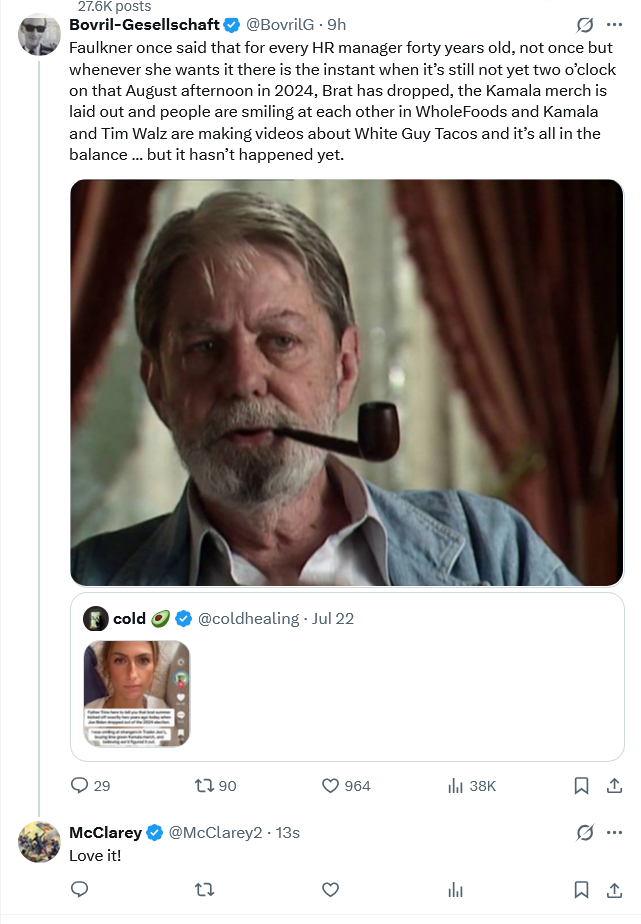
For every Southern boy fourteen years old, not once but whenever he wants it, there is the instant when it’s still not yet two o’clock on that July afternoon in 1863, the brigades are in position behind the rail fence, the guns are laid and ready in the woods and the furled flags are already loosened to break out and Pickett himself with his long oiled ringlets and his hat in one hand probably and his sword in the other looking up the hill waiting for Longstreet to give the word and it’s all in the balance, it hasn’t happened yet, it hasn’t even begun yet, it not only hasn’t begun yet but there is still time for it not to begin against that position and those circumstances which made more men than Garnett and Kemper and Armistead and Wilcox look grave yet it’s going to begin, we all know that, we have come too far with too much at stake and that moment doesn’t need even a fourteen-year-old boy to think This time. Maybe this time with all this much to lose and all this much to gain: Pennsylvania, Maryland, the world, the golden dome of Washington itself to crown with desperate and unbelievable victory the desperate gamble..
William Faulkner, Intruder in the Dust


Such thoughts as these, by men who dream dreams, are what decides whether a man loves history or thinks it to be “dry.”
I have no problems when history is presented for what it is but its ennobling of tragic events to cover what are actually disappointments or even failures lends an unwarranted coloration to these events. The Alamo occurred because Travis failed to pull back and consolidate with other Texas forces. Result was losses at the Alamo and Goliad. Little Big Horn was the result of a vainglorious egomaniac with visions of the Presidency. Picket’s charge had no chance from the start because of a terrible Confederate position in the open. The tragedy of these loses is is well noted but to cover them with a veneer of bravery in order to imply that a measure of glory was worth the loss diminishes that loss.