

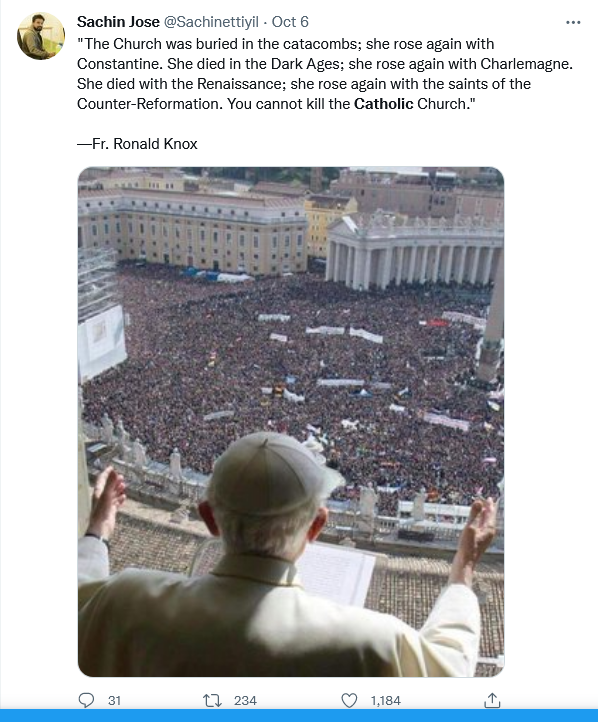
This quotation from the anti-Catholic writer Lord Macaulay written in 1840 comes vividly to mind:
There is not, and there never was on this earth, a work of human policy so well deserving of examination as the Roman Catholic Church. The history of that Church joins together the two great ages of human civilisation. No other institution is left standing which carries the mind back to the times when the smoke of sacrifice rose from the Pantheon, and when camelopards and tigers bounded in the Flavian amphitheatre. The proudest royal houses are but of yesterday, when compared with the line of the Supreme Pontiffs. That line we trace back in an unbroken series, from the Pope who crowned Napoleon in the nineteenth century to the Pope who crowned Pepin in the eighth; and far beyond the time of Pepin the august dynasty extends, till it is lost in the twilight of fable. The republic of Venice came next in antiquity. But the republic of Venice was modern when compared with the Papacy; and the republic of Venice is gone, and the Papacy remains. The Papacy remains, not in decay, not a mere antique, but full of life and youthful vigour. The Catholic Church is still sending forth to the farthest ends of the world missionaries as zealous as those who landed in Kent with Augustin, and still confronting hostile kings with the same spirit with which she confronted Attila. The number of her children is greater than in any former age. Her acquisitions in the New World have more than compensated for what she has lost in the Old. Her spiritual ascendency extends over the vast countries which lie between the plains of the Missouri and Cape Horn, countries which a century hence, may not improbably contain a population as large as that which now inhabits Europe. The members of her communion are certainly not fewer than a hundred and fifty millions; and it will be difficult to show that all other Christian sects united amount to a hundred and twenty millions. Nor do we see any sign which indicates that the term of her long dominion is approaching. She saw the commencement of all the governments and of all the ecclesiastical establishments that now exist in the world; and we feel no assurance that she is not destined to see the end of them all. She was great and respected before the Saxon had set foot on Britain, before the Frank had passed the Rhine, when Grecian eloquence still flourished at Antioch, when idols were still worshipped in the temple of Mecca. And she may still exist in undiminished vigour when some traveller from New Zealand shall, in the midst of a vast solitude, take his stand on a broken arch of London Bridge to sketch the ruins of St. Paul’s.




“And she may still exist in undiminished vigour when some traveller from New Zealand shall, in the midst of a vast solitude, take his stand on a broken arch of London Bridge to sketch the ruins of St. Paul’s.”
This was written 1840. I’m not that would be written today.
This lord never met Jorge Bergoglio
esterday, a true annual annoyance, was the local HS homecoming parade. I unwittingly got caught in traffic over it. Later, I walked into the village to buy groceries and saw the parade.
Well, this morning a Francisco missionary nun gave a talk at Mass and we gave some money. She recounted how she was at the parade and so was our pastor. She said of all the people that greeted Father T., one little girl specifically said, “Thank you Father for giving me Holy Communion.”
It is better to light one candle than to curse the darkness.
Keep the Faith.
This was written 1840. I’m not that would be written today.
Only by truly wise observers. The Church has survived endless calamities. For example, take a vantage point of 1840. In the next 30 years the Church would be stripped of her territorial rule and be confronted with a new, and hostile, unified Italy. The French Second Empire would go down in flames to be replaced by a hostile French Fourth Republic. Pio Nono would strike many observers within the Church, including Cardinal Newman, as ill equipped to lead the Church in the modern world. Marxism and Anarchism were growing threats, and making large inroads among urban working classes in Spain and Italy. There was ample reason for pessimism to an intelligent observer looking at the Catholic Church in 1840. The secret is to see the Church in the broad sweep of History and not be bogged down in current battles and problems.
Yes, in the past opposition to the Catholic Church came from government and secular powers but the faithful still existed. Today, vocations are down, Mass attendance is down and Christianity in all denominations is considered as naive. The faithful who supported the Church in the past are dwindling numbers.
but the faithful still existed.
I wonder. Saints have spent quite a lot of time in the past, berating both the clergy and laity for indifference and worse. Mass attendance throughout the history of the Church has often been a sore point in most times and places. The Easter duty was imposed to make certain that most Catholics bother receiving communion at least once a year. What we experienced in America from the twenties to the fifties in heavy Mass attendance was the exception. Vocations have ebbed and flowed throughout the history of the Church. The current period of the Church is definitely not a good one, but I think not that different from other bad periods in the history of the Church. We of course are living through it and we fear for what comes next, and thus it seems the worst to us. I recall my optimism as John Paul II repaired the damage to the Church in the aftermath of Vatican II. Perhaps both undue optimism and undue pessimism are both to be avoided.
[…] You Cannot Kill the Catholic Church – Donald R. McClarey, J.D., at The American Catholic Cardinal Müller Condemns F. B. I. Raid […]