
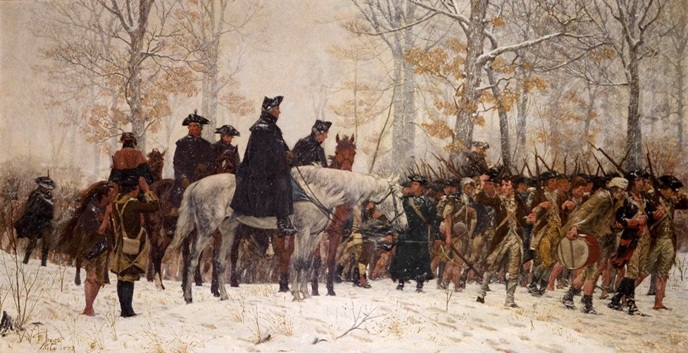
This is the one hundred and tenth anniversary of the birthday of Washington. We are met to celebrate this day. Washington’s is the mightiest name of earth — long since mightiest in the cause of civil liberty; still mightiest in moral reformation. On that name no eulogy is expected. It cannot be. To add brightness to the sun, or glory to the name of Washington, is alike impossible. Let none attempt it. In solemn awe pronounce the name, and in its naked deathless splendor leave it shining on.
Abraham Lincoln, February 22, 1842
George Washington said that the American victory in the Revolution was a standing miracle. I agree. Another miracle was that just when we needed him, God granted us George Washington. Washington had preternatural leadership abilities that were recognized early in life. Not out of his twenties he commanded the Virginia militia in the French and Indian War, earning respect for his courage on the battlefield and his good sense in councils of war. Men naturally gravitated to him as a leader. During the Revolution, when his Continental Army was often dressed in rags and subsisted upon slop that many a self-respecting dog would reject, the men paid in worthless currency and too often seeming to be forgotten of an ungrateful nation, it was Washington who held them together and forged a mob into a war winning instrument. Time after time we find in letters and diaries pledges by the men of the Army that they would stand with the task as long as the General, as they called Washington as if no other general existed, did. To many Americans Washington became the American Revolution at the low points in that struggle, a man to rally around when the cause seemed hopeless, a man who could avoid permanent defeat, who could somehow wrest victories out of thin air, and who kept his starveling Army alive and in being from day to day, week to week, month to month, and long year after long year until the cause was won. As King George observes in the Hamilton musical, Next to Washington they all look small.
Greater generals than George Washington have existed, but in secular history, almost no greater men.


Who, in history, was handed a kingdom and turned it down? Like an ancient Israelite, he saw God’s providence, yet kept the faith. I will forever be grateful for his sacrifices on behalf of a just war.
George Washington not only turned down the crown of b a king, he made two terms as president a tradition. Washington recommended prayer and prayed at Valley Forge.
Some ignorant individuals believe that secular means atheist and that separation of church and state means the imposition of Godlessness. Not so. Religion is how citizens respond to Faith. Secular is how citizens respond to the state.
Death occurs when the soul leaves the body. Atheism interprets death, the soul leaving the body, as separation of church and state in its final solution.
Washington said to pray to God.
My reading of the American Revolution and Washington’s leadership and greatness tells me that it was God’s will that this nation should be brought forth and Washington was His willing instrument.
Off topic. A friend gave me a book, The Wisdom of Fulton Sheen.
It has daily passages.
“A dying man asked a dying man for eternal life; a man without possessions asked a poor man for a kingdom; a thief at the door of death asked to die like a thief and steal Paradise. One would have thought a saint would have been the first soul purchased over the counter of Calvary by the red coins of Redemption, but in the Divine plan it was a thief who was to escort the King of kings into Paradise. If Our Lord had come merely as a teacher, the thief would never have asked for forgiveness. But since the thief’s request touched the reason of His coming, namely, to save souls, the thief heard the immediate answer.
“It was the thief’s last prayer, perhaps even his first. He knocked once, sought once, asked once, dared everything and found everything. When even the disciples were doubting and only one was present at the Cross, the thief owned and acknowledged Him as Savior.”
St. Dismas pray for us.
[…] Donald R. McClarey, J.D. Requiescat In Pace: Mikhail Gorbachev – Donald R. McClarey, J.D. Leadership Personified: George Washington – Donald R. McClarey, […]
Couldn’t it be said that the very public statements of the Good Thief on the Cross were an act of confession? He acknowledged his guilt, the justice of his punishment, and defended Christ in the most public way possible. Even though it was not public the tax collector in the Parable of the Pharisee and the Tax Collector admitted his sinfulness and was very straightforward in his admission when pleading for mercy. Neither of them had pride movements, felt banners, flags, and parades. How many kindred spirits would the Good Thief and the tax collector find in today’s Church?
GREGB,
Perfectly correct. Years ago, I read on the net a transcript of a lengthy sermon on the subject. I could not find it a while back.
St. Dismas in his brief, final ‘confession’ pretty much covered Faith, Hope, and Love – the Cardinal Virtues. Plus, contrition. St. Augustine’s Confession is also very good in 400 pages.