

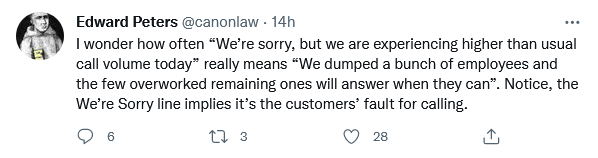
Answering the calls costs them money. Doing something about customer problems costs them money. The call in experience, often with people from the subcontinent paid slave labor wages, is made as unpleasant as possible to get customers to give up and hang up. My Bride has far more persistence and patience than I do and always gets through, whether at home or in the law mines, and then baffles them with her calm and logic until the problem is cured or we get a full refund. She is the velvet terminator who keeps coming and coming at them until her objective is obtained. It shouldn’t require her awesome skill set for companies to give meaningful support.





Cost cutting always catches up with them. Eventually. In the meantime everyone suffers except for the ones at the top.
Amen, Don and Ezabelle. What has baffled me, having seen this happen from the inside of a major telecom company, is how the quality of our customer service actually declined the more the buzzwords “delight the customer” were tossed around. The now-ubiquitous “customer satisfaction survey”, which emerged as a big deal with the explosive growth of the Web, was seen by the managerial consultant class as the ticket to sales growth and corporate happiness. The problem was, the accounting side kept forcing every cost-cutting measure we could get away with under our labor contracts, so the problems exposed by the surveys just kept getting worse. A company that once had a well earned reputation for solid customer service thus became one of the worst in the industry. Poorly paid non-employees are never going to care about the reputation of the firm whose water they are carrying in a call center, especially after what you’re selling has become a commodity. It was morbidly fascinating to watch as my career wound down. For that and other reasons, I found myself feeling quite pleased to be able to escape when I did.
My bride is also a natural when dealing with such situations. A overlord of ours at a company we both worked for, and where we met, labeled her politely assertive bordering on pleasantly aggressive.
Since I only have two speeds, acquiescence or mushroom cloud ballistic, I usually prefer my wife handle negotiations.
Whichever was the first company to offer a helpline and setup offshore to the subcontinent was genius, as it gives appearance of helpfulness and caring, while being the cheapest form of once removed stonewalling and deflection.
Frank, I found during Covid the customer service situation has gotten worse. You are fortunate to not still be in the workforce during these strange times.
“Since I only have two speeds, acquiescence or mushroom cloud ballistic, I usually prefer my wife handle negotiations.” That’s very funny.
Moving the call centres offshore not only means the call centre operator has no local understanding of the situation or your geographical location, but they also don’t have the skill set to think outside of the box and problem solve. Most are also doing the job because they can’t find work after completing university degrees (particularly the Indian ones). It’s quite a deliberate step to move them offshore because eventually their aim is to not have a phone helpline so you are forced to email or live chat your predicament. Which is even more frustrating. It takes 3 times the effort to explain the situation in an email let alone communicate frustration very well.
I know several companies shifted their call-support centers state-side because the supposed savings of moving it off shore never actually showed up.
State laws can make it complicated, and the really bad habits of call center supervisors make it worse, but I know people who work from home as call-center employees, both in single-sector-multi-company operations and in big single-company ones.
Usually, the company’s flow-chart (the one you can hear them following, IE, “is it plugged in”…) is terrible.
The reason companies are moving their call centers back? American call-center personnel learn, and apply it. If the last six times they got [Odd Symptom] for the internet not working it turned out to be somehow fixed by resetting the bluetooth connection and restarting the machine? They’ll ask if the customer wants to try that before the flow chart says “call a technician”, which makes the customer feel valued and well served….and also gets the call done faster.
For me, I much prefer email support– when they use a human being. Nothing pisses me off faster than getting an email that picked out key-words of the very carefully written “tell us as much as possible about the problem” section and suggests I do what I just did.
I think the phrase the customer is always right should be the cornerstone to any organisations dealings with the customer (big corporate or small). Without the customer paying for the service, there is no organisation. And good healthy competition in the market. Because the problem is that the big fish are eating the small fish and these larger entities monopolise the market. So there is no pressure on feat of loosing the customer to Competition. The customer service then becomes lacking. IMHO
*no pressure or fear of loosing customer.
No, some customers are really not worth having; they eat up 90% of your customer service resources, utterly destroy the ability to keep skilled customer service personnel, and are still not happy.
I’m usually behind them in line as they scream bloody murder at the poor kid at the service desk for not honoring a warranty that expired six months ago, and half the time it works.
Which means that I pay for them to get free stuff, just because they are willing to be utterly horrible, and they are the loudest about how horrible the company is even after they are handed the thing they wanted.
They’re maybe one in ten or twenty callers to call centers, but guess who the folks I know who’ve worked at call centers cite as their reason for quitting?
You’d have a different point of view if you owned and ran your own business.
:dryly:
You may have noticed that I gave examples of the human cost that pointed to multiple different strategies. That might, just possibly, hint that I have some first hand experience operating businesses that succeeded, that failed, and that ate the employees and then the owner alive because they forgot that employees are also human and due the same respect as any other human being.
“The customer is always right” with the unspoken ‘at all costs’ is the motto of companies that turn their workers into nothing but disposable tools in search of profit, and they don’t even get the profit.
In contrast, those who respect their workers as a valuable resource, keep their deals both implicit and explicit not just to the customer who is willing to abuse workers but to customer and employee a like, and are not willing to run over anyone and anything for the chance to keep a customer…well, they’re the ones that are still open, and sometimes even survive a change of ownership when the current owner/manager retires.
Ok
Even lazy American workers tend to care at least a little about helping the customer. That is, maybe they don’t want to spend their whole day on the issue but if they can solve the problem quickly they would do it.
Most overseas workers only have the priority of making the call someone else’s problem as quickly as possible. The “this is a screen issue, I will now transfer you to the people who handle screen issues” from the video is spot on.