
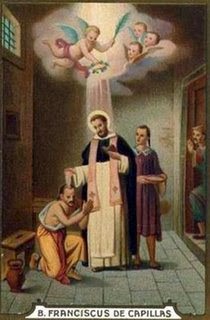
The viceroy of Peking wrote this about the five martyrs that included Peter Sanz: “What are we to do with these men? Their lives are certainly irreproachable; even in prison they convert men to their opinions, and their doctrines so seize upon the heart that their adepts fear neither torments nor captivity. They themselves are joyous in their chains. The jailors and their families become their disciples, and those condemned to death embrace their religion. To prolong this state is only to give them the opportunity of increasing the number of Christians.”
Peter Sanz was among the first group of martyrs in Tonkin, which also included Bishop Francis Serrano, Father Joachim Royo, Father John Alcober, and Father Francis Diaz.
Peter Sanz was professed a Dominican at Lerida when he was 18 (1697). He was ordained in 1704, volunteered for the Chinese missions, and was sent to Manila, The Philippines, in 1713. After studying the language for two years, he entered China where he spent 31 years evangelizing the Chinese before he was captured. In 1730, he was nominated vicar apostolic of Fukien and titular bishop of Mauricastro. When a renewed persecution of Christians flared up in 1746, he was accused of breaking the laws by converting thousands to Christianity by a man to whom he had refused to lend money, according to one account.
The five men, bound together by their vows and their work, were brought more closely together during their imprisonment at Foochow. Fathers Serrano, Alcober, and Diaz were captured first, and tortured to reveal the whereabouts of Bishop Sanz. They did not break down, but the bishop and Father Royo, hearing about the torture, surrendered in the hope of sparing their brothers’ suffering, says another account.
Go here to read the rest.

