
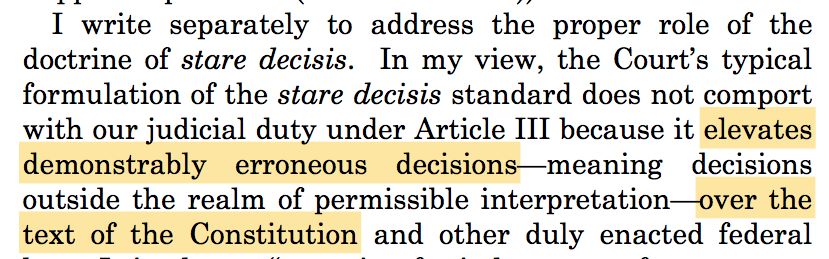
The dissent criticizes today’s decision as a departure from modern habeas precedent. Post, at 2; post, at 3, n. 2; post, at 12–13. But the dissent’s history is selective. The dissent champions decisions from the 1950s, ’60s, and ’70s. But it disregards how those decisions departed from a century of this Court’s precedents and the common law before that. Supra, at 5–8. At the same time, the dissent’s account overlooks this Court’s precedents refusing to afford retroactive application in every case since the 1980s. Post, at 10–11; post, at 12, n. 7. The dissent may prefer decisions within a particular 30-year window. But it is too much to say this preference is required to “[r]espect[] stare decisis.” Post, at 1, n. 1.
Justice Gorsuch, concurring opinion, Edwards v. Vannoy
Since law school I have been extremely cynical about stare decisis, the doctrine that courts should be bound by their prior decisions. Although I recognized the utilitarian worth of the doctrine, courts should not constantly be revisiting matters already decided and that lower courts had to follow the rulings of higher courts, it was clear from the case law that stare decisis presented no obstacle when courts wanted to embark on a new course in a previously decided area of the law. Law Professor Josh Blackman notes this aspect of courts in regard to the current Supreme Court:
Justice Kagan and her colleagues are keen to extoll the precedents established by the Warren Court. But left unsaid is how those decisions had zero respect for precedent.
Randy and I have added a chapter on Criminal Procedure for the 4th Edition of our casebook. In the process, I re-read many of the leading Warren Court CrimPro decisions. And I approached these cases from the perspective of constitutional law, rather than the nuances of law enforcement. I was struck, over and over again, at how willy-nilly the Warren Court nullified precedents. There were no discussions of reliance interests. In some cases, cases were overruled in footnotes, almost as an afterthought.
Go here to read the rest. In practice stare decisis, on the appellate level, means stare decisis for thee but not me. I will over rule precedents when it suits me, and when you attempt to do the same I will scream stare decisis. Any judge taken in by such double dealing is too stupid to be a judge.


As “Feddie” (now an appellate judge) used to say:
“Stare decisis is fo suckas.”
I miss his blog.
I recall a fun discussion in my law school Con Law class wherein a classmate, who had a stronger spine than I, took on the professor over exactly this issue when the prof defended one of the more egregious instances of Warren Court bench legislation. When asked to explain what “stare decisis” meant in the wake of a summary reversal of then-existing precedent by the Warren libs, the professor served up a ten-minute word salad that said nothing. My classmate then said, “So, in other words, it means whatever the majority wants it to mean?” The prof said, “That’s true for everything.” The collective shocked intake of breath was immediate. 😂
Courts throughout history have played fast and loose with legal principles to arrive at desired results, but the Warren Court pioneered the concept that jurisprudence is merely the ability to put together five judges.
From the Heritage Foundation’s “Stare Decisis 101”:
Stare decisis is a presumption for both negative and positive reasons. On the negative side, it helps limit the power of the judiciary and, therefore, of government. “If men were angels,” wrote James Madison, “no government would be necessary. If angels were to govern men, neither external nor internal controls on government would be necessary.”
Those controls include the separation of federal government power into three branches. In Federalist No.78, Alexander Hamilton wrote that “liberty can have nothing to fear from the judiciary alone, but would have everything to fear from its union with either of the other departments.”
Hamilton also explained that the judiciary would be the “weakest” and “least dangerous” branch because the judiciary has “neither FORCE nor WILL, but merely judgment.” To avoid that judgment becoming “arbitrary discretion,” Hamilton wrote, it is “indispensable that [judges] should be bound down by strict rules and precedents, which serve to define and point out their duty in every particular case that comes before them.” More than two centuries later, in the January 2006 hearing on his Supreme Court nomination, Justice Samuel Alito cited Hamilton in explaining that stare decisis “is a fundamental part of our legal system…because it limits the power of the judiciary.”’
On the positive side, stare decisis is a presumption because it promotes confidence that judicial decisions are not simply “arbitrary, based on personal preference, or unbounded.” The Supreme Court has explained that “[s]tare decisis is the preferred course of action because it…contributes to the actual and perceived integrity of the judicial process.” Stare decisis also contributes to “stability in the law,” as well as “evenhandedness” and “predictability.”
Professor Michael Sinclair connects the negative and positive effects of stare decisis when he writes that its “most significant” virtue “is the stability, continuity, and predictability it lends to the law….Stability and certainty reduce judicial discretion.”
https://www.heritage.org/courts/report/stare-decisis-101