
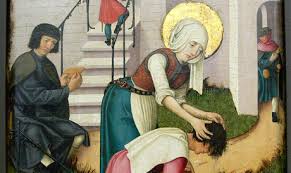
Tradition states that she grew up in the third century in the Theban region (modern day Luxor in Upper Egypt) in a noble Christian family. She was placed in the care of Bishop Sherimon, Bishop of Beni Suef, who taught her and baptized her a Christian. St. Verena joined the Theban Legion in its mission to Rhaetia (modern-day Switzerland) and was a relative of St. Victor of the Theban Legion. The soldiers’ relatives were allowed to accompany them in order to look after them and take care of their wounds.
After St. Maurice, St. Victor and the other members of the Theban Legion were martyred, St. Verena led a lonely life as a hermit. First, she settled in a place called Solothurn, but later moved into a cave near present-day Zurich. She fasted and prayed continuously. Moreover, God performed several miracles through her. She was particularly concerned about young girls and looked after them spiritually and physically, due to her expertise as a nurse. As a result of her fame, the ruler arrested her and sent her to jail, where St. Maurice appeared to her to console and strengthen her. After her release from jail, she moved into several regions, and God made several miracles through her prayers. Due to her, many converted to Christianity. St. Verena was interested in serving the poor and offered them food. Moreover, she enjoyed serving the sick, especially those suffering from leprosy. She washed their wounds and put ointments on them, without fearing infection. At the time of departure of St. Verena from our world, the Most Holy Virgin Mary appeared to her to console and strengthen her. St. Verena reposed on the fourth day of Thout (September 14).


“The Theban Legion (also known as the Martyrs of Agaunum) figures in Christian hagiography as an entire Roman legion — of “six thousand six hundred and sixty-six men” — who had converted en masse to Christianity and were martyred together, in 286, according to the hagiographies of Saint Maurice, the chief among the Legion’s saints.” St. Maurice is depicted in paintings and statue as a black African.
Known women named Verena, Verna, Verenda and then there’s Mrs. Jefferson Davis who was Varina. Only Verenda was Catholic.