
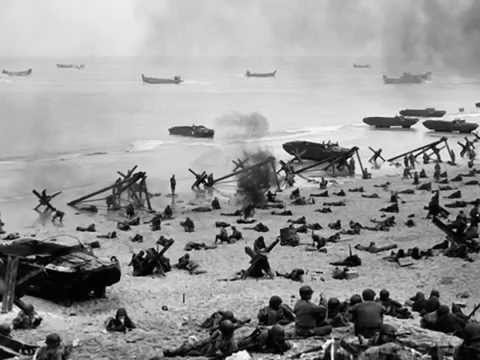
Our men simply could not get past the beach. They were pinned down right on the water’s edge by an inhuman wall of fire from the bluff. Our first waves were on that beach for hours, instead of a few minutes, before they could begin working inland.
You can still see the foxholes they dug at the very edge of the water, in the sand and the small, jumbled rocks that form parts of the beach.
Medical corpsmen attended the wounded as best they could. Men were killed as they stepped out of landing craft. An officer whom I knew got a bullet through the head just as the door of his landing craft was let down. Some men were drowned.
The first crack in the beach defenses was finally accomplished by terrific and wonderful naval gunfire, which knocked out the big emplacements. They tell epic stories of destroyers that ran right up into shallow water and had it out point-blank with the big guns in those concrete emplacements ashore.
When the heavy fire stopped, our men were organized by their officers and pushed on inland, circling machine-gun nests and taking them from the rear.
As one officer said, the only way to take a beach is to face it and keep going. It is costly at first, but it’s the only way. If the men are pinned down on the beach, dug in and out of action, they might as well not be there at all. They hold up the waves behind them, and nothing is being gained.
Our men were pinned down for a while, but finally they stood up and went through, and so we took that beach and accomplished our landing. We did it with every advantage on the enemy’s side and every disadvantage on ours. In the light of a couple of days of retrospection, we sit and talk and call it a miracle that our men ever got on at all or were able to stay on.
Ernie Pyle writing about Omaha Beach


There’s an excellent article from 1960, “The First Wave on Omaha Beach” by S.L.A. Marshall on the Atlantic’s website.
If you can find it, there’s also a very interesting episode of the PBS/BBC series “Nazi Mega-Weapons” on the Atlantic Wall and D-day. I got the impression from the German veterans they interviewed that we only took that beach after they had largely run out of ammunition.
Compare the scene from Saving Private Ryan to the one from The Longest Day found here:
https://idreporter.net/v/the-longest-day-1962-omaha-beach-cpWYxVM80Mw.html
Very different results when they drop the ramp.
Another first hand account of the landings on Omaha.
https://www.kofc.org/en/columbia/detail/to-hell-and-back.html
During the DDay commemorations this past week, the Russian Foreign Minister downplayed the D-Day invasion and credited the Red Army for saving the Sllies at the Ardennes.
The loss of life on the Soviet side was ghastly, but they cannot bring themselves to admit that Stalin started the war in Europe with Hitler and Stalin was supplying the German war machine right up to the start of Operation Barbarossa.
What you see in “Saving Private Ryan” is horrific. In reality, it was worse.
“Uncommon valor was a common virtue.”
The loss of life on the Soviet side was ghastly,
Not my field. Just to put this out there, unless I’m misremembering, Anton Antonov-Ovseyenko attributed 3/4 of Soviet losses during WWii to the regime’s bad tactics and strategy.
The Soviets lost about 27 million during the War, of which about 8.5 million were military deaths. The Soviets executed about 217,000 of their own troops. (The US by comparison lost about 291,000 in combat deaths for the whole of World War II.) The Soviets made extensive use of penal battalions. The men in them were used as cannon fodder, with documented cases of them being sent through mine fields to clear them by causing the mines to explode as they traversed the fields. Life was very cheap in the Red Army. However, that does not detract from the military feat that the Soviets accomplished. Three quarters of all German combat deaths were on the Eastern Front, and the Soviets accomplished this with most of European Russia occupied by the Germans at the end of 1941. Lend Lease was essential for the Soviet victory in feeding the Red Army troops, and in providing endless trucks to allow logistical support of their troops that the Soviets were simply unable to produce in great enough numbers themselves. The Soviets also benefited from the Allied bombing campaign that caused the Germans to cede air superiority to the Soviets on the Eastern Front, while they concentrated on fighters to attack American and British bombers, and diverted resources to try to repair Allied bombing damage. The Soviets also benefited from the fact that a fourth of the German army was stationed in the West, guarding against expected Allied invasions. Victory against the Germans was very much a team effort.
Donald R. McClarey wrote:
*
The Soviets lost about 27 million during the War, of which about 8.5 million were military deaths. The Soviets executed about 217,000 of their own troops.
*
From what I’ve heard the Red Army was subjected to purges which eliminated many experienced officers. Are they part of the figure quoted above?
The purges were mainly in the thirties in the Red Army, and did a great deal of harm to the Red Army. The military executions during the War covered a broad range of “offenses” including sometimes executing generals for being defeated. Three hundred Soviet officers were executed on one day, October 16, 1941.
My dad’s Uncle Mike was on Omaha Beach that day, a soldier with the US Army.