
Freedom is not only a gift, but also a summons to personal responsibility. Americans know this from experience — almost every town in this country has its monuments honoring those who sacrificed their lives in defense of freedom, both at home and abroad.
Pope Benedict XVI, April 16, 2008
John A. Logan is the father of Memorial Day. Today he is largely forgotten except by Civil War buffs and that is a shame. He was a fascinating man and he is largely responsible for establishing the tradition of putting aside a day in the calendar to our nation’s war dead.
Logan began the Civil War as a Democrat congressman from southern Illinois. He was ardently anti-War even after the firing on Fort Sumter, denouncing the Lincoln administration and calling for peace and compromise. He was attacked as being disloyal to the Union and an almost advocate of the Confederacy.
This perception changed in the twinkling of an eye at the battle of Bull Run. Like many another congressman he went out to view the Union army launch an attack on the Confederates. Unlike the other congressmen, Logan picked up a musket and, attaching himself to a Michigan regiment, blazed away at the Confederates with that musket. This experience transformed Logan into an ardent advocate of the War.
He returned to Southern Illinois and gave a fiery speech in Marion, Illinois for the Union that helped swing that section of the state in support of the War. Resigning from Congress, he helped raise an infantry regiment from southern Illinois, and was made colonel of the regiment, the 31st Illinois.
Logan quickly made a name for himself as a fighter. At the battle of Belmont he led his regiment in a successful charge, and was noted for his exceptional courage. He would eventually be promoted to major general and was one of the best corp commanders in the Union army, briefly commanding the Army of the Tennessee. He was wounded three times in the war, one of the wounds being serious enough that he was erroneously reported as killed, a report that might have been proven to be accurate if he had not been nursed back to health by his devoted wife.
Logan was never beaten in any engagement that he fought in during the War. He was popular with his men who affectionately called him “Black Jack”, a tribute to his raven black hair and his inspiring battlefield presence, and would often chant his name on the battlefield as he led them from the front. On May 24th 1865, as a tribute to his brilliant war record, he commanded the Army of the Tennessee during the victory Grand Review of the Union armies in Washington.
After the War, Logan began his political career anew, serving as a congressman from Illinois and a senator. He was now a radical Republican and fought ardently for civil rights for blacks. He ran for Vice President in 1884 on the Republican ticket that was defeated by Grover Cleveland. He was considered the leading candidate for the Republican nomination in 1888, and might well have been elected President that year, but for his untimely death in 1886 at the age of sixty.
From 1868 to 1871, Logan served three consecutive terms as commander in chief of the Grand Army of the Republic, the Union veteran’s association. He started the custom of remembering the Union war dead on May 30th when he issued General Order Eleven on May 5, 1868:
Headquarters, Grand Army of the Republic
Washington, D.C., May 5, 1868
I. The 30th day of May, 1868, is designated for the purpose of strewing with flowers or otherwise decorating the graves of comrades who died in defense of their country during the late rebellion, and whose bodies now lie in almost every city, village, and hamlet churchyard in the land. In this observance no form or ceremony is prescribed, but posts and comrades will in their own way arrange such fitting services and testimonials of respect as circumstances may permit.
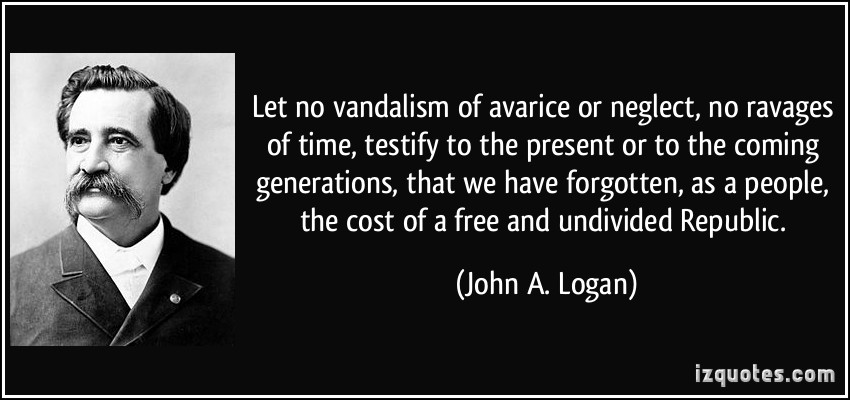
We are organized, comrades, as our regulations tell us, for the purpose, among other things, “of preserving and strengthening those kind and fraternal feelings which have bound together the soldiers, sailors, and marines who united to suppress the late rebellion.” What can aid more to assure this result than by cherishing tenderly the memory of our heroic dead, who made their breasts a barricade between our country and its foe? Their soldier lives were the reveille of freedom to a race in chains, and their death a tattoo of rebellious tyranny in arms. We should guard their graves with sacred vigilance. All that the consecrated wealth and taste of the Nation can add to their adornment and security is but a fitting tribute to the memory of her slain defenders. Let no wanton foot tread rudely on such hallowed grounds. Let pleasant paths invite the coming and going of reverent visitors and found mourners. Let no vandalism of avarice or neglect, no ravages of time, testify to the present or to the coming generations that we have forgotten, as a people, the cost of free and undivided republic.
If other eyes grow dull and other hands slack, and other hearts cold in the solemn trust, ours shall keep it well as long as the light and warmth of life remain in us.
Let us, then, at the time appointed, gather around their sacred remains and garland the passionless mounds above them with choicest flowers of springtime; let us raise above them the dear old flag they saved from dishonor; let us in this solemn presence renew our pledges to aid and assist those whom they have left among us as sacred charges upon the Nation’s gratitude,–the soldier’s and sailor’s widow and orphan.
II. It is the purpose of the Commander-in-Chief to inaugurate this observance with the hope it will be kept up from year to year, while a survivor of the war remains to honor the memory of his departed comrades. He earnestly desires the public press to call attention to this Order, and lend its friendly aid in bringing it to the notice of comrades in all parts of the country in time for simultaneous compliance therewith.
III. Department commanders will use every effort to make this order effective.
By command of:
JOHN A. LOGAN,
Commander-in-Chief.
N. P. CHIPMAN,
Adjutant-General.
The May 30 Decoration Day events became a fixture of life in the Northern states. The states of the old Confederacy had similar events to honor their Civil War dead, but on different dates, varying from state to state, as befitted the champions of states’ rights. The term Memorial Day was first used in 1882, but the name Decoration Day remained for the holiday until after World War II. As Civil War veterans aged and passed from the scene, the day was broadened to remember all of America’s war dead. The Uniform Monday Holiday Act in 1968 moved Memorial Day to the last Monday in May.
And so this weekend we remember those we owe a debt to that can never be repaid. We put up monuments to them that they cannot, in the flesh, see, give speeches that they cannot hear and write blog posts that they cannot read. What they accomplished is far beyond “our poor power to add or detract” to, but it is very important that we never forget “what they did”. Their sacrifices are why we enjoy this day in freedom, and that is worthy of remembrance not just on Memorial Day, but every day.


Unlike the other congressmen, Logan picked up a musket and, attaching himself to a Michigan regiment, blazed away at the Confederates with that musket.
Oh, my….
That is a PERFECT response, and I can’t imagine why more people didn’t have it.
/salute
This old muzzle-loading deer hunter stands in awe at the sheer bravery of those men who would dare to go into battle with a clumsy musket. How many must have died while trying to reload those cumbersome things?
By the end of the War some of the Union troops, and a few of the Confederate troops, had breach loading repeaters, The Union could have had almost all of its troops armed with repeaters by 1863, but Union Army ordinance was quite hidebound as opposed to their Confederate counterparts who displayed a lot of ingenuity.
This day is about our honored dead.
It was the afternoon of second day at Gettysburg. General Hancock noticed a gap in the Union lines and CSA General Wilcox’ brigade advancing to exploit the gap. Hancock addressed Col. Colville of the 1st Minnesota, “Do you see those colors? Take them!” Immediately, the 1st Minnesota charged. There was a short, fierce fight. The needed time was gained to reinforce the Union line. The colors were captured. The 1st Minnesota suffered 82% casualties. Rossiter Johnson’s book, Campfires and Battlefields of the Civil War. .
Re: CW infantry weapons and ammunition. The Irish Brigade [and somewhere between 10% and 30% of Federal Army units] loaded their muskets with buck and ball – a vicious mixture of a mini-ball/bullet and several buck shots.
Additionally, in some Irish units as many as 30% of the troops were veterans of British (Crimea and the Sepoy Mutiny) or Papal military units; and some leaders like Meagher were Fenians.
Troops were extensively drilled to be able to work their muskets under extreme duress. Drill also included company, regiment, brigade, . . . massed maneuvers. The impetuous bayonet charge was another ‘feature.’
They were veterans. They were on a rise and saw what was coming at them. They knew few of them would walk away from the charge. They did not hesitate.
https://www.youtube.com/watch?v=Y0S12LkEU0U
As early as 1866, a ladies memorial association in Columbus, Mississippi, decorated the graves of both Union and Confederate soldiers. This act inspired the poem “The Blue and The Gray” by Francis
Miles Finch published in the Atlantic
Monthly. Before the widespread hatred and division promoted by leftist in recent decades, some acknowledged this as the beginning of our Memorial Day. Credit to all, including Mr Logan, who honor our fallen heroes. Would that this day could reunite our strife torn nation.
“….Union Army ordinance was quite hidebound as opposed to their Confederate counterparts who displayed a lot of ingenuity.”
Something like the bureau of ordinance and the mark 14 torpedo at the beginning of World war 2 Which was actually worse since the bureau of ordinance refused to listen to the people using the weapon. Bureaucracy is where intelligence and common sense goes to die.
Which is why humility is the mother of all virtues.
The lives lost in war are remembered in street names, town names, battleship names.
Marion, Illinois must be named for Francis Marion, known as the Swamp Fox, terror of the British Army during the War for Independence.
USS John A. Basilone, from Raritan, N.J.
Joyce Kilmer.
The Tomb of the Unknown Soldier is for all.
The eagle is the symbol of the swiftness of Divine Justice in Saint John’s Gospel and in our Nation.
“The states of the old Confederacy had similar events to honor their Civil War dead, but on different dates.”
Texas still has Confederate Heroes day which is celebrated on January 19th every year. As might be expected there’s been continuous efforts to abolish the day and turn it into some type of peace and love holiday. If they can tear down statues they can tear down memories.
So I’ve seen dozens of the same story pop up this year, that Memorial Day was actually first invented not by Logan, but by a unit of black soldiers who gathered to honor the fallen who had fought for their cause. I don’t know the period of history well enough to more than guess it’s leaving some points out, but thought perhaps that is something new we’ve discovered (though I’m usually wary of ‘we discovered this that changes history’ stories). Figured I check it out here, since I know the Civil War rates high on the priority scale in terms of historical eras.
Dave, there was plenty of homage paid to dead soldiers both during and after the war, Lincoln’s Gettysburg address being the greatest example. However Decoration Day clearly got started due to Black Jack Logan and the Grand Army of the Republic. Confederate veteran groups in each individual former Confederate state took the lead in producing the Southern equivalent. Imagine a war that produced 750000 to a million dead, and hundreds of thousands maimed for life. The magnitude of the loss is stunning to contemplate.
When Civil War monuments are knocked down or removed, l mourn. Many of these monuments were erected by private groups, usually women’s. Some statues are works of art. The destroyers don’t care. They rarely stop to think that there might be bodies of the fallen buried underneath.